



Bottom of the Falls Boat Cruise
The launch cruise to the base of Murchison Falls is the park’s signature outing, and for good reason. You board a shaded boat at the Paraa jetty, turn upstream against the Victoria Nile, and spend the next couple of hours drifting through one of the densest concentrations of big game and waterbirds in East Africa — before the river narrows, the roar builds, and you sit rocking gently in the spray beneath the most powerful waterfall on the planet.
This guide is about that specific trip: the roughly 17km run from Paraa to the bottom of the falls and back. It covers what you actually see along the banks, how the boats work, when to go for the best light and wildlife, how to book, and how to combine the cruise with the short climb to the top of the falls for the full picture.
The route: Paraa to the foot of the falls
The cruise begins at Paraa, the crossing point roughly in the middle of the park where the ferry links the northern and southern banks. From here the boat heads east and upstream, following an archetypally African stretch of the Nile fringed with borassus palms, acacia and stands of mahogany, its clay banks rising into steep, spray-washed cliffs closer to the cataract.
It is around 17km each way, and the full return trip generally runs two to three hours. The boat travels slowly and deliberately, pausing wherever there is something to watch, so the distance matters less than the time on the water. The climax comes at the Fajao Gorge, where the entire Nile is forced through a gap barely seven metres wide and crashes some 43 metres to the plunge pool below. Boats hold position here for fifteen to twenty minutes, close enough to feel the mist and, on a clear day, to watch a rainbow hang in the spray.
Wildlife along the banks
This is the reason the cruise is the park’s most-booked activity: it delivers big game at close range without a game drive. Hippos are present along the entire route, wallowing in pods and often surfacing right beside the hull, while giant Nile crocodiles bask open-mouthed on the sandbars and mudflats, some of the largest you will see anywhere on the continent.
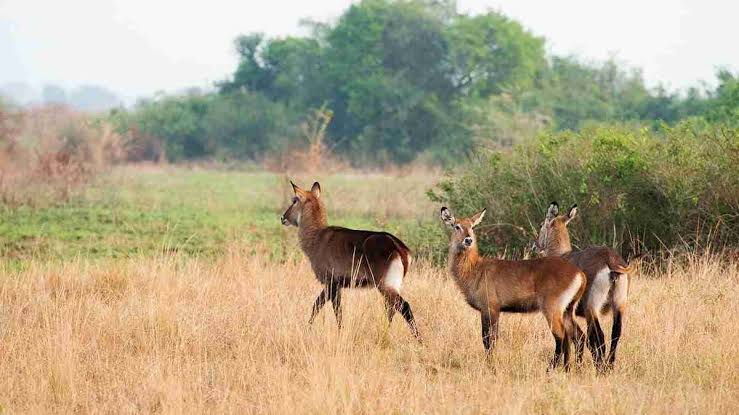
The banks draw a steady procession of thirsty animals, especially in the dry months from June to September when the surrounding bush is parched. Expect elephants coming down to drink and bathe, herds of buffalo, and waterbuck, Uganda kob and bushbuck grazing the margins. Buffalo regularly cross the river near Paraa, and water monitor lizards sun themselves on fallen logs close to the water’s edge.
A birder’s river
Even if you are not a dedicated birder, the birdlife here is impossible to ignore, and sightings on a single cruise routinely top thirty species. The soundtrack belongs to the African fish eagle, whose ringing call carries across the water as pairs perch on dead limbs above the current. Pied kingfishers hover and plunge everywhere, joined by the huge giant kingfisher and jewel-like malachite kingfishers along the softer reed fringes.
The undoubted stars are the red-throated bee-eaters, which excavate their nesting burrows straight into the sandy cliffs above the river and gather in wheeling, calling colonies — most famously near the Nyamusika Cliffs on the run up to the falls. Ask your guide to ease the boat in and cut the engine for close, eye-level views. Herons of several species stalk the shallows, cormorants and African darters string along the banks to dry their wings, and near the cataract itself the localised rock pratincole perches on midstream boulders in the spray. For the full picture, see our guide to the birds of the Victoria Nile.
Boat types: shared launch versus private
Most travellers take the scheduled shared launch, a shaded double-decker seating a group at a fixed departure time. It is sociable, good value and comfortable, with a park ranger or guide on board to point out wildlife and deliver the safety briefing. Prices for the shared trip typically fall in the region of US$35 to US$60 per person, depending on the operator.
A private boat costs more — often from around US$270 for the vessel — but buys flexibility that keen photographers and birders value: your own departure time, the freedom to linger at a bee-eater colony or a basking crocodile, and no jostling for the rail. Boats work from both banks — the Uganda Wildlife Authority and Paraa Safari Lodge operate from the north, and Wild Frontiers runs from the south bank — and pick-ups from riverside lodges can usually be arranged in advance.
Best time of day and what to bring
There are typically two scheduled departures: a morning trip around 9am and an afternoon one around 2pm, with extra slots added when demand is high. The morning cruise offers cooler air, softer light and the most active hippos, which are more likely to be out of the water. The afternoon cruise puts you at the falls in golden light around 5pm and catches animals returning to drink as the day cools — the pick for photographers chasing warm tones.
Bring sun protection, a hat, water and light clothing, as the open river gets hot through the middle of the day. Binoculars transform the birding, and for cameras a wide-angle lens for the falls plus a telephoto of 300mm or more for wildlife will cover almost everything. The ride is smooth with little wave action, so motion sickness is rarely a problem. Life jackets are provided.
Combining with the top-of-the-falls hike
The classic pairing is to see the falls from below and then from above. Many operators will drop you at the base of the Fajao Gorge so you can climb the short but steep top-of-the-falls trail to stand beside the point where the Nile is squeezed through the rock — a vantage that looks straight down into the thunderous chasm. From the top you are collected by vehicle, often continuing with a game drive through the wildlife-rich Buligi area on the north bank.
The two experiences are complementary rather than interchangeable: the cruise is about wildlife, water level and the frontal view of the falls, while the hike delivers the vertigo-inducing overhead perspective. Doing both in a single day is one of the most rewarding ways to spend your time in the park.
Frequently Asked Questions
- How long does the cruise to the bottom of the falls take?
-
The return trip from Paraa to the base of the falls generally runs two to three hours, covering roughly 17km each way. The boat pauses often for wildlife and holds position beneath the falls for fifteen to twenty minutes.
- What time do the boats depart?
-
Scheduled shared launches typically leave around 9am and 2pm, with additional departures when demand is high. Private boats can be booked at a time to suit you.
- How is this different from the delta cruise?
-
This launch heads upstream to the base of the falls through a rocky, fast, wildlife-dense stretch. The delta cruise runs downstream towards Lake Albert through calmer papyrus channels and is the top choice for spotting the rare shoebill stork.
- Is it better than a game drive?
-
They show you different things — the cruise excels for hippos, crocodiles, waterbirds and animals at the bank, while a drive covers open savannah for lions and giraffe. We compare the two in our boat cruise versus game drive guide.
- How do I book?
-
You can book through the Uganda Wildlife Authority, your lodge, or a tour operator who arranges the seats and transfers as part of your itinerary.
Plan Your Safari
The bottom-of-the-falls launch is the single best-value few hours in Murchison — big game, superb birding and the raw power of the falls in one gentle cruise. Talk to us about building your trip around an early departure, and browse our Murchison Falls safari packages. For more ideas on the water and beyond, see our guides to the top things to do in the park and the birding around Paraa.