



Buligi Area Guide
Ask any Murchison guide where the morning magic happens and the answer is the same: Buligi. This broad triangle of open savannah on the northern bank, wedged between the Victoria Nile and the Albert Nile, is the park’s classic game-drive country — the ground where elephants, giraffes, lions and thousand-strong antelope herds share the same wide horizon.
This guide covers the Buligi area as a whole: how the peninsula is laid out, the network of tracks that thread through it, the big game you can realistically expect, when to drive, how to reach it via the Paraa ferry, and how to plan a drive that makes the most of a single golden morning.
Where Buligi sits and why it matters
Murchison Falls National Park is split in two by the Victoria Nile. Almost all serious game viewing happens on the northern bank, and the Buligi Peninsula is its heart — a triangle of grassland bounded by the Victoria Nile as it enters Lake Albert in the south, and the Albert Nile flowing out of the lake to the west. The two river systems meet at the delta, the tapering northern point of the triangle.
The sector spans roughly 170 square kilometres and forms the primary game-viewing area in the whole park. What makes it so productive is the mix of habitats packed into a compact space: open savannah, whistling-thorn bushland, borassus palm stands and riverine woodland along the Nile. Each holds a different concentration of animals, so a single circuit moves you through a continuous sequence of viewing zones rather than one uniform plain.
The network of tracks
Buligi is not one road but an interlocking web of tracks, and understanding them helps you picture a drive. The Buligi Track is the backbone, starting about seven kilometres north of Paraa and running toward the delta. Depending on how you link it, the full circuit measures somewhere between 120 and 170 kilometres of drivable route and passes through every habitat type in the sector.
Branching off it are the shorter connectors. The Victoria Track, roughly 17 kilometres, runs down toward the delta side and links the Queen’s Track to the main Buligi loop. The Queen’s Track — about 13 kilometres — is a handy interconnector, joining the Victoria and Albert tracks so guides can switch between the interior and the lakefront. The Albert Track, around 11 kilometres, hugs the Albert Nile on the western edge, offering water’s-edge sightings and, on a clear day, distant views toward the hills of the Democratic Republic of Congo. Together they let a guide build anything from a two-hour loop to a full-day itinerary that also folds in the neighbouring Pakuba tracks.
The big game of Buligi
This is where Murchison delivers on its promise of classic African plains game. Elephants move through in large herds, particularly toward the delta, and buffalo are present year-round near water. The open, sparsely wooded ground gives long, clean sightlines, so animals are easier to locate here than in denser habitats elsewhere in the park.
Buligi is the park’s most reliable lion country. Prides tend to concentrate along the mid-Buligi stretch, especially near the junctions with the Queen’s and Albert tracks and around the termite mounds and fig trees the cats favour as vantage points and shade. Leopard are shyer, but drainage lines and riverine groves near the delta margins reward a patient early start.
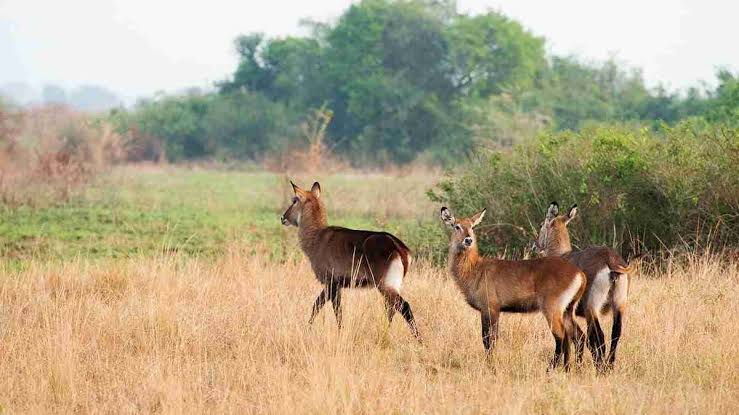
The signature animal, though, is the Rothschild’s giraffe. Murchison holds one of the largest remaining wild populations of this endangered subspecies — current estimates put the park’s numbers above 400 — and they concentrate in the central Buligi section and toward the Albert Track. On a morning drive, giraffe sightings are the rule rather than the exception. Add in the sheer volume of antelope — Uganda kob, oribi, Jackson’s hartebeest and Defassa waterbuck across the flats, with warthog and the occasional patas monkey — and the plains rarely feel empty.
Grassland scenery and the Nile confluence
Beyond the animals, Buligi is simply beautiful to drive. The savannah rolls away in soft, golden grasses punctuated by borassus palms, and the light at dawn turns the whole peninsula amber. Because the ground is so open, the sense of space is enormous — you can watch a giraffe browsing half a kilometre away and a kob herd grazing on the near horizon at the same time.
The tracks converge near the delta, where the Victoria Nile empties into Lake Albert and the Albert Nile flows north out of it. This confluence is a natural place to pause — offshore you can pick out distant hippos and waterbirds, and it is a convenient spot for refreshments before turning back. It is worth remembering that a dedicated birding piece covers the delta’s wetland species in detail; on a general game drive, the confluence is best enjoyed as a scenic and mammal-viewing highlight.
Best time to drive Buligi
The peninsula rewards early risers. Rangers advise being on the tracks before 7:00, when animals are active and the light is soft. The midday heat pushes most wildlife into cover, and sightings drop off sharply between roughly 12:00 and 15:00, so the classic rhythm is an early drive followed by a mid-morning return for breakfast. Big game is typically most active between about 6:00 and 10:00, and again from 4:00 in the afternoon.
A focused Buligi circuit takes three to four hours under good conditions, while a fuller loop that adds the Albert or Pakuba tracks fills a morning or a long day. In the wet months a four-wheel-drive is essential — sections west of Paraa hold deep ruts and soft murram after rain, though the tracks nearer Paraa are graded regularly.
Reaching Buligi via the Paraa ferry
Most visitors are based on the southern bank near Paraa, the park’s main hub, and reach the Buligi tracks on the vehicle ferry that crosses the Victoria Nile at Paraa in a few minutes. The ferry runs to a fixed daily schedule — crossings at around 07:00, 09:00, 11:00, 12:00, 14:00, 16:00, 18:00 and 19:00 — so an early game drive means catching the first crossing and arriving at the ramp in good time, especially in peak season when space fills quickly.
Travellers already staying on the northern bank skip the ferry entirely. Northern gates including Tangi, Chobe and Wankwar, plus Pakuba Airstrip for those flying in, put you within a short drive of the Buligi sector without a river crossing at all.
Frequently Asked Questions
- How long does a Buligi game drive take?
-
A focused circuit takes three to four hours; a fuller morning that adds the Albert or Pakuba tracks can run five hours or more. Most people drive it early and return to their lodge for a late breakfast.
- What animals am I most likely to see?
-
Rothschild’s giraffe, Uganda kob, oribi, hartebeest, waterbuck, elephant and buffalo are routine. Lions are seen regularly along the central tracks, and leopard sightings are possible but less predictable.
- Do I need a 4×4 for Buligi?
-
In the dry season a saloon can manage the graded sections, but a vehicle with good ground clearance is strongly recommended, and a four-wheel-drive is essential in the wet months when the western tracks turn soft.
- Is the Paraa ferry the only way in?
-
For visitors on the southern bank, yes — it is the practical route across the Victoria Nile. Anyone staying at northern lodges or entering via the Tangi, Chobe or Wankwar gates can reach Buligi without the ferry.
Plan Your Safari
The Buligi tracks are the centrepiece of any Murchison itinerary, and they pair naturally with a Nile boat cruise to the base of the falls. Browse our 3-day Murchison Falls safari for a first visit built around a Buligi morning drive, or our 4-day Murchison Falls safari to add the delta, extra drives and a chimpanzee trek. Get in touch and we will time the ferry crossings and lodges around the wildlife you most want to see.