



Albert Track Game Drive Guide
The Albert Track is one of those quietly rewarding drives that seasoned guides slip into an itinerary when they want a client to see Murchison Falls at its most peaceful. Running along the western reach of the park’s northern bank, it trades the vehicle traffic of the busier loops for wide Nile views, unhurried herds, and the low light that makes early mornings here so memorable.
This guide covers what the Albert Track actually delivers — the route and its length, the wildlife you can expect, when to drive it, and how to reach the northern bank via the Paraa ferry — for travellers who want to understand the drive before committing a morning to it.
Where the Albert Track fits in the northern circuit
Murchison Falls National Park is split by the Victoria Nile into a northern and a southern bank. Almost all serious game viewing happens on the northern bank, where open savannah, borassus palm stands and riverine woodland hold the highest concentrations of wildlife. The northern network is made up of interlocking tracks — Buligi, Queen’s, Victoria, Pakuba and Albert — each threading through a slightly different habitat.
The Albert Track takes its name from Lake Albert and runs roughly 11 to 14 kilometres parallel to the Albert Nile, the stretch of river below the delta where the Victoria Nile empties into the lake. It sits on the western, lakefront side of the Buligi sector. Rather than a standalone loop, it works best as an extension: guides link into it from the Queen’s Track — a short connector between the Victoria and Albert tracks — and it also joins the Buligi and Pakuba tracks, so it folds easily into a longer northern-bank circuit.
What makes the Albert Track different
Its defining feature is water. Because the track hugs the riparian edge, animals drift towards it to drink, and the open ground between the woodland and the river gives long, clean sightlines. On a clear morning you can look across towards the hills of the Democratic Republic of Congo — a view none of the interior tracks offer.
It is also less travelled than Buligi’s southern loop, which can gather vehicles at a good sighting. As a lesser-used vantage line, a leopard resting in a fig or a herd of buffalo at the water’s edge is more likely to be yours alone. The trade-off is that sightings can be more spread out, and the terrain near the lake edge — murram depressions in particular — turns soft and rutted after heavy rain, so it favours a vehicle with decent ground clearance.
Wildlife you can expect
The Albert Track holds a strong share of the park’s larger mammals. Elephants and buffalo graze the open ground and move down to the river, while the riverine woodland is prime leopard country — this corridor is one of the better places in the northern sector to look for them at dawn and dusk. Lions range through the wider Buligi area and cross onto the Albert reach, often near the more isolated grazing zones towards the lake.
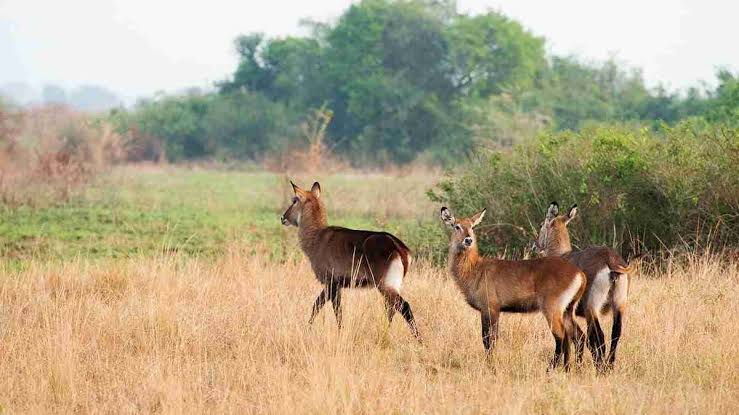
Antelope are plentiful and varied: defassa waterbuck along the wetter margins, bushbuck in the thickets, and oribi and Jackson’s hartebeest out on the flats, alongside warthog and herds of Uganda kob. Murchison Falls is also the stronghold of the Rothschild’s giraffe, the most endangered giraffe subspecies, and these tall browsers concentrate in the Buligi–Albert area. Their recovery here — from a handful of animals to well over a thousand across the greater conservation area — is one of Uganda’s quieter conservation successes.
Birdlife is a genuine draw. The park records around 450 species, and the water’s edge along the Albert Track is dominated by fish eagles, pied kingfishers and African jacanas, with the striking Abyssinian ground hornbill stalking the grassland. It is a productive stretch for anyone with binoculars and a little patience.
Timing your drive
The northern bank rewards early starts. Rangers advise being on the tracks before 7:00, or entering after about 4:30 in the afternoon, because the midday heat drives most animals into cover and sightings drop off sharply between roughly 12:00 and 15:00. A thorough Buligi-and-Albert circuit takes four to five hours, so an early drive followed by a mid-morning return for breakfast is the classic rhythm.
Late afternoon is arguably the Albert Track’s finest hour: animals move back towards the water, and the light across the Nile is at its best. If you are staying near Pakuba or Paraa, the connecting Queen’s Track lets you build a shorter loop when time is tight.
Access via the Paraa ferry
Most visitors are based on the southern bank, near Paraa, and reach the northern tracks on the vehicle ferry at Paraa, which crosses the Victoria Nile in a few minutes. The ferry runs to a fixed daily schedule — commonly around 07:00, 09:00, 11:00, 14:00, 16:00 and 18:00 — so an early game drive means catching the first crossing and arriving at the ramp in good time, especially in peak season when vehicle space fills up.
Travellers already on the northern bank can skip the ferry entirely. Northern access gates include Tangi, Chobe and Wankwar; the Tangi Gate connects most directly to the Pakuba Track and is closest to the northern lodges, while Pakuba Airstrip serves those flying in. From any of these, the Albert Track is a short drive away through the Buligi sector.
Frequently Asked Questions
- How long does it take to drive the Albert Track?
-
The track itself is about 11 to 14 kilometres, but few people drive it in isolation. Combined with the Buligi loop as a full northern-bank circuit, set aside four to five hours, best in the early morning or late afternoon.
- Do I need a 4×4 for the Albert Track?
-
A vehicle with good ground clearance is strongly recommended. The stretches near the lake edge include murram depressions that turn soft and rutted after rain.
- Can I see the Big Five on the Albert Track?
-
You can realistically look for four of them — lion, leopard, elephant and buffalo. Rhino are seen separately at Ziwa Rhino Sanctuary en route from Kampala.
- Is the Paraa ferry the only way to reach the track?
-
No. It is the main route for visitors based on the southern bank, but anyone staying at northern lodges or arriving via the Tangi, Chobe or Wankwar gates can reach the Albert Track without crossing the ferry at all.
Plan Your Safari
The Albert Track is best enjoyed as part of a wider Murchison Falls itinerary that pairs northern-bank game drives with a Nile boat cruise to the base of the falls. Browse our 3-day Murchison Falls safari for a focused first visit, or our 4-day Murchison Falls safari to add extra drives, the delta and a chimpanzee trek. Get in touch and we will build the timing, ferry crossings and lodges around the wildlife you most want to see.