


Bugungu Sector
The Bugungu sector is the corner of Murchison Falls most travellers see first without quite realising it is a place in its own right. Tucked into the south-western shoulder of the park, above the shimmer of Lake Albert, it is where the Great Rift Valley falls away in a single dramatic step and the savannah of the conservation area begins. For anyone arriving from Hoima or the Albertine lakeshore, this is the threshold to Murchison — and one of its most beautiful.
This guide looks at Bugungu as a place to explore rather than simply drive past: the escarpment scenery and views over Lake Albert, the gate and the roads that reach it, the woodland and grassland habitats, the wildlife you meet here, and how the sector connects to the ferry at Paraa and the wider southern circuit.
Where the Bugungu sector sits
Murchison Falls National Park is part of the larger Murchison Falls Conservation Area, and the Bugungu sector forms its south-western flank. It lies within Buliisa District, on and below the Albertine Rift escarpment, where the highland around Hoima and Biiso drops onto a valley floor sitting at roughly 650 metres above sea level before the land runs out into the swamps that fringe Lake Albert.
The sector takes its name from the Bugungu gate, the park’s southern boundary entrance, and from the neighbouring Bugungu Wildlife Reserve that buffers this side of the park. It is a transitional landscape — escarpment, dry Borassus-palm hills, wooded slopes and seasonal wetland — quite different in feel from the open northern game tracks across the Nile. If you are approaching from the west, this is your introduction to the whole conservation area.
The escarpment descent — the park’s most scenic arrival
The defining experience of Bugungu is the drive down the Rift Valley escarpment. The road climbs through the sugar plantations and Budongo woodland above Biiso, then tips over the edge and begins a long, steep descent to the valley floor. The view that opens up is genuinely arresting: the wide silver sheet of Lake Albert below, the dark line of the Blue Mountains of the Democratic Republic of Congo on the far shore, and the little fishing town of Butiaba spread along the water.
It is a stretch that rewards a camera and an unhurried pace. Borassus palms stand across the dry hillsides, and the light late in the day turns the whole basin gold. The gradient is real, though — the descent is steep and demands a careful hand on the brakes, and after rain the surface can be slick with spray. Guides who know the route often build in a few minutes at a viewpoint simply to let clients take the scene in before dropping onto the flats.
Reaching Bugungu gate: the routes
Two approaches bring travellers to the Bugungu sector. The first runs from Masindi and is the classic scenic option — around 135 kilometres to the gate, passing through Budongo Forest before that memorable escarpment descent. It is longer than the direct Kichumbanyobo route but far prettier, and it pairs naturally with a chimpanzee stop in Budongo on the way.
The second comes from Hoima and the oil-region corridor, following the Kampala–Hoima–Biiso–Buliisa road down to the lakeshore and turning for the gate near Buliisa town. This is the preferred entrance for anyone travelling up the Albertine belt rather than from Kampala or Masindi. Much of both corridors has been sealed with bitumen under the national oil-road upgrade, so a standard high-clearance vehicle now reaches the gate comfortably, where it once needed a sturdy 4×4. From Kampala, allow roughly four and a half to five and a half hours depending on the route you take.
The gate itself has been renovated in recent years, with covered ranger booths, clearer signage and payment kiosks; Uganda Wildlife Authority staff check permits and vehicle categories on entry. Card and mobile-money payments are accepted, though carrying some cash remains sensible this far from town.
Habitats and wildlife of the sector
Bugungu is a mosaic rather than a single habitat. The escarpment slopes carry wooded thicket and grassland; the valley floor holds savannah and Borassus palm stands; and towards Lake Albert the ground softens into seasonal wetland and swamp. This variety is what makes the sector interesting to naturalists even before the famous northern-bank herds come into view.
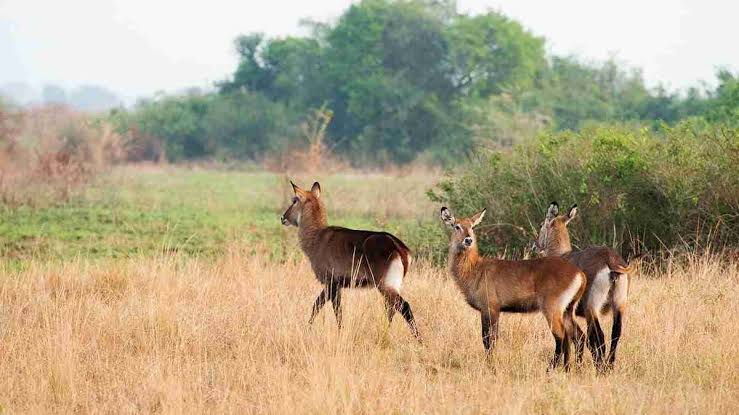
On the drive in and around the gate you can expect Uganda kob, oribi, bushbuck and warthog on the open ground, with olive baboons common along the roadside. The wooded escarpment shelters primates including black-and-white colobus and L’Hoest’s monkeys, while the swampy margins near the lake are home to the elusive sitatunga. Elephant and buffalo range across this southern buffer, moving between the reserve and the park proper.
Birdlife is a particular strength of the wetter, lower ground. The Lake Albert flats and delta fringe are among Uganda’s better places to look for the prehistoric-looking shoebill, alongside a long list of water-associated species. Murchison as a whole records over 450 birds, and the range of habitats packed into the Bugungu sector — cliff, woodland, palm savannah and marsh — puts a good share of them within reach.
How Bugungu links to Paraa and the southern circuit
Bugungu gate sits only about 13 kilometres from Paraa, the park’s tourism hub on the southern bank of the Victoria Nile. That short link is the sector’s practical importance: it feeds travellers straight into the heart of the visitor experience. Paraa — whose name means “home of the hippo” in the local Luo — is the launch point for Nile boat cruises to the base of the falls and to the delta, and the site of the vehicle ferry that shuttles across to the northern bank.
From Bugungu, most itineraries run to Paraa, take a boat cruise and the top-of-the-falls walk on the southern side, then cross on the Paraa ferry to reach the productive Buligi game tracks in the north. In other words, the sector is the western doorway onto the whole southern circuit — you arrive through the escarpment, settle near the river, and use the crossing to reach the big game viewing beyond.
Where to stay near the sector
Most accommodation lies in a cluster on the southern riverbank a few kilometres west of Paraa, reached from Bugungu or through the small Mubako gate that serves the lodges just outside the park boundary. Options span the range — the grand hilltop Paraa Safari Lodge above the ferry, mid-range and tented choices such as Murchison River Lodge, and intimate riverside camps like Baker’s Lodge — while Budongo Eco Lodge sits back along the forest route for those combining chimpanzees with the park.
Basing on this southern stretch keeps you close to the boat jetty, the falls walk and the ferry, which is why many travellers who enter through Bugungu simply pass through the sector to reach these lodges. Others linger deliberately for the escarpment scenery and the quieter, less-visited feel of the park’s south-western edge.
Frequently Asked Questions
- Where is the Bugungu sector in Murchison Falls?
-
It occupies the south-western side of the park, in Buliisa District, on and below the Rift Valley escarpment above Lake Albert. It is reached through the Bugungu gate, around 13 kilometres from Paraa.
- Is the drive to Bugungu gate worth the extra distance?
-
For scenery, yes. The route from Masindi via Budongo is about 135 kilometres — longer than the direct Kichumbanyobo road — but the descent of the escarpment, with its views over Lake Albert and towards the Congo mountains, is one of the finest arrivals in the whole park.
- Do I need a 4×4 to reach the sector?
-
The main corridors from Hoima and Masindi to the gate have largely been tarmacked, so a high-clearance vehicle is fine as far as the entrance. Inside the park, some internal tracks still favour a proper 4×4, and the escarpment descent calls for careful driving in the wet.
- What wildlife will I see around Bugungu?
-
Uganda kob, oribi, bushbuck, warthog and baboons are common on the open ground, with colobus and L’Hoest’s monkeys on the wooded slopes and sitatunga in the swamps. Elephant and buffalo range through, and the lake margins are excellent for water birds, including the shoebill.
Plan Your Safari
The Bugungu sector works best as a scenic entrance woven into a fuller Murchison itinerary — the escarpment drive in, a Nile cruise from Paraa, and a ferry crossing to the northern game tracks. Browse our 3-day Murchison Falls safari for a first visit, or our 4-day Murchison Falls safari to add a chimpanzee trek in Budongo Forest on the way down. Get in touch and we will build the route, gates and lodges around the pace and scenery you want.