


Albert Nile Guide
Most visitors to Murchison Falls fix their eyes on the roaring cataract, yet some of the park’s most memorable hours are spent 20km downstream, where the river loses its fury and spreads into a glassy maze of papyrus and open water. This is the Albert Nile country — the quiet, wildlife-rich north-western corner where the Victoria Nile finally meets Lake Albert and the great river reorganises itself for the long journey to the Mediterranean.
This guide covers the geography of the Albert Nile, the famous delta and its birdlife, the animals that gather on its banks, the fishing on this stretch of the Nile, and how to reach it all by boat from Paraa.
Where the Albert Nile begins
The naming here confuses many travellers, so it is worth getting straight. The Victoria Nile is the river that leaves Lake Victoria, thunders over Murchison Falls, and flows west across the park. When it reaches the north-eastern shore of Lake Albert it fans out into a broad delta and empties into the lake.
The Albert Nile is what emerges on the far side. It issues from the northern tip of Lake Albert, just north of the Victoria Nile’s mouth, and flows roughly 210km (130 miles) north past Pakwach to the South Sudanese border at Nimule, where it becomes the Mountain Nile. It is navigable along its whole length, spreading in places more than 5km wide into a shifting complex of fringe lakes, silt banks and papyrus islands.
Lake Albert and the delta
Lake Albert is the northernmost lake of the Albertine Rift, the western arm of the East African Rift. It is Africa’s seventh-largest lake — about 160km long and 30km wide — lying between two dramatic escarpments at an elevation of 619m. Nearby Butiaba landing site is the lowest point in Uganda.
The delta itself is where the drama of the falls gives way to serenity. Sediment built up over millennia has formed a flat alluvial plain, so the river breaks into countless slow channels weaving between reed islands — best thought of less as a river and more as a living wetland.
The birds: shoebill country
For birdwatchers, the delta is the whole point of a Murchison trip. Its still, mirror-flat channels are the park’s most reliable place to find the extraordinary shoebill, the prehistoric-looking marsh stork that ranks near the top of every serious birder’s wish list. Sightings are never guaranteed, but the odds here are among the best in the country, especially in the dry season when low water concentrates the birds.
The supporting cast is superb. Expect grey-crowned cranes, saddle-billed storks, goliath and purple herons, African jacanas stepping across lily pads, Egyptian geese, and both malachite and pied kingfishers darting through the reeds. Murchison as a whole records over 450 bird species, and a good share of the wetland specialists live here. For more, see our guide to the best places to see shoebills in Uganda.
Wildlife along the banks
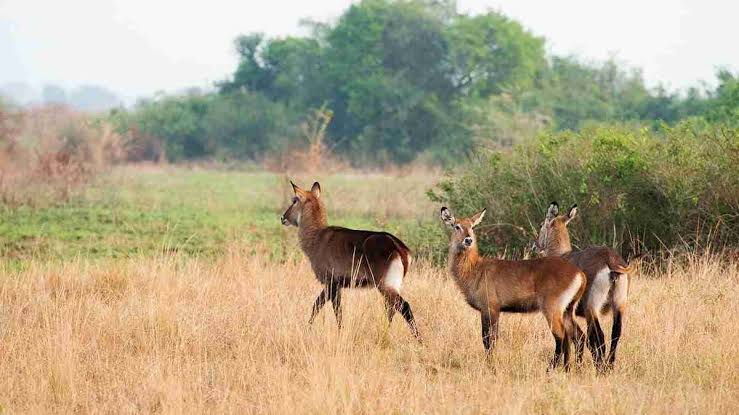
The delta is not only for birders. Because it holds water year-round, it draws big game down to drink, particularly in the dry months. Elephants wade in the shallows, buffalo and waterbuck graze the fringing grasslands, and herds of Rothschild’s giraffe — the park’s conservation prize — move along the Albert flats.
The water teems with hippos and large Nile crocodiles basking on the silt banks. On the adjacent northern savannah, reached by the Buligi, Albert and Queen’s tracks, you may add Jackson’s hartebeest, Uganda kob, warthog, and the lions that hunt them. A morning delta cruise pairs well with an afternoon game drive in this circuit.
Fishing the Nile
This stretch of the Nile is world-renowned among anglers, chiefly for the Nile perch (locally emputa), which can exceed 50kg here; the largest ever recorded in the park weighed 113kg, landed opposite the crocodile pool. Tigerfish, catfish and tilapia round out the sport.
Most serious fishing is done at the base of the falls around the turbulent, oxygen-rich Devil’s Cauldron, and in the pools and eddies downstream — either from rocky banks or from a moored boat. You must buy a UWA sport-fishing permit, separate from park entry: currently around US$50 for one day or US$150 for four days. Fishing operates on a catch-and-release basis, and a UWA guide will show you the productive spots.
Reaching the delta by boat from Paraa
The delta is accessible only by water, which is part of its charm. The dedicated delta cruise is an entirely different trip from the busy run to the base of the falls — it heads downstream instead of up, and moves slowly and quietly, drifting through the reeds with the engine cut whenever a bird appears.
Cruises leave from the Paraa jetty on the south bank, usually at 7:00am, cover roughly 20km each way, and last around 4–5 hours return. Wild Frontiers operates a scheduled shaded boat with a breakfast-on-board option (about US$55 per adult), and private charters with flexible timings can be arranged. An early start rewards you with calm water, soft light and the most active birdlife. See our full boat cruise versus game drive comparison to plan your days.
Frequently Asked Questions
- Is the Albert Nile the same as the Victoria Nile?
-
No. The Victoria Nile flows from Lake Victoria over Murchison Falls into Lake Albert. The Albert Nile is the section that leaves the northern tip of Lake Albert and flows north towards South Sudan.
- What is the best time to visit the delta?
-
The dry seasons, roughly December to February and June to September, are ideal. Low water levels concentrate birds and make navigation easier, and the light is best for photography.
- How long is the delta boat cruise?
-
The return cruise from Paraa is about 4–5 hours and covers roughly 20km each way. It usually departs at 7:00am and is slower and quieter than the cruise to the base of the falls.
- Can I fish on this part of the Nile?
-
Yes, with a UWA sport-fishing permit (separate from park entry). Most fishing happens at the base of the falls and in downstream pools, targeting Nile perch, tigerfish and catfish on a catch-and-release basis.
- Am I likely to see a shoebill?
-
The delta is Murchison’s most reliable shoebill spot, but sightings are never guaranteed. An early morning cruise in the dry season with an experienced guide gives you the best chance.
Plan Your Safari
The Albert Nile delta adds a slower, wilder dimension to a Murchison trip — a morning of drifting through papyrus after shoebills and giraffe, framed by the great Rift Valley escarpments. Talk to us about combining the delta cruise with northern-sector game drives, the falls hike and, for anglers, a UWA fishing permit, and we will build the timing around the calm, wildlife-rich dawns that make this corner of the park so special.