



Guided Nature Walks in Murchison Falls
Game drives show you Murchison Falls at speed — buffalo on the Buligi plains, giraffe in acacia, lions in the grass. Guided nature walks show you the park at ground level: a warthog track in soft mud, medicinal bark a ranger crushes between his fingers, colobus crashing through the canopy. For travellers who want more than a window seat, walking is how the conservation area reveals its quieter layers.
Uganda Wildlife Authority (UWA) permits guided walks on designated trails only, and every group must be accompanied by an armed ranger. This guide covers the main routes — the Top of the Falls, south-bank circuits near Paraa, Rabongo Forest, Kaniyo Pabidi in Budongo, and the Nile delta swamps — with fees, wildlife, and practical planning.
How UWA Guided Walks Work
Walking in Murchison is not free-form. UWA restricts foot access to approved trails, and an armed ranger must lead every group — for safety in an area with elephant, buffalo, hippo and, on the northern savannah, lion — and to interpret what you pass. Rangers adjust pace and route if large animals are nearby.
Under the UWA tariff valid July 2024 to June 2026, a bird watching or day nature walk costs USD 25 for foreign non-residents (USD 20 for foreign residents), on top of the daily park entry fee of USD 45. The Top of the Falls hike is USD 15 with a ranger. Walks run morning and afternoon; book at the UWA desk in Paraa, through your lodge, or via your tour operator. Rabongo and Kaniyo Pabidi sit away from the ferry crossing, so advance notice helps.
Top of the Falls Hike
The park’s most famous walk climbs to the lip of the waterfall, where the Victoria Nile is forced through a gorge barely seven metres wide before plunging 43 metres into the Devil’s Cauldron. The trail covers roughly 1.5 kilometres with about 100 metres of ascent — short but steep, with stone steps slick in the permanent mist.
Most hikers start at Baker’s Point, where Sir Samuel Baker stood in 1864. The classic format is the launch cruise from Paraa, disembark at the base, and climb with your ranger in 45 minutes to an hour. Your vehicle meets you at the car park above. Closed shoes with grip are essential. See our boat cruise vs top of the falls hike guide for the full combo.
South-Bank Walks Near Paraa
Between the vehicle ferry and the falls trailhead, marked circuits pass through riverine forest, rocky outcrops and grassland margins above the Nile. These standard walking safaris run two to four hours at moderate pace, departing from Paraa or the falls car park.
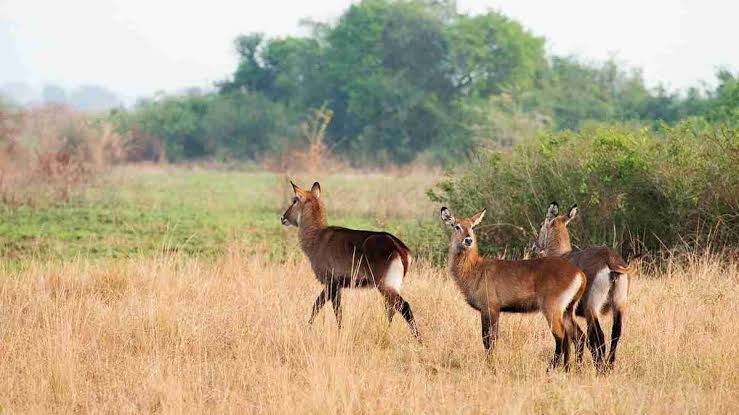
Buffalo, Uganda kob, waterbuck, warthog and hippo use the south bank, so the armed ranger is essential. At walking pace you notice what drives miss: termite mounds, fig trees with fruit bats, and birds such as Ross’s turaco and African pygmy kingfisher. Longer circuits reach viewpoints across to the northern savannah.
Rabongo Forest
Roughly an hour and a half’s drive south-east from Paraa, Rabongo Forest is a compact island of tropical riverine woodland — about four square kilometres — surrounded by savannah and bounded by the Wairingo River. With no vehicle tracks inside, it is explored almost entirely on foot.
Morning and afternoon walks of around two hours follow trails beside the Wairingo River. Olive baboons, black-and-white colobus, red-tailed and vervet monkeys are seen regularly. Crested guineafowl and white-thighed hornbill add strong birding. Chimpanzees are occasionally reported but not reliably present — Kaniyo Pabidi is the better choice for chimps. Dry seasons from December to February and June to September offer firmer trails.
Kaniyo Pabidi and Budongo Forest
Eight kilometres inside Kichumbanyobo gate on the Masindi–Paraa road, Kaniyo Pabidi is a managed ecotourism site in Budongo Forest — mature mahogany and ironwood managed with the Jane Goodall Institute. Walks focus on primates, birds and botany, including colobus monkeys, olive baboons, the chocolate-backed kingfisher and Puvel’s illadopsis, an Albertine Rift endemic found nowhere else in East Africa.
Chimpanzee tracking is a separate permit-based activity and should not be confused with a general nature walk. Our Budongo Forest guide and chimpanzee trekking in Budongo pages explain how each fits a Murchison itinerary.
Nile Delta Swamp Walks
Where the Victoria Nile spreads into papyrus channels before Lake Albert, UWA offers two-to-four-hour guided swamp walks complementing delta boat cruises. The prize sighting is the shoebill, though nothing is guaranteed.
January to March, when papyrus thins, historically offers the best shoebill odds. Grey crowned cranes, saddle-billed storks and Goliath herons reward any delta morning. Waterproof footwear and tolerance for boggy ground are essential; many visitors pair a short walk with a delta cruise. See our guide to the best place to see shoebills in Uganda.
Wildlife, Safety and What to Bring
Murchison holds 76 mammal species and more than 450 birds. Lion and leopard inhabit the open savannah, which is why walking stays on designated trails. Wear closed, grippy shoes, neutral clothing, a hat and insect repellent. Carry water and a light rain jacket. Stay behind your ranger and keep voices low.
Frequently Asked Questions
- Do I need an armed ranger for nature walks?
-
Yes. UWA requires an armed ranger on all permitted walks — Rabongo, Kaniyo Pabidi, south-bank circuits and delta routes included.
- How much do guided nature walks cost?
-
Day nature walks cost USD 25 per foreign non-resident plus the USD 45 park entry fee. The Top of the Falls hike is USD 15 with a ranger, separate from the launch cruise.
- Which walk if I only have half a day?
-
Pair the launch cruise with the Top of the Falls hike. If you have done the falls, a south-bank walk from Paraa fits between a morning drive and an afternoon boat trip.
- Can I see chimpanzees on a nature walk?
-
Monkeys are common, but reliable chimp encounters need a dedicated tracking permit at Kaniyo Pabidi. Rabongo is rewarding for primates and birds, but chimps there are uncommon.
- When is the best time for walking?
-
Dry seasons from December to February and June to September offer firmer trails. Forest and delta walks run year-round, though March to May and October to November bring mud.
Plan Your Safari
A guided walk often ties savannah, river and forest together in one trip. We can slot south-bank walks, the Top of the Falls climb, Rabongo Forest or a delta morning alongside game drives and boat cruises. Browse our Murchison Falls safari packages, see things to do in the park, or ask about adding delta birding to a walking day on the Nile.