



Murchison Falls vs Kruger National Park
Travellers planning a first African safari often ask whether Kruger National Park or Murchison Falls National Park delivers the better experience. Kruger is the benchmark — vast, famous and backed by decades of SANParks infrastructure. Murchison is a fraction of the size, far less visited, and built around a Nile waterfall rather than endless Lowveld bushveld. Neither park is objectively better; they answer different briefs.
This guide compares scale, wildlife density, infrastructure, costs and atmosphere so you can decide which fits your trip. We run safaris at Murchison daily; the Kruger facts below come from SANParks, UWA tariff schedules and published conservation data.
Scale, Landscape and First Impressions
Kruger covers roughly 19,485 square kilometres across Limpopo and Mpumalanga — about five times the area of Murchison Falls National Park, which UWA lists at 3,840 square kilometres. Kruger stretches 360 kilometres north to south; you could spend two weeks on its 850 kilometres of tarred roads and still not cover every ecozone from southern thornveld to northern mopane woodland.
Murchison is defined by the Victoria Nile. The river runs west before forcing through a gorge barely seven metres wide and dropping 43 metres into the Devil’s Cauldron. Open savannah on the northern Buligi plains sits beside papyrus delta, rift escarpment and Budongo Forest — more habitat variety in a two-day loop than a comparable slice of Kruger’s bushveld.
Wildlife: Big Five Density and Specialist Species
Kruger holds the full Big Five — lion, leopard, elephant, buffalo and both black and white rhino — alongside roughly 147 mammal species and more than 500 bird species. The southern sector around Skukuza, Lower Sabie and Crocodile Bridge offers the highest predator density on tarred roads. Adjacent private reserves such as Sabi Sands add off-road tracking, night drives and leopard sightings among the most reliable on the continent. For sheer mammal density on established routes, Kruger is hard to beat.
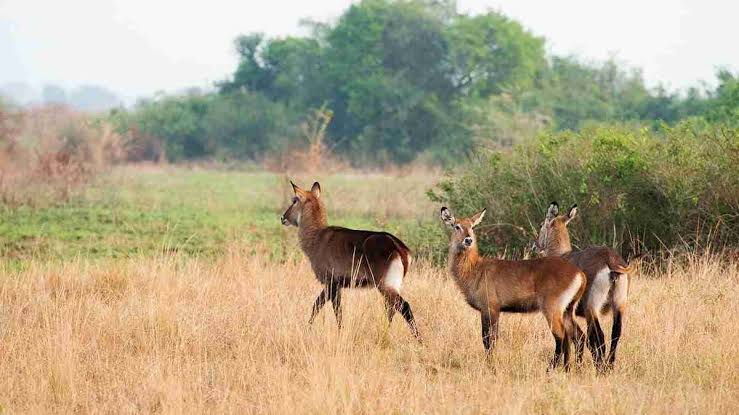
Murchison records 76 mammal species and over 451 bird species, with four of the Big Five on the northern plains. There are no wild rhino inside the park; add them at Ziwa Rhino Sanctuary on the Kampala road. Where Murchison pulls ahead is specialist wildlife: Nubian giraffe in numbers found almost nowhere else (GCF surveys recorded roughly 1,770 unique individuals in 2024–2025), shoebill stork in the Albert Delta, and chimpanzees in Budongo Forest — none of which Kruger offers. Lion sightings on Buligi have improved since the park became a Lion Conservation Unit in 2005; the Nile boat cruise puts hippos and crocodiles at close range in a way no Kruger tar road replicates.
Getting There, Gates and On-the-Ground Logistics
Kruger is remarkably accessible. From Johannesburg, Paul Kruger Gate is about 442 kilometres — roughly five and a half hours — and Skukuza rest camp sits 12 kilometres inside. Ten main gates span the park; most tarred routes suit a standard sedan. Self-drive between Satara, Lower Sabie and Skukuza is genuinely straightforward for first-timers who prefer independence.
Murchison demands more planning. Paraa sits about 305 kilometres from Kampala — four to five hours — or six to seven from Entebbe. Most southern approaches enter at Kichumbanyobo Gate, 16 kilometres north of Masindi, then run 86 kilometres through Budongo to the Nile. Unless your lodge sits on the northern bank or you fly to Pakuba airstrip, you cross the Victoria Nile by vehicle ferry — the 07:00 sailing matters if your game drives are on Buligi and your lodge is south of the river. Uganda safaris are overwhelmingly guided; Kruger suits independent travellers who prefer tar roads to ferry timetables.
Crowds, Atmosphere and Safari Style
Kruger welcomed a record 1,959,757 guests in the 2025/26 financial year. Popular tarred loops between Crocodile Bridge, Lower Sabie and Skukuza can feel busy at peak South African school holidays; lion sightings may queue several vehicles deep. Murchison sees a fraction of that traffic — on a mid-week dawn drive along Buligi you might share a sighting with one other vehicle, or none at all.
Kruger’s core experience is road-based game viewing. Murchison layers a launch cruise to the base of the falls (UWA departures from Paraa at 09:00 and 14:00, US$30 per person), delta shoebill cruises, chimp trekking and the Top of the Falls hike onto standard game drives — a broader daily menu in a smaller area, with lighter crowds as the trade-off.
Cost, Seasons and Which Park to Choose
For 1 November 2025 to 31 October 2026, SANParks charges international visitors R602 per adult per day at Kruger. Under the UWA tariff valid through June 2026, Murchison costs US$45 per foreign non-resident adult per 24 hours, with activities charged separately — see our Murchison park fees guide. Park entry alone is broadly comparable; the bigger difference sits in flights, guided packages and whether you add gorilla trekking elsewhere in Uganda.
Kruger’s dry window from April to September thins vegetation and concentrates game. Murchison’s best windows are December to February and June to September. Choose Kruger for self-drive Big Five infrastructure, rhino inside the park and a South Africa add-on to Cape Town. Choose Murchison for the waterfall, Nile cruise, Nubian giraffe, shoebill and chimp trekking — or as part of a wider Uganda circuit through Bwindi or Queen Elizabeth.
Frequently Asked Questions
- Is Murchison Falls better than Kruger for a first safari?
-
Kruger is easier for a first self-drive safari — more roads, more camps, full Big Five on site. Murchison suits first-timers who book a guided Uganda package and want waterfall drama, river cruises and specialist species alongside savannah game.
- Which park has better lion sightings?
-
Kruger holds far more lions across a vastly larger area, so you encounter them more often along river roads in the dry season. Murchison’s Buligi plains produce reliable sightings with a good UWA ranger and an early start, but the population is smaller and less predictable.
- Can I see rhino at Murchison Falls?
-
Not inside the national park. Reintroduced southern white rhino live at Ziwa Rhino Sanctuary, about 176 kilometres from Kampala on the road to Murchison — a half-day stop en route completes the Big Five for Uganda itineraries.
- How many days do I need at each park?
-
Three to four nights covers Murchison’s core triangle — a northern game drive, launch cruise and top-of-the-falls visit. Kruger warrants at least four nights; a week lets you sample southern and central zones without rushing between gates.
Plan Your Safari
Murchison Falls is not a Kruger replacement — it is a different proposition built around the Nile, lighter visitor numbers and wildlife you cannot tick off in South Africa. Browse our Murchison Falls safaris, read the first-time visitors guide and cost breakdown, or tell us your dates and we will map gates, ferry crossings and lodge side so your days follow the wildlife rather than the schedule.