



Murchison Falls & Lake Bunyonyi Safari
A Murchison Falls & Lake Bunyonyi Safari pairs two of Uganda’s most contrasting landscapes: thundering Nile savannah in the north-west and the terraced highlands of the Kigezi region in the south-west. You spend mornings scanning for elephants and Rothschild giraffes on the northern bank of the Victoria Nile, then finish the trip paddling between islands on a bilharzia-free lake where hippos and crocodiles are absent. Few itineraries cover that much ground with this little repetition.
This guide explains how the two destinations fit together on a realistic route, what wildlife and activities to expect at each stop, suggested day counts, and the practical details — gate names, drive times, park fees and lodge tiers — that turn a long-distance Uganda loop into a smooth holiday rather than a series of exhausting transfers.
Why combine Murchison Falls with Lake Bunyonyi?
Murchison Falls National Park is Uganda’s largest conservation area and sits in UWA’s Category A+ tier. Foreign non-residents pay US$45 per adult per 24 hours under the July 2024–June 2026 tariff, separate from activity fees. The park delivers classic Big Five-adjacent game viewing — elephants, buffaloes, lions, leopards and large herds of Uganda kob — plus the world’s largest single population of Nubian (Rothschild’s) giraffes, numbering well over 1,000 animals on the northern bank game tracks.
Lake Bunyonyi — the name means “place of many little birds” — sits at roughly 1,973 metres above sea level between Kabale and Kisoro. Scientific surveys put its average depth at about 40 metres across a surface of roughly 56 square kilometres, dotted with 29 islands. Over 200 bird species live around the shore, the water is bilharzia-free, and the absence of hippos and crocodiles makes swimming genuinely possible — a rare treat after days of savannah dust.
Distances and how the route works
These parks sit at opposite ends of Uganda. From Paraa in Murchison to Lake Bunyonyi via the standard southbound corridor — Masindi, Kampala, Mbarara and Kabale — the road distance runs to roughly 650–710 kilometres. Non-stop driving would take 12 hours or more; no operator schedules that in a single day.
The sensible approach breaks the transfer across three to four driving days, with wildlife stopovers at parks that lie naturally on the route. Many travellers include Ziwa Rhino Sanctuary near Nakitoma on the way north — about 176 kilometres from Kampala and the only place in Uganda to track white rhino on foot — then enter Murchison via Kichumbanyobo Gate, roughly 16 kilometres east of Masindi. If your lodge sits on the northern bank, allow 30 to 45 minutes for the Paraa ferry, which runs daily between about 07:00 and 19:00.
Southbound from Murchison, the corridor passes through Kibale Forest for chimpanzee tracking, Queen Elizabeth National Park for the Kazinga Channel boat cruise and Ishasha’s tree-climbing lions, and optionally Bwindi Impenetrable Forest for gorilla trekking. From Bwindi, Lake Bunyonyi is only 60 to 80 kilometres — typically two to three hours on winding highland roads. The final transfer from the lake back to Entebbe covers about 410 kilometres and seven to eight hours; exiting via Kigali instead takes roughly four to five hours including the border.
Suggested itinerary shape
Most well-paced versions run eight to ten days. A typical north-to-south flow keeps the longest drives away from your most demanding activity mornings:
Days 1–2: Meet in Entebbe or Kampala, drive north with a rhino stop at Ziwa, and reach your Murchison lodge with daylight to spare. Overnight near Paraa or on the northern bank.
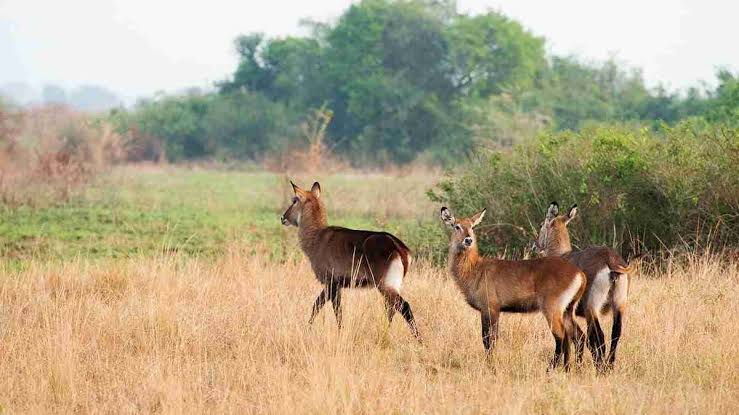
Day 3: Morning game drive on the northern bank — giraffes, elephants, buffaloes, hartebeest and waterbuck are regular sightings — followed by an afternoon Nile launch cruise to the base of the falls. The cruise typically runs about two hours and delivers close views of hippos, crocodiles and waterbirds.
Day 4: Visit the Top of the Falls viewpoint where the Nile forces through a seven-metre gorge, or take a delta boat option for shoebill searches, then begin the southbound transfer toward Kibale or Fort Portal.
Days 5–7: Chimpanzee tracking in Kibale, game viewing and a Kazinga Channel cruise in Queen Elizabeth, and an Ishasha game drive for tree-climbing lions. Optional gorilla trekking in Bwindi adds a permit day — see our guide on combining Murchison with gorilla trekking for permit timing.
Days 8–9: Transfer to Lake Bunyonyi for a full day or two of canoeing between islands — including historic Punishment Island (Akampene) and forested Bwama Island — swimming, birdwatching and Bakiga community walks through terraced hillsides.
Day 10: Return to Entebbe for your departure flight, or cross to Kigali if that suits your onward travel.
Wildlife and activities at each stop
At Murchison, the northern bank game tracks deliver the park’s strongest savannah viewing. Lions are present though not guaranteed on every drive; the Nile boat adds a different perspective entirely. Budongo Forest, reached through the same Kichumbanyobo approach road, offers chimpanzee tracking for travellers who prefer forest primates without leaving the Murchison area.
Lake Bunyonyi rewards a slower pace. Hire a dugout canoe or motorboat to reach islands where forest patches hold monkeys and small antelope; otters appear occasionally near quiet bays. Community walks through the Kigezi highlands visit blacksmith sites and the Bakiga Cultural Museum near Kabale. After gorilla trekking or several days of early-morning game drives, the lake works brilliantly as a decompression stop — warm days around 25°C and cool evenings at altitude.
Accommodation and travel style
The itinerary works across budget, mid-range and luxury tiers at both ends. Along the Nile, lodges at Paraa, Pakuba and Chobe suit different budgets; at Lake Bunyonyi, options range from lakeside campsites to boutique lodges above the water. A high-clearance 4×4 with a driver-guide is standard for the full loop — the Masindi–Paraa stretch and the final Kabale approach roads reward proper ground clearance, especially during the long rains from March to May and the short rains in October and November.
Travellers short on time can fly one leg: scheduled light aircraft link Entebbe to Pakuba, Bugungu or Chobe airstrips near Murchison in about an hour, cutting two long driving days from the northbound section. Read our fly-in vs road safari guide for how operators mix flights with overland transfers.
Best time to travel
Uganda runs year-round, but the drier windows — June to September and December to February — give the firmest game-drive tracks at Murchison and the most reliable road conditions on the long southbound transfer. Lake Bunyonyi sits at altitude and stays pleasant even in the rains, though hillside paths become slippery. The wetter months bring greener scenery, excellent birding — including grey-crowned cranes around the lake — and fewer visitors at both destinations.
Frequently Asked Questions
- How many days do I need for Murchison Falls and Lake Bunyonyi?
-
Allow eight to ten days for a comfortable overland loop with two nights at Murchison, stopovers at parks on the route south, and at least one full day at Lake Bunyonyi. Shorter trips are possible with a flight leg, but attempting the full distance in under a week means back-to-back 8-hour drives.
- Can I visit Lake Bunyonyi without gorilla trekking?
-
Yes. Lake Bunyonyi stands on its own as a scenic and cultural destination. Many travellers add it after Bwindi, but you can reach the lake directly from Kabale without a gorilla permit — the focus shifts to canoeing, island visits, hiking and community encounters.
- Is Lake Bunyonyi safe for swimming?
-
Unlike most Ugandan lakes, Bunyonyi has no hippos or crocodiles and the water is bilharzia-free, which makes swimming popular. Depth drops quickly offshore, so non-swimmers should stay near the shore or use a life jacket on boat trips.
- Which gate should I use for Murchison Falls?
-
Kichumbanyobo Gate through Masindi is the standard choice for Paraa and most Nile-side lodges. Northern gates via Karuma Bridge suit north-bank lodges or onward travel toward Gulu. Refuel completely in Masindi — there is no dependable petrol inside the park.
- Can this safari be customised?
-
Absolutely. Day counts, lodge tier, optional gorilla or chimpanzee permits, fly-in sections and exit via Entebbe or Kigali can all be adjusted. Early booking matters if your dates include gorilla trekking or travel during peak season.
Plan Your Safari
A Murchison Falls & Lake Bunyonyi Safari covers the full width of Uganda — Nile thunder and highland calm — when the routing respects the distance between them. We match gate selection to your lodge, sequence drive days around permits and ferry timings, and choose accommodation at both ends that fits your budget. Browse our Murchison Falls safari packages, explore wider Uganda safaris, and tell us your dates — we will build a loop that arrives at each stop with time to enjoy it.