



Murchison Falls vs Kibale National Park
Murchison Falls and Kibale National Park sit at opposite ends of Uganda’s wildlife spectrum — one is open savannah threaded by the Nile, the other a dense rainforest hailed as the primate capital of Africa. Most travellers do not choose between them so much as decide how many days to give each, and in what order. The contrast is the point: thundering falls and Rothschild’s giraffe in the north, then chimpanzees and thirteen primate species in the west.
This guide compares landscapes, signature activities, transfer times, UWA fees and realistic day counts so you can judge whether one park alone suits your trip — or whether a combined circuit, as on our 5-day Murchison and Kibale safari, is the stronger option.
What each park does best
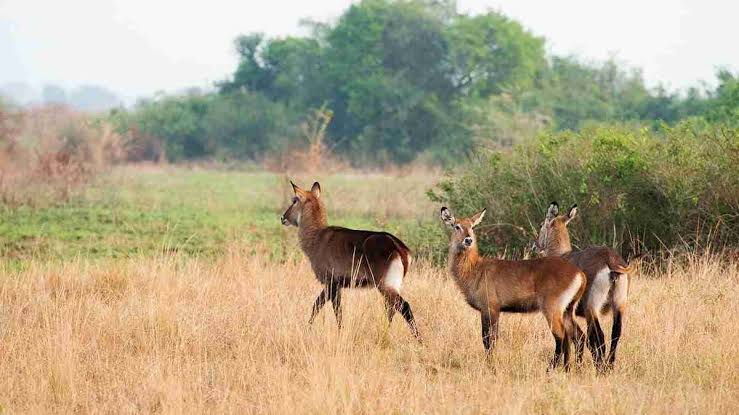
Murchison Falls National Park covers roughly 3,840 square kilometres along the Victoria Nile — Uganda’s largest protected area. Game drives on the northern Buligi Peninsula produce elephant, buffalo, lion, leopard and Uganda kob against Borassus palms and acacia woodland. The park holds the world’s strongest population of Nubian (Rothschild’s) giraffe, numbering over 1,500 animals. The UWA launch cruise from Paraa runs 17 kilometres upstream to the base of the falls, where the entire river is forced through a seven-metre gorge.
Kibale National Park spans about 795 square kilometres of tropical rainforest 24 kilometres east of Fort Portal, at roughly 1,100 to 1,590 metres above sea level. UWA records 13 primate species — around two-thirds of Uganda’s total — including an estimated 1,450 chimpanzees, red colobus, L’Hoest’s monkey and the Uganda mangabey. Kibale is not a savannah park: large mammals such as elephant and buffalo exist but sightings are rare. The headline is forest trekking, not open-plains game viewing.
In short, Murchison rewards travellers who want Big Four savannah drama, river cruises and giraffes. Kibale rewards those who prioritise close primate encounters in primary forest — and who accept that the experience is on foot, not from a vehicle.
Wildlife and activities compared
At Murchison, a typical two-night stay includes a morning game drive on the Buligi or Queen’s tracks, the afternoon Nile launch cruise (UWA departures from Paraa at 09:00 and 14:00), and optionally the Top of the Falls viewpoint or a delta shoebill cruise. Birders target the shoebill stork in Nile Delta papyrus and more than 450 bird species park-wide. Chimpanzees do occur at Murchison — in the Kaniyo Pabidi sector of Budongo Forest — but success rates and habituation quality fall well short of Kibale. See our Murchison chimpanzee trekking guide for that secondary option.
At Kibale, the flagship activity is chimpanzee tracking from the Kanyanchu visitor centre. Treks run in morning and afternoon sessions, last roughly two to four hours on forest trails, and end with one hour observing a habituated community — group size is capped at six visitors per chimp party, minimum age 12 years. UWA also offers the Chimpanzee Habituation Experience (four hours with chimps, higher permit fee). The community-run Bigodi Wetland Sanctuary walk adds shoebill, pitta and forest-edge birding on a boardwalk loop. Kibale lists 372 bird species, including Albertine Rift endemics such as green-breasted pitta and African pitta.
Neither park replaces the other. Murchison does not offer Kibale-grade chimp tracking; Kibale does not offer savannah lions, Nile boat cruises or Rothschild’s giraffe.
Distances and transfer times
From Entebbe or Kampala, Murchison via Masindi and Kichumbanyobo Gate covers roughly 305 kilometres and five to six hours on a good day — longer if you stop at Ziwa Rhino Sanctuary, 176 kilometres north of Kampala, for on-foot white rhino tracking.
Kibale is reached through Fort Portal: about 320 kilometres and five to six hours from Kampala on tarmac via Mubende. The drive between the two parks — the standard combined-safari leg — runs roughly 340 to 350 kilometres through Hoima and Fort Portal and takes six to eight hours in a pop-up-roof 4×4. Plan it as a full transfer day with a lunch stop in Fort Portal rather than arriving after dark. From Kibale, Queen Elizabeth National Park is only about 150 kilometres and two hours, which is why many circuits continue west after chimps. No scheduled flights link Murchison directly to Kibale; Aerolink Uganda serves Murchison’s Pakuba airstrip from Entebbe, but Kibale access remains road-based for most travellers.
Park fees and permit costs
Under the UWA tariff valid July 2024 through June 2026, foreign non-resident adults pay US$45 per 24 hours at Murchison and US$40 at Kibale (children aged five to fifteen pay US$25 and US$20 respectively; under-fives free). Activities are charged separately at Murchison: day game-drive ranger US$25, Nile launch US$30, Top of the Falls hike US$15.
Kibale chimpanzee tracking permits cost US$250 for foreign non-residents and US$200 for foreign residents — the permit includes park entry and ranger guide on the tracking day. The habituation experience runs US$300 (foreign non-residents). UWA announced discounted chimp permits at US$200 for foreign non-residents during the low-season months of April, May and November 2026. Book permits well ahead in peak season; daily quotas are limited. Kaniyo Pabidi chimp permits at Murchison are cheaper but a different product entirely.
How many days, and can you combine both?
Two nights at Murchison is the practical minimum — one full day for a game drive and launch cruise, plus arrival and departure buffers around the Paraa ferry (07:00–19:00) if you lodge on the north bank. One night at Kibale suits a single chimp trek and optional Bigodi walk; add a second night if you want habituation or a relaxed forest-birding morning.
A focused five- to seven-day circuit might run: Days 1–2 Murchison (game drive, launch, falls), Day 3 transfer to Kibale, Day 4 chimp tracking, Day 5 return to Entebbe or continue to Queen Elizabeth. Our 7 Day Murchison, Kibale & Queen Elizabeth Safari extends that shape. For route planning across more parks, see best Uganda safari itineraries and the Murchison vs Queen Elizabeth guide.
Best time to visit
Dry seasons from June to September and December to February firm murram roads at Murchison, concentrate wildlife along the Nile banks and keep Kibale forest trails drier underfoot. April–May and October–November bring lush scenery, fewer vehicles and excellent birding — but forest paths become slippery and the Hoima–Fort Portal transfer can slow after heavy rain. If chimp permits are your priority, dry months sell out first; low-season discounts in April, May and November 2026 can reduce permit cost if your dates are flexible.
Frequently Asked Questions
- Which park should you visit if you only have three days?
-
Choose Murchison for savannah, the Nile cruise and giraffes — it fits a long weekend from Entebbe more naturally. Choose Kibale only if chimpanzees are your single must-do and you accept less Big Four exposure.
- Can you see chimpanzees at Murchison instead of Kibale?
-
Yes, at Kaniyo Pabidi in Budongo Forest — but Kibale offers higher success rates, more habituated communities and the full primate diversity Kibale is known for. Murchison chimps are a bonus, not a substitute.
- How long is the drive between Murchison and Kibale?
-
Plan six to eight hours and roughly 340 to 350 kilometres via Hoima and Fort Portal. Break in Fort Portal for lunch rather than pushing through after dusk.
- Do you need a permit for Kibale?
-
Yes — chimpanzee tracking and habituation require UWA permits booked in advance through a licensed operator. Walk-ins rarely succeed in peak season.
- Is Kibale harder physically than Murchison?
-
Generally yes. Chimp tracking involves two to four hours on uneven forest trails, sometimes steep and muddy. Murchison game drives and the launch cruise are vehicle-based with short walks at viewpoints.
Plan Your Safari
Murchison Falls vs Kibale is not really an either-or for most Uganda itineraries — savannah thunder in the north and chimpanzee forest in the west complement each other cleanly over five to seven days. Browse our Murchison Falls safaris, read our chimpanzee trekking in Kibale guide, or tell us your dates and we will build a quotation around the pace — and permits — that suit you.