



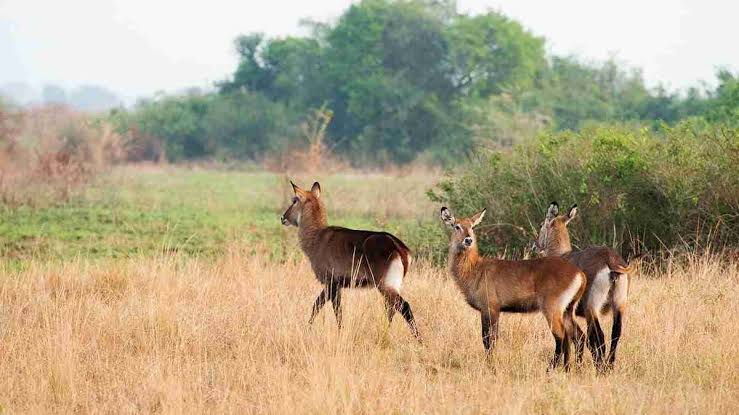
Savannah Birds of Murchison Falls National Park
Most visitors come to Murchison Falls for elephants, lions and the thundering gorge — and then discover that the open country north of the Nile holds some of Africa’s most rewarding savannah birding. Short-grass plains, whistling-thorn acacia and tall borassus palms roll across the northern bank of Uganda’s largest protected area, some 3,893 square kilometres bisected by the Victoria Nile. Turkey-sized ground hornbills stride through the dew, secretary birds hunt on stilt legs, bustards display over the grass and raptors quarter the thermals above palm crowns.
This guide focuses on those open-country birds — the species you tick on game drives across Buligi, the Albert and Pakuba tracks, and the riverine savanna fringing the Nile. Wetland and forest birds belong to separate habitats; the savannah community is what sets Murchison apart from Uganda’s hillier parks.
Why the northern savanna holds so many birds
The Victoria Nile divides Murchison into two contrasting banks. The southern sector is largely woodland and forest — productive for primates, but harder to scan from a vehicle. The northern bank is open savanna where Uganda kob, Nubian giraffe and buffalo graze in plain sight, and where birds are equally visible.
Uganda Wildlife Authority records 556 bird species across the park, with older checklists citing 451; the savannah belt accounts for a substantial share. Habitat mosaics within a single morning’s drive explain the richness: short-grass plains hold larks, pipits and bustards; scattered acacia supports silverbirds, barbets and weavers; borassus palm groves concentrate raptors and oxpeckers; and riverine thickets along the Victoria and Albert Nile add bee-eater colonies and lapwings at the savanna edge.
Large terrestrial birds — the savannah headliners
The Abyssinian ground hornbill is the park’s signature sound: a deep, booming call from a black, turkey-sized bird with a scarlet throat pouch, walking the grass in pairs and snapping up snakes and insects. It is one of the most reliable large birds on any good northern-bank morning.
Alongside it hunts the secretary bird, crested and long-legged, stamping prey through taller grass. Two bustards share the same plains: the larger Denham’s bustard, often striding across open ground, and the smaller black-bellied bustard, whose cork-popping display call carries far on still air. The grey crowned crane, Uganda’s national bird, favours wetter hollows and river margins. Helmeted guineafowl flush in noisy parties, and Heuglin’s spurfowl often startles drivers scanning only the horizon.
Raptors, bee-eaters and the acacia-palm belt
Lift your eyes from the grass and the savanna delivers a strong raptor cast. Bateleurs rock over the plains; martial and tawny eagles perch on the tallest crowns; black-chested snake eagles and dark chanting goshawks hunt from low acacia posts. Where lions have fed, Rüppell’s griffon, white-backed and lappet-faced vultures gather — often with marabou storks nearby. From roughly November to March, steppe eagles join as Palearctic migrants; the tiny pygmy falcon sits low in thorn trees on the Albert Track.
Borassus palms hold yellow-billed oxpeckers on grazing mammals, while piapiacs — glossy black corvids of the Sudan–Guinea savanna zone — follow buffalo and giraffe. Resident red-throated bee-eaters nest in sandy Nile banks near Nyamusika; from roughly July, the spectacular northern carmine bee-eater passes through. Lilac-breasted and Abyssinian rollers perch on open branches, and the silverbird — a rufous-and-grey flycatcher — is an acacia special worth ticking early.
Grassland birds — larks, cisticolas, weavers and lapwings
Below the headline species, the savanna supports a dense layer of smaller birds. Black-headed lapwings and African wattled lapwings work bare patches; red-capped larks, pipits and yellow-throated longclaws forage among grazing antelope. Rattling, winding and zitting cisticolas sing from grass tufts across Buligi. Speckle-fronted weavers, northern red bishops in breeding plumage and pin-tailed whydahs favour the same open country, while black-billed barbet and yellow-fronted tinkerbird call from scattered trees. The black-headed gonolek inhabits thicker riverine scrub where savanna meets water — part of the same morning’s drive, even if shoebill belongs to a separate wetland outing.
Where to see savannah birds — tracks and timings
All serious savannah birding happens on the northern bank, reached from Paraa by the daily ferry — typically 07:00 to 19:00 — or via western gates such as Tangi, near Pakwach on the Kampala–Arua road. The Buligi circuit is the backbone: interlinking tracks beginning roughly seven kilometres north of Paraa and stretching toward the Nile delta.
The Albert Track and western Pakuba sector extend the same community toward Tangi Gate and Pakuba Airstrip. Allow longer than the standard three-to-four-hour loop; go at first light when ground birds are active. The drier months — roughly December to February and June to September — keep tracks firm; the migrant window from November to April swells the list. See our birding calendar for month-by-month targets. A four-wheel-drive vehicle is essential year-round and non-negotiable after rain.
Frequently Asked Questions
- What are the most iconic savannah birds at Murchison Falls?
-
The Abyssinian ground hornbill, secretary bird, Denham’s and black-bellied bustards, grey crowned crane, and the raptors and bee-eaters of the acacia-palm belt. On a good morning across Buligi, most are realistic targets from the vehicle.
- Do I need to cross the Nile to see savannah birds?
-
Yes. The northern bank holds the open savanna; the southern sector is predominantly forest and woodland. Cross at Paraa ferry or enter via Tangi, Chobe or Wankwar gates on the north bank.
- When is the best time for savannah birding?
-
Early morning, year-round. Seasonally, November to April brings migrants; December and January combine firm tracks with peak activity.
- Can I combine savannah birding with a shoebill cruise?
-
Easily. Run a dawn game drive on Buligi, then join an afternoon delta cruise for wetland species — Murchison’s best single-day birding combination.
- How many bird species does the park hold overall?
-
Uganda Wildlife Authority records 556 species across all habitats. See our full bird checklist for the complete roll-call.
Plan Your Safari
Savannah birds reward slow drives, sharp-eyed guides and time on the northern bank at first light. Talk to us about an itinerary pairing Buligi and the Pakuba tracks with a Nile delta cruise, and we will build gates, season and lodge location around your target species. Start with our complete birding guide and browse Murchison Falls safari packages to shape a trip that gives the open country the mornings it deserves.