



Animal Tracks & Signs in Uganda
Long before you see the animal, the ground has already told its story. A lion crossed the Buligi track at dawn, an elephant herd pushed through the palm bush at midnight, a hippo hauled itself back to the Victoria Nile before first light — and every one of them left a record in the dust for anyone who knows how to read it.
Learning to spot tracks and signs turns a Uganda safari from a series of sightings into a running conversation with the bush. This guide covers the prints and spoor you will meet most often at Murchison Falls — lion, elephant, hippo and antelope — plus the dung, feeding damage and other clues that reveal what has passed through, and roughly how long ago.
Tracks, spoor and why they matter
Two words worth separating. A track is the footprint itself — the shape pressed into sand or mud. Spoor is the wider trail of evidence: droppings, flattened grass, broken branches, scratch marks, tufts of hair and scent. Together they build a picture of which animals are near, where they were heading and how recently they came through.
Freshness is the tracker’s first question. Sharp, clean edges and moist soil suggest a recent passage; crumbling rims, windblown grains and insect trails over the top mean hours or days have gone by. Early morning and late afternoon are the best times to read the ground, when a low sun throws long shadows into every depression — the same golden hours that make the northern-bank game drive so productive.
Lion: the round, clawless print
Lion tracks are broad, heavy and rounded, pressing deep into the soft soil of riverbeds and the sandy edges of the Buligi tracks. Look for four teardrop-shaped toe pads above a large three-lobed heel pad. The front paw is bigger than the hind and can measure up to around 14 centimetres across in a big male.
The tell that separates cat from dog or hyena is the claws: lions walk with theirs sheathed, so you see no claw marks ahead of the toes. Trackers also read the gait — a single lion walking with purpose leaves neat, evenly spaced prints in a near-straight line, while a pride fans out in overlapping trails. At Murchison the prides that hunt kob near the Queen’s and Albert junctions leave classic fresh spoor along the tracks at dawn.
Elephant: counting toes in the dust
Nothing else leaves a track like an elephant. The front feet stamp large, almost circular prints — up to 50 to 59 centimetres across — while the hind feet leave a slightly more oval mark. In good soil you can count the toenail impressions: five on the front foot, four on the back.
Even when the prints are faint, elephants advertise themselves through spoor. Watch for snapped branches, stripped bark and trampled foliage, and for the unmistakable dung — huge, fibrous boluses packed with undigested plant matter. Guides use that dung as a clock and a size guide: the more coarse, poorly digested material, the older the animal, and the warmer and moister the pile, the more recently the herd moved through. Around the Nile delta and the Buligi palm bush, big old bulls leave prints and dung along the same paths they have used for generations.
Hippo: flat feet and mown lawns
Hippo tracks are distinctive and, frankly, a track you want to read rather than meet. Each broad, flat foot leaves four rounded toes, with prints roughly 23 to 28 centimetres across and pressed deep by the animal’s enormous weight. You will find them on the muddy margins of the Victoria Nile and Lake Albert, where hippos leave the water to graze after dark.
The clearest hippo sign is not the footprint at all but the landscape. Look for well-worn trails running from the river inland, often twin ruts worn by their short legs, leading to patches of grass cropped so short they look mown. Piles of scattered dung — flicked about with the tail to mark territory — line these paths. On the Murchison boat cruise you see the animals themselves; walk the bank and it is the trails and grazing lawns that give them away.
Antelope: cloven hooves and communal middens
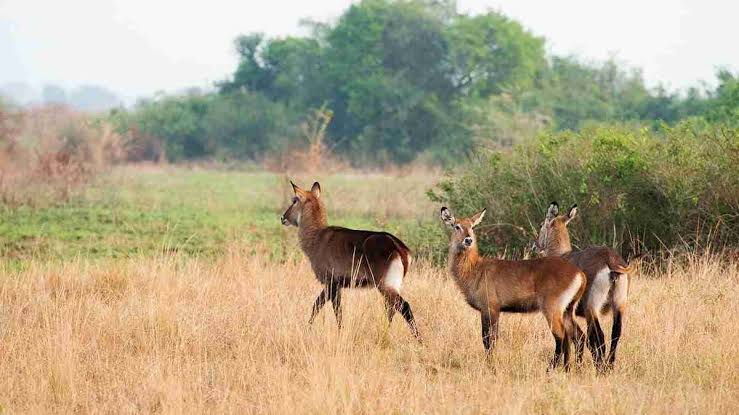
Antelope leave the most common tracks on any Murchison drive: narrow, cloven hooves that form a heart-shaped imprint, rounded at the back and tapering to a point in the direction of travel. Size sorts the species — a tiny sharp print belongs to an oribi, a broad splayed one to a waterbuck moving over soft ground near the river.
The park’s grasslands teem with Uganda kob, Jackson’s hartebeest, Defassa waterbuck, oribi and bushbuck, so their spoor is everywhere. Beyond hoof prints, watch for communal dung middens of small pellets that many antelope use to mark territory, grazed and matted grass, and horning marks where males have thrashed bushes with their horns. A sudden burst of deep, widely spaced prints in a zig-zag usually means something spooked the herd — often a predator not far off.
Reading dung and other signs
Dung is one of the most reliable signs because it stays put. Elephant droppings are vast and fibrous; lion and leopard scat is smaller, dark and full of hair and bone; antelope leave neat pellet piles; buffalo drop wet, cattle-like pats. Texture and moisture reveal how fresh it is and, with practice, hint at what the animal has eaten.
Then there is everything else: scratch marks where a leopard has sharpened its claws or a buffalo rubbed off mud, feathers snagged on thorns, flattened forms where an animal lay up for the night, and alarm calls from birds and monkeys that betray a predator. In the forests at Budongo, knuckle prints, night nests and discarded fruit reveal chimpanzees long before you hear them.
Frequently Asked Questions
- What is the difference between a track and spoor?
-
A track is the footprint itself, while spoor is the broader set of clues an animal leaves behind — dung, hair, broken branches, scratch marks and scent. Reading both together tells you far more than a print alone.
- How can I tell how fresh a track is?
-
Look at the edges and the soil. Crisp, sharp rims and moist ground mean the animal passed recently; crumbling edges, windblown grains and insect trails over the print mean hours or days have gone by.
- How do I know a lion print from a hyena or dog?
-
Cats retract their claws, so lion tracks show four rounded toe pads with no claw marks. Hyenas and wild dogs leave visible claw marks ahead of the toes and more oval-shaped prints.
- Can I track animals on foot at Murchison Falls?
-
Most tracking at Murchison happens from a vehicle on the northern tracks, but guided forest walks at Budongo and Kaniyo Pabidi let you read signs on foot. Always go with an experienced ranger or guide — never approach hippo, elephant or buffalo trails alone.
Plan Your Safari
The best way to learn to read the ground is beside a guide who has done it for years. Our safari packages pair early Buligi drives with trackers who spot the spoor you would miss, and you can weigh the plains against the water on our boat cruise versus game drive guide before you travel.