


Uganda Conservation Guide
Uganda punches well above its weight in African conservation. A country roughly the size of the United Kingdom holds more than half the world’s remaining mountain gorillas, the largest wild population of Nubian (Rothschild) giraffe, and some of the continent’s richest Albertine Rift forests — all within a protected-area network that covers about 16.1% of terrestrial land. That statistic, reported by the World Bank and UWA’s own State of Wildlife Resources Report 2026, represents decades of deliberate investment in rangers, habitat restoration and community partnerships.
This guide maps how Uganda’s conservation system works nationally: what UWA manages, where recovery has been measurable, where flagship species still face pressure, and how your park fees and permits fit into the picture. For Murchison-specific management detail, see our protected area management guide; for the organisations behind the work, read the guide to Uganda conservation organisations.
How Uganda’s Protected Areas Are Organised
The Uganda Wildlife Authority (UWA) was formed in 1996 when the Game Department merged with Uganda National Parks. Governed today by the Uganda Wildlife Act 2019, it manages 10 national parks, 12 wildlife reserves, 5 community wildlife management areas and 13 wildlife sanctuaries — 22 protected areas in the core national-park-and-reserve category, alongside dozens of smaller sites nationwide.
The ten national parks span every major biome: savannah at Murchison Falls and Queen Elizabeth; montane forest at Bwindi and Mgahinga; chimpanzee strongholds at Kibale and Semuliki; alpine zones on the Rwenzori and Mount Elgon; and remote Kidepo Valley on the South Sudan border. UWA employs roughly 2,054 field rangers to patrol more than 26,600 square kilometres of wildlife estate — a vast mandate for a single agency, which is why partnerships with NGOs such as the Uganda Conservation Foundation and Wildlife Conservation Society remain essential.
In the Albertine Graben — the oil-rich western rift where Murchison, Queen Elizabeth, Bwindi and seven other protected areas sit — wildlife conservation areas alone cover about 14.5% of land, with forest reserves adding another 7%. Ten of Uganda’s 22 core protected areas lie in this region, making it both the country’s biodiversity heartland and its most contested landscape for development.
Where Conservation Is Winning
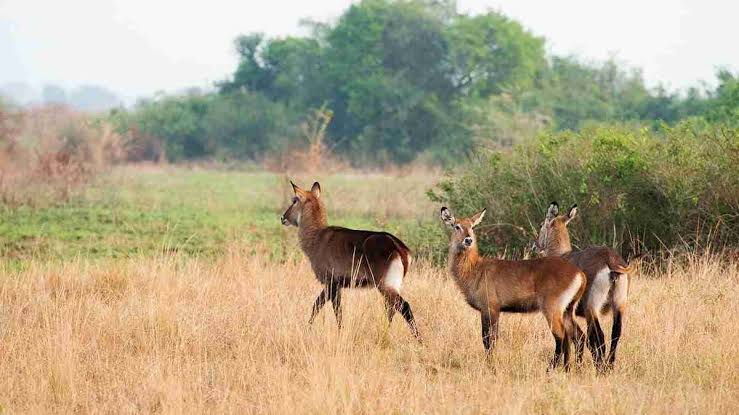
UWA’s State of Wildlife Resources Report 2026 documents measurable gains across several herbivore populations between 2021–2022 and 2023–2025. Buffalo rose from 32,235 to 41,548; hippopotamus from 8,226 to 9,026; Uganda kob from 166,526 to 175,109; and Nubian giraffe from 2,414 to 2,519 in monitored protected areas. Waterbuck, zebra, topi and common eland showed similar upward trends.
The mountain gorilla remains Uganda’s flagship success. Collaborative work by UWA, the International Gorilla Conservation Programme and range-state partners has lifted the global population from fewer than 600 individuals in the early 1990s to an estimated 1,063 by the 2019 census — the only great ape whose numbers are increasing. Uganda hosts more than half those animals across Bwindi Impenetrable National Park (331 km²) and Mgahinga Gorilla National Park, with 27 habituated gorilla families open to regulated trekking. The IUCN downgraded mountain gorillas from Critically Endangered to Endangered in 2018; a new Bwindi–Sarambwe census launched in 2025 will update the count.
At Murchison Falls National Park, giraffe recovery is especially visible. Giraffe Conservation Foundation surveys estimate roughly 2,250 individuals in the park — the world’s largest wild Nubian giraffe population, rebuilt from fewer than 200 in the 1970s. Chimpanzee numbers nationally are estimated at around 6,075, with nearly 1,500 in Kibale alone. Southern white rhinos, extinct in the wild since the 1980s, are returning: UWA translocated the first four animals from Ziwa Rhino Sanctuary to Ajai Wildlife Reserve in January 2026, opening a national programme targeting 20 rhinos at Ajai before wider releases to Kidepo and eventually Murchison.
Pressures That Keep Rangers Busy
Recovery is uneven. The same 2026 wildlife report shows elephant numbers in monitored protected areas falling from 6,621 to 6,352, and lions from 314 to 291 over the same period. Snaring, retaliatory killing after livestock losses, and habitat fragmentation all play a role. During the previous UWA strategic plan cycle, rangers conducted more than 114,000 anti-poaching patrols, recovering 156,823 poaching implements and arresting 11,597 suspects. At Murchison alone, partners have removed more than 34 metric tonnes of wire snares from the Albert Delta since 2018.
Human encroachment remains the wider threat. Around 79% of the Albertine Graben is under agriculture, settlement or miscellaneous use; forest loss around key blocks such as Bugoma and Budongo has accelerated since the 1980s. UWA cleared 13,625 hectares of invasive species and restored 3,825 hectares of degraded habitat during the last planning period, including Borassus palm removal that reopened up to 15,000 hectares of Murchison grassland for kob and giraffe. Electric fencing — 157 kilometres maintained nationally in 2024/25, including 53 km at Murchison — is a practical tool where elephants meet maize fields along park boundaries.
Oil development in the Lake Albert Basin adds a new layer. The Tilenga project inside Murchison targets commercial production from late 2025, with TotalEnergies restricting in-park infrastructure to eight well pads and a stated footprint below 0.03% of park surface area. Monthly biodiversity monitoring tracks elephants, lions and giraffe, but conservation groups and communities remain divided on whether mitigation can offset long-term disturbance along the Victoria Nile corridor.
Communities, Corridors and the Law
Conservation that ignores neighbours fails quickly. Section 65 of the Wildlife Act requires UWA to return 20% of park entry fees to districts bordering each protected area. In August 2024, six districts around Murchison received UGX 3.15 billion for schools, clinics and boreholes. Nationally, revenue-sharing disbursements in 2024/25 exceeded UGX 10.2 billion across Murchison, Queen Elizabeth, Kibale, Bwindi and Mgahinga. At Bwindi, an additional US$10 per gorilla permit reaches frontline parishes on top of the standard trekking fee.
Landscape connectivity matters as much as park boundaries. Chimpanzees in Budongo Forest, elephants crossing between Lake Albert and the rift floor, and forest birds moving through the Semliki Valley all depend on corridors outside formal reserves. Programmes such as ECOTRUST’s Bugoma–Budongo corridor restoration and REDD+ payment-for-ecosystem-services schemes pay smallholder farmers to retain forest strips that double as wildlife highways. Without them, interior populations risk becoming genetic islands.
Community tourism gives households a direct stake. Village walks with cooperatives near Murchison gates, cultural performances at Mubako, and UCOTA-registered projects across the country channel cash to people who live beside elephants and lions daily. Our community conservation guide covers how that model works on the ground.
Tourism Revenue and What You Pay
Tourism is UWA’s primary income engine. Government records show 267,623 tourist visits to wildlife protected areas in 2024/25, with conservation education reaching 283,593 learners at the Entebbe education centre. Under the UWA conservation tariff valid through June 2026, foreign non-resident adults pay US$45 per 24 hours at Murchison (Category A+), US$40 at Queen Elizabeth, Bwindi, Kibale, Kidepo and Lake Mburo (Category A), and US$35 at Rwenzori, Semuliki and Mount Elgon (Category C). Gorilla trekking permits cost US$800; chimpanzee tracking at Kibale is US$250.
Every ticket funds ranger salaries, patrol fuel, habitat work and the revenue-sharing pool. Choosing licensed operators, paying at official gates, and including conservation stops — Ziwa rhino tracking, Budongo chimps, a community walk — spreads benefit across multiple catchments on a single circuit. For practical ethics on the road, read our responsible safari guide.
Frequently Asked Questions
- How much of Uganda is protected?
-
About 16.1% of Uganda’s terrestrial area is under formal protected-area status, according to World Bank and UWA data. In the Albertine Graben, protected areas — including national parks, wildlife reserves and forest reserves — cover roughly 20.9% of land, though agriculture and settlement dominate the remainder.
- Which species have recovered most strongly?
-
Herbivores including buffalo, Uganda kob, hippo and Nubian giraffe show clear upward trends in UWA’s 2026 wildlife report. Mountain gorillas are the standout predator-prey success, with global numbers above 1,000. Southern white rhinos are being reintroduced after national extinction in the 1980s.
- Which species are still under pressure?
-
Elephants and lions in monitored protected areas declined between 2021–2022 and 2023–2025. Snaring, habitat loss, human-wildlife conflict and, in Murchison’s case, oil infrastructure development all contribute. Giraffe face wire-snare injuries and skin disease documented by ongoing GCF surveys.
- Where does my park entry fee go?
-
UWA retains the majority for operations and conservation programmes. By law, 20% of gate entry fees returns to districts bordering each protected area for community projects. Activity fees — game drives, launches, primate permits — are charged separately and also support management.
- Can tourism genuinely help Ugandan conservation?
-
Yes, when fees are paid through official channels. Park entry, gorilla permits and regulated activities fund rangers, anti-poaching patrols, habitat restoration and community revenue sharing. Over 267,000 protected-area visits in 2024/25 demonstrate the scale of that contribution.
Plan Your Safari
Uganda’s conservation story is written in ranger patrol data, giraffe survey counts, gorilla census results and the community projects funded by your gate receipt. Start with the savannah and Nile circuits at Murchison Falls National Park, add a rhino morning at Ziwa and a chimp trek in Budongo, then extend west to Bwindi or Queen Elizabeth to support multiple revenue-sharing catchments on one trip. Browse our Murchison Falls safari packages, explore conservation experiences, and read the future of Murchison Falls conservation for what lies ahead. Share your dates and we will build an itinerary that puts your visit behind the parks’ next chapter.