



Murchison Falls vs Kruger National Park
Murchison Falls National Park and Kruger National Park both belong on any serious Africa safari shortlist — open savannah, big game at close range and dawn light that justifies the early alarm. Yet they sit in different countries, run on different logistics, and reward travellers with genuinely different highlights. Choosing between them is less about ranking parks and more about matching the destination to how you want to travel.
This guide compares scale, wildlife, signature experiences, access, costs, crowds and the wider Uganda versus South Africa safari context. We operate in Murchison every week, so our perspective is grounded in Uganda — but the Kruger facts below come from SANParks data and published conservation figures.
Scale, Landscape and First Impressions
Kruger National Park covers roughly 19,623 square kilometres across Limpopo and Mpumalanga — about five times the area of Murchison Falls National Park, which UWA lists at 3,840 square kilometres. Kruger stretches some 360 kilometres north to south along the Mozambique border, with roughly 850 kilometres of tarred roads and thousands more kilometres of gravel tracks. You could spend two weeks driving its ecozones and still leave corners unexplored.
Murchison is defined by a single dramatic axis: the Victoria Nile running west for about 80 kilometres before the entire river is forced through a gorge barely six metres wide and drops 45 metres into the Devil’s Cauldron. North of the Nile, the Buligi Peninsula opens into Borassus-palm savannah; south of it, woodland thickens toward Budongo Forest and the rift escarpment. Where Kruger impresses with sheer breadth, Murchison delivers waterfall drama, riverine forest and open plains within a park you can know intimately in three or four days.
Wildlife: Big Five Completeness vs Uganda Specialists
Both parks hold lion, leopard, elephant and buffalo in serious numbers. The dividing line is the fifth Big Five member and the species you cannot swap between parks.
Kruger is a complete Big Five destination. SANParks records roughly 147 mammal species and more than 500 bird species. Elephant and buffalo each number well over 10,000; white rhino remain in the thousands despite ongoing poaching pressure. Lion counts sit around 1,600 to 1,700, with leopard, cheetah and African wild dog all present. For sheer density of large mammals on established roads, Kruger is hard to beat.
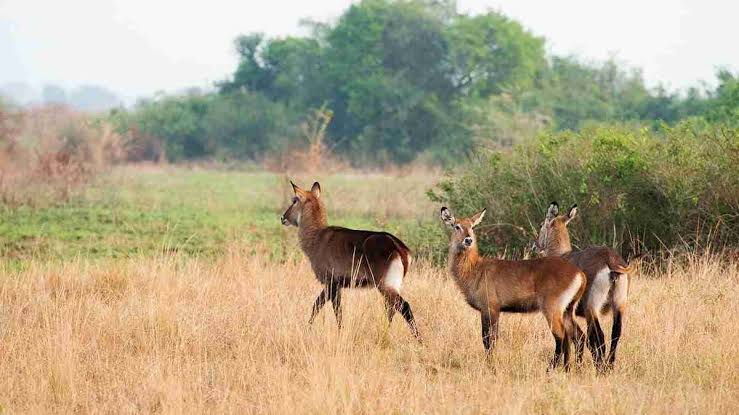
Murchison Falls National Park holds four of the Big Five inside the park gates. There are no wild rhino here; add them with a guided walk at Ziwa Rhino Sanctuary, roughly halfway between Kampala and Kichumbanyobo Gate. What Murchison offers instead is exclusivity: a global stronghold for the Nubian giraffe, with Giraffe Conservation Foundation surveys recording roughly 1,770 individuals in recent rounds — a major share of all wild Nubian giraffe on the continent. Buffalo exceed 10,000; Uganda kob herds run into the tens of thousands. UWA records more than 451 bird species, including shoebill stork in the Albert Delta papyrus — a bird Kruger simply does not produce.
For predator density and rhino on the same drive, Kruger wins. For giraffe in numbers, shoebill on the Nile and chimpanzees in Budongo Forest on the same itinerary, Murchison wins.
Signature Experiences and Safari Style
Murchison’s headline activity is the UWA launch cruise to the base of the falls — US$30 per person under the current tariff — running upstream from Paraa Jetty for roughly 17 kilometres past hippo pods, Nile crocodiles and elephants on the banks, ending at the thundering cascade. Boats typically depart at 09:00 and 14:00. Many visitors disembark below the falls and hike 45 to 60 minutes to the clifftop viewpoint (Top of the Falls fee US$10). Game drives concentrate on the northern Buligi circuit and require crossing the Nile at the Paraa ferry unless you enter via northern gates at Tangi, Wankwar or Chobe, or fly to Pakuba airstrip about 19 kilometres from Paraa. Optional chimpanzee tracking in Budongo Forest and delta shoebill cruises add further dimensions no Kruger itinerary replicates.
Kruger’s signature is its road network. SANParks maintains an extensive system of tar and gravel tracks, and self-drive is genuinely excellent — a standard sedan handles most tarred routes. Dawn loops around Satara, Skukuza or Olifants produce reliable Big Five sightings without leaving the public road system. Adjacent private reserves such as Sabi Sand add off-road tracking, night drives and luxury lodges, but the public Kruger experience alone justifies a week. Activity mix differs sharply: Kruger is overwhelmingly road-based; Murchison layers river cruises, waterfall hikes and primate trekking onto standard game drives.
Getting There, Logistics and Crowds
Kruger is remarkably accessible from South Africa’s main hubs. From Johannesburg, Paul Kruger Gate near Hazyview is about 442 kilometres — roughly five and a half hours by car — and Skukuza rest camp sits just 12 kilometres inside. Ten main entrance gates span the park; SANParks rest camps, shops and fuel points are well mapped. Charter flights reach Skukuza or Hoedspruit in under an hour.
Murchison demands more planning. Paraa, the main hub, sits about 305 kilometres from Kampala — typically four to five hours — or six to seven from Entebbe International Airport. Most southern approaches enter at Kichumbanyobo Gate, 16 kilometres north of Masindi, then run 86 kilometres through Budongo to the Nile. Unless your lodge sits on the northern bank or you fly to Pakuba, you cross the Victoria Nile by vehicle ferry on a fixed schedule — the 07:00 sailing matters if your game drives are on Buligi and your lodge is south of the river. Uganda safaris are overwhelmingly guided; a UWA ranger on Buligi and a driver who knows ferry timings turn logistics into sightings.
The crowd picture differs dramatically. Kruger welcomed a record 1,959,757 guests in the 2025/26 financial year — close to two million people in twelve months. Popular tarred loops between Crocodile Bridge, Lower Sabie and Skukuza can feel busy at peak holiday weekends. Murchison sees a fraction of that traffic. On a mid-week dawn drive along Buligi you might share a lion sighting with one other vehicle — or none at all.
Cost, Seasons and Uganda vs South Africa Context
For the tariff period 1 November 2025 to 31 October 2026, SANParks charges international visitors R602 per adult per day (children aged 2–11 pay R300) as Kruger’s conservation fee — activity-free, before accommodation, vehicle hire or private-guide costs. Under the UWA tariff valid through June 2026, Murchison sits in Category A+ at US$45 per foreign non-resident adult per 24 hours (children US$25), with launch cruises, ranger guides and chimp permits charged separately. Park entry alone is broadly comparable once you convert rand to dollars; the bigger cost difference sits in international flights, guided packages and whether you add gorilla trekking elsewhere in Uganda.
Seasons align more than you might expect. Kruger’s dry window from April to September thins vegetation and concentrates game. Murchison’s best windows are December to February and June to September — book peak dates three to six months ahead at either park. Kruger pairs naturally with Cape Town, the Garden Route or Victoria Falls; Murchison slots into Uganda’s primate-and-savannah loop with chimps in Kibale, gorillas in Bwindi and Queen Elizabeth’s tree-climbing lions. Many international visitors do both across separate trips rather than one marathon route — Johannesburg to Kruger is a different flight hub from Entebbe, and trying to combine them in a single holiday usually wastes days in transit.
When to Choose Which Park
Choose Kruger if you want the classic Big Five checklist on your own schedule, extensive self-drive infrastructure, rhino inside the park fence and the option to chain Kruger with Cape Town or the Garden Route in one South Africa trip. It is the right call for repeat safari-goers who know what they want and prefer tar roads to ferry timetables.
Choose Murchison if the waterfall, Nile boat cruise, Nubian giraffe herds, shoebill search and chimpanzee trekking matter as much as lion — or if you are building a wider Uganda itinerary. Murchison rewards travellers who accept guided logistics in exchange for lighter crowds and habitat variety. For a deeper head-to-head, see our Is Murchison Falls better than Kruger? guide.
Frequently Asked Questions
- Which park is better for a first safari?
-
Kruger is the classic first-safari choice for southern Africa — self-drive friendly, complete Big Five and decades of visitor infrastructure. Murchison suits travellers already centred on Uganda who want savannah, a waterfall cruise and easy links to primate tracking without adding a second country. Match the park to how you prefer to travel rather than chasing a universal winner.
- Can you see all of the Big Five at Murchison Falls?
-
Four species — lion, leopard, elephant and buffalo — live inside the park. Wild rhino require a stop at Ziwa Rhino Sanctuary on the Kampala–Masindi road. Most organised itineraries include Ziwa as a half-day walk, completing the Big Five over the course of the trip.
- Which park has better lion sightings?
-
Kruger holds far more lions across a vastly larger area, so statistically you encounter them more often — especially along river roads in the dry season. Murchison’s Buligi plains produce reliable lion sightings with a good ranger and an early start, but sightings are less predictable and the population is smaller.
- How do park fees compare?
-
Murchison charges US$45 per foreign non-resident adult per 24 hours under the current UWA tariff, plus separate activity fees for day game drives (US$30), the launch cruise (US$30) and other activities. Kruger charges R602 per international adult per day for November 2025 to October 2026, before accommodation and vehicle costs.
- Can you visit both parks on one trip?
-
Technically yes, but practically they belong to different countries and circuits. Flying Entebbe–Johannesburg takes roughly four hours, and each park deserves at least three full days inside the gates. Most travellers choose one per holiday.
Plan Your Safari
If Uganda is on your map, Murchison Falls delivers giraffe, the Nile falls and uncrowded Buligi game drives within reach of Kampala — and slots cleanly into a week that adds chimps, gorillas or Queen Elizabeth’s tree-climbing lions. Browse our Murchison Falls safaris, read the first-time visitors guide and cost breakdown, or tell us your dates and we will map gates, ferry timings and lodge side so your days follow the wildlife rather than fight the schedule.