



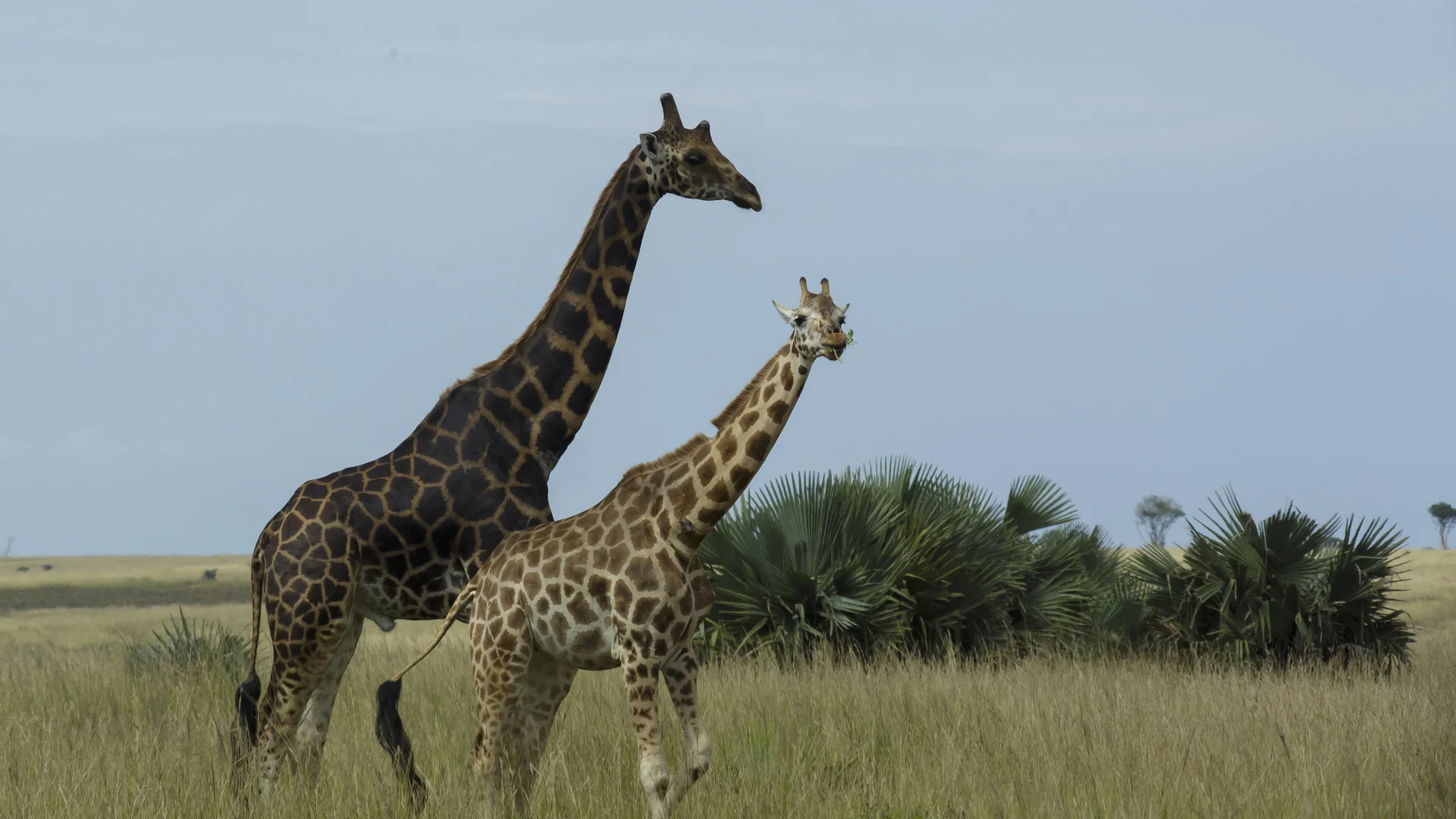
Murchison falls national park giraffe
Stand on the Buligi grasslands at first light and the horizon fills with necks. Herds of Nubian giraffe browse the acacia canopy in loose groups of ten, twenty, sometimes fifty — a sight most of Africa lost when giraffe numbers collapsed across the continent. Murchison Falls National Park is where that picture still holds, and it holds at a scale found nowhere else on Earth.
This guide covers the giraffe you will meet here — what subspecies they are, how their numbers recovered from near collapse, where on the park’s northern and southern banks to find them, what threatens them today, and how to plan a game drive that puts you among the herds with time to spare.
The Nubian giraffe of Murchison Falls
The tall animals browsing the Borassus palm savannah here were long called Rothschild’s giraffe, one of the rarest forms in Africa. DNA studies by the Giraffe Conservation Foundation and partners found Rothschild’s to be genetically identical to the Nubian giraffe (Giraffa camelopardalis camelopardalis), the nominate northern giraffe subspecies first described along the Nile. You will still hear both names in Uganda; they refer to the same herds.
Visually they are unmistakable — deep chestnut patches separated by clean cream lines, fading to white “stockings” on the lower legs as though the socks never quite reach the knee. Mature bulls stand around five to six metres at the horn tips and weigh roughly 1,200 kilograms; cows are smaller, typically near 850 kilograms. The subspecies is assessed as critically endangered globally, which makes Murchison’s thriving population one of the most important conservation assets on the continent.
How many giraffe live in the park?
The numbers tell a remarkable recovery story. In the 1970s, poaching and instability had reduced Murchison’s giraffe to fewer than 200 animals. Decades of UWA protection, reinforced by the GCF partnership from 2013, reversed that decline sharply.
Photographic road surveys — where every individual is identified by its unique spot pattern — put the park population at roughly 2,258 giraffe in the Round 18 and 19 counts of 2022–2023. The Uganda State of Giraffe report for 2023 rounds this to about 2,250 animals across the northern and southern banks combined, with roughly 400 calves recorded in that monitoring cycle. That makes Murchison home to the largest wild population of Nubian giraffe anywhere — close to half of every Nubian giraffe left in the wild.
Uganda as a whole held fewer than 300 Nubian giraffe in 2010, confined to Murchison and Kidepo Valley. Targeted translocations have since spread founder groups to Lake Mburo, Pian Upe Wildlife Reserve and the park’s own southern bank, yet the northern herds remain the engine of national recovery.
Where to see giraffe in Murchison Falls
Almost all classic giraffe viewing happens on the northern bank, where open savannah between the Victoria Nile and the Albert Nile supports enormous herds. The Buligi circuit — beginning about seven kilometres north of Paraa — is the heart of giraffe country. Work the Queen’s Track (roughly 13 kilometres), the Albert Track (around 11 kilometres along the Albert Nile) and the Victoria Track (about 17 kilometres toward the delta). Acacia woodland along these connectors holds browsing groups through the morning.
The Pakuba sector, reached from Pakuba Airstrip or the northern gates at Tangi and Chobe, puts you in the same giraffe-rich grassland without crossing the Nile. Elephants concentrate nearer the delta; giraffe spread across the central Buligi flats and the Albert Track fringes. See our Buligi game drive guide for junctions and loop options.
Guests based on the southern bank near Paraa need the Paraa ferry to reach the northern tracks. Crossings run on a fixed schedule from 07:00 through 19:00, so a serious giraffe drive means catching the first sailing or staying at a northern-bank lodge. Our Nile ferry guide covers timings in detail.
The southern bank: Operation Twiga
Historically, giraffe were absent from the southern bank — the Victoria Nile forms a natural barrier, and giraffe do not swim. That changed through Operation Twiga, a UWA and GCF initiative named after the Swahili word for giraffe.
In January 2016, 18 Nubian giraffe (13 females and five males) were captured on the northern plains, held briefly in a boma near Tangi Gate, then trucked across the Nile on the Paraa pontoon ferry to a release site on the southern bank. Operation Twiga II in August 2017 moved a further 19 animals. The goal was twofold: expand the subspecies’ range within the park and establish a satellite population away from the oil-development zone and snare pressure concentrated on the northern plains.
UWA’s most recent figures put the southern herd at around 45 giraffe, breeding successfully with calves born on the quieter wooded savannah south of the river. Sightings here are less predictable than on Buligi — the track network is sparser — but they reward patient drives through the southern game tracks near Paraa and toward Rabongo Forest.
Behaviour on the savannah
Giraffe in Murchison are diurnal browsers, feeding mainly on acacia leaves and whistling-thorn pods. A mature animal may consume close to 30 kilograms of browse in a day, and the park’s acacia–borassus mosaic gives them plenty to work through. Herds are loosely structured — cows and calves form nursery groups, while mature bulls wander between them or move alone.
They appear calm at a distance, but lions do take calves, particularly where tall grass near the delta gives cats cover. Giraffe defend themselves with powerful kicks; a direct blow to a predator’s skull can be fatal. At waterholes and Nile margins, crocodiles pose a rare but real risk when an animal spreads its front legs to drink. For visitors, the practical point is patience: a browsing group will often pause and watch your vehicle with equal curiosity if you keep engine noise low and maintain a respectful distance.
Conservation threats and ongoing monitoring
Large numbers do not mean the population is secure. GCF and UWA surveys in 2024 and 2025 identified two persistent health concerns: giraffe skin disease (GSD), observed in roughly 47% of individually catalogued animals, and snare wounds from wire traps set for bushmeat, affecting about 3.8% of surveyed giraffe. Snaring clusters most heavily in the western delta area, where human settlements and waterways give poachers easier access.
Oil infrastructure in the northern sector adds a longer-term habitat pressure that conservation planners monitor closely. The UWA–GCF mobile veterinary unit has de-snared hundreds of giraffe since 2019 — 77 in a single year to August 2023 alone — and 21 animals in Murchison carry GPS ear tags that feed movement data back to managers. Individual photographic monitoring, using pattern-recognition software to track every animal, underpins Uganda’s National Giraffe Conservation Strategy and Action Plan (2020–2030). For the community side of this work, see our community conservation guide.
Best time and tips for giraffe viewing
Giraffe are resident year-round, so there is no month when they disappear. That said, the dry seasons — roughly June to September and December to February — bring shorter grass, firmer murram tracks and wildlife drawn toward the Nile and shrinking water sources, which sharpens both visibility and photography.
Be on the northern tracks by 06:30, when gates open for game drives. Cool morning air keeps animals active, and side-light flatters those long necks against the horizon. Mid-morning on Buligi frequently produces the largest groupings before the heat pushes herds into scattered shade. A UWA ranger guide — currently around US$25 for a day drive — reads the terrain and knows which acacia belts held herds yesterday.
Bring binoculars and a lens of 300mm or more. Giraffe are among the easiest large mammals to photograph well: frame the whole animal against clean sky, shoot from a low angle through the vehicle window, and avoid crowding a nursery group — cows are protective and will move off if approached too closely.
Frequently Asked Questions
- Are there giraffes in Murchison Falls National Park?
-
Yes — large numbers of them. Murchison holds the world’s largest wild population of Nubian giraffe, estimated at roughly 2,250 animals across the northern and southern banks. Sightings on the Buligi game tracks are among the most reliable anywhere in Africa.
- Are Murchison’s giraffe Rothschild’s or Nubian?
-
Both names describe the same subspecies. Genetic research merged Rothschild’s giraffe into the Nubian giraffe (G. c. camelopardalis). Either term is still used locally and in older literature.
- Where is the best place to see giraffe in Murchison?
-
The northern Buligi circuit — the Queen’s, Albert and Victoria tracks — and the Pakuba sector. Fly-in guests landing at Pakuba Airstrip are already in prime giraffe country. Southern-bank drives can produce sightings but cover a smaller, less predictable range.
- How many giraffe were moved in Operation Twiga?
-
Thirty-seven in total: 18 in January 2016 and 19 in August 2017, all ferried across the Paraa pontoon from the northern bank to establish the southern satellite herd.
- What threatens giraffes in Murchison Falls?
-
Wire-snare poaching (especially near the western delta), giraffe skin disease, habitat pressure from oil development, and the risk of keeping the entire subspecies concentrated in one park. UWA and GCF run active de-snaring, veterinary and monitoring programmes in response.
- Can I see giraffe on a one-day visit?
-
A single morning on the northern Buligi tracks can deliver excellent sightings, but you need time for the Paraa ferry crossing if you are based on the southern bank. Two or three nights gives a comfortable margin for dawn drives and a Nile boat cruise between them.
Plan Your Safari
Watching Nubian giraffe by the dozen on Murchison’s open plains is one of Uganda’s defining wildlife experiences — and it pairs naturally with lions on the Buligi tracks, elephant herds toward the delta and the thunder of the falls themselves. Talk to us about a northern-sector itinerary timed for first light on the game tracks. Start with our Murchison Falls game drive guide, read how Murchison compares in our guide to Uganda’s giraffe parks, and browse our Murchison Falls safari packages to build the days around the herds you came to see.