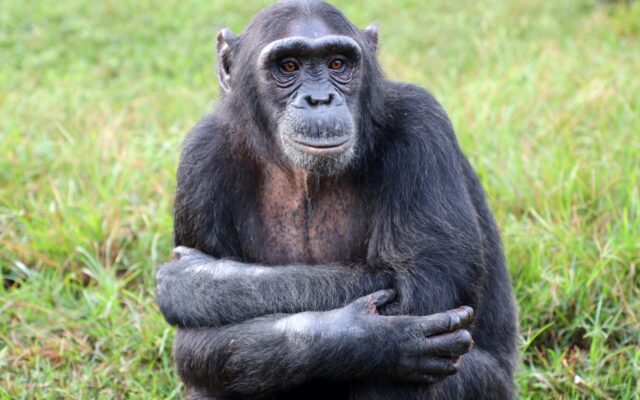
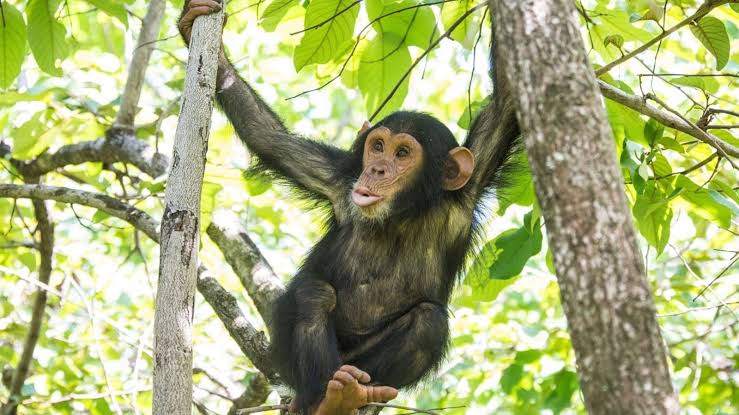
Uganda is home to roughly 5,000 wild chimpanzees distributed across forest patches from the Albertine Rift to the Nile corridor. Five locations offer habituated groups for visitor tracking; a sixth — Ngamba Island — provides sanctuary encounters for those who cannot meet wild-trek age or fitness requirements. Choosing the right forest shapes your route, budget and probability of a successful sighting.
This guide ranks and explains each chimpanzee trekking destination with current permit fees and honest encounter expectations.
1. Kibale Forest National Park — The Default Choice
Africa’s primate capital hosts the continent’s largest chimp population and the industry’s highest encounter rates — often above 90% in dry peak months. Thirteen species of primate occur in the park including red colobus, L’Hoest’s monkey and grey-cheeked mangabey.
Permit: US$250 foreign non-resident (US$200 low season).
Habituation experience: US$300 — full day with researchers from dawn.
Best paired with: Queen Elizabeth, Bwindi gorillas, Fort Portal crater lakes.
Multiple trekking groups depart each morning. Book peak season permits 3–6 months ahead. Bigodi Wetland Sanctuary adjacent to the park adds community-guided birding and primate walks.
2. Budongo Forest (Kaniyo Pabidi) — The Murchison Companion
On the southern edge of the Murchison Falls conservation area, Budongo’s mahogany forest offers excellent chimp trekking without detouring to Kibale. Kaniyo Pabidi sector is the visitor hub.
Permit: US$130 foreign non-resident.
Encounter rate: Good — operators report strong success, though Kibale remains the statistical leader.
Best paired with: Murchison Falls game drives and Nile boat cruises.
Ideal for 7–8 day northern safaris where adding Kibale would cost an extra 2–3 travel days south.
3. Kyambura Gorge — Queen Elizabeth’s Scenic Gamble
A 100-metre-deep gorge cutting through Queen Elizabeth National Park’s eastern savannah. Chimps here are habituated but range widely — encounter rates lower than Kibale or Budongo. The gorge itself is spectacular.
Permit: US$100 foreign non-resident.
Terrain: Steep descents, river crossings — most demanding chimp trek in Uganda.
Best paired with: Kazinga Channel boat, Ishasha tree-climbing lions.
4. Kalinzu Forest Reserve — Budget Alternative
Community-managed forest reserve bordering Queen Elizabeth. Growing reputation for reliable encounters at lower cost.
Permit: US$130 foreign non-resident.
Best paired with: Queen Elizabeth southern circuit, budget itineraries skipping Kibale permit premium.
5. Semuliki Wildlife Reserve
Remote western reserve with chimp trekking in gallery forest near the Congolese border. Low visitor numbers, specialist appeal. Permit fees align with UWA chimp tariff schedule for that sector — confirm current rate at booking.
Best paired with: Semuliki National Park (Congo biome birds), Fort Portal extensions for experienced safari travellers.
6. Ngamba Island Chimpanzee Sanctuary (Lake Victoria)
Not wild forest trekking — habituated orphaned chimps on a 100-acre island. Viewing from walkways and feeding platforms. No age 15 restriction like gorilla trekking; suitable for families with younger children.
Access: Boat from Entebbe — half or full day.
Best paired with: Arrival/departure days at Entebbe when wild trek fitness or age limits exclude family members.
How to Choose
Maximum encounter probability: Kibale.
Murchison combination: Budongo.
Lowest permit cost with Queen Elizabeth: Kyambura or Kalinzu.
Full-day researcher access: Kibale habituation only.
Families with under-12s: Ngamba Island.
General Trekking Notes
Morning departures — briefing at 07:00–08:00 typical. One hour near chimps once located. Maximum group size six visitors per chimp party at most sites. No eating near animals. Face masks may be required. Minimum age typically 12–15. Porter hire recommended on muddy trails. Waterproof boots essential year-round.
Chimp Trekking Seasons
June–September and December–February offer drier forest trails and reliable fruiting patterns that keep chimps within range. March–May and October–November bring mud and longer searches — but Kibale’s encounter rates remain strong because researchers know group territories intimately. Low-season chimp permits (US$200 at Kibale) make wet months financially attractive for budget travellers accepting trail difficulty.
Morning treks outperform afternoon attempts — chimps are active after nesting emergence and before midday heat. Habituation experiences start at dawn and follow groups until nesting — a fundamentally different rhythm from the standard two-to-four-hour morning trek.
Frequently Asked Questions
How does chimp trekking compare to gorilla trekking?
Chimps are faster, louder and more arboreal — harder to photograph but equally thrilling. Treks are generally shorter and less steep than Bwindi gorilla trails. Chimp permits cost less (US$250 vs US$800).
Can I trek chimps twice in one trip?
Yes — habituation day plus standard trek at Kibale, or Budongo plus Kibale for enthusiasts. Most itineraries include one chimp day.
What is the best month for chimp trekking?
June–September and December–February — drier trails, chimps nearer to trails. Wet months (April–May) remain productive at Kibale but mud increases difficulty.
Do chimps carry diseases dangerous to humans?
Yes — respiratory disease transmission works both ways. Do not trek if unwell. Follow ranger distance rules.
Chimpanzee trekking certificates and community craft purchases support local livelihoods around Kibale and Budongo — small costs that reinforce conservation incentives beyond permit revenue alone.
Are chimps dangerous?
Habituated chimps are accustomed to visitors but are powerful wild animals. Follow ranger instructions; never approach infants or challenge males displaying dominance.
Operator Selection
Chimp trekking quality depends partly on operator relationships with park rangers — established companies receive earlier briefings on group locations and fitness matching. Verify UTB licensing before payment. Ask about success rates honestly — no operator guarantees chimps, but Kibale’s statistics are industry benchmark. Porter inclusion, packed lunch provision and transport to trailhead should be confirmed in writing.
Plan Your Safari
We match chimp locations to your wider route — Murchison north, Queen Elizabeth central, or Kibale-focused primate circuits. Explore Uganda safaris and our gorilla and chimpanzee safari guide.