


Greater Murchison Conservation Area
Most safari brochures talk about Murchison Falls National Park as though it ends at the park boundary. It does not. Northwestern Uganda is stitched together by a much larger conservation landscape — the Greater Murchison Conservation Area — where open savannah, river corridor, escarpment woodland and one of East Africa’s last great mahogany forests function as a single ecological system. Understanding that wider picture helps you plan smarter: which gate to use, where chimps and shoebills fit in, and why buffer reserves matter even when they rarely appear on a standard itinerary.
This guide maps the Greater Murchison landscape: its legal boundaries, the three UWA-managed units that form the core, Budongo Forest’s role on the southern flank, and the conservation pressures shaping the region today. Pair it with our park overview and Murchison Falls travel guide for practical logistics.
What the Greater Murchison Conservation Area Covers
At its administrative heart sits the Murchison Falls Conservation Area (MFCA) — roughly 5,072 square kilometres managed collectively by the Uganda Wildlife Authority (UWA). That figure combines Murchison Falls National Park (about 3,840 km²) with the contiguous Bugungu and Karuma Wildlife Reserves. The Key Biodiversity Area boundary totals approximately 4,860 km² across the same three units.
Travellers and conservationists often use “Greater Murchison” to include Budongo Central Forest Reserve south of Bugungu — an additional 825 km² managed by the National Forestry Authority (NFA), not UWA. Together, park, reserves and forest span more than 6,200 km² between 650 and 1,290 metres above sea level. The Victoria Nile runs from Karuma Falls west to the Albert Delta at Lake Albert, linking habitats that share wildlife corridors and human pressure alike.
Murchison Falls National Park — The Core
Uganda’s oldest and largest national park anchors the system. Gazetted as a game reserve in 1926 and upgraded in 1952, it holds the falls — where the Nile forces through a gap about six metres wide and drops roughly 45 metres — plus the northern savannah of the Buligi Peninsula, southern woodland and the Ramsar-listed Albert Delta wetland (17,293 hectares, designated 2006).
UWA records 76 mammal species and more than 451 bird species in the park and adjoining Budongo. The northern plains support elephant, buffalo, lion, leopard and the world’s largest single population of Nubian (Rothschild’s) giraffe. The park has been a Lion Conservation Unit since 2005. Paraa, the main tourism hub, is reached via Kichumbanyobo Gate (16 km from Masindi), Bugungu and Mubako on the Buliisa road, or northern gates at Chobe, Wankwar and Tangi off the Kampala–Pakwach highway at Karuma.
Bugungu Wildlife Reserve
South-west of the park, at the foot of the Great Rift Valley escarpment, lies Bugungu Wildlife Reserve — approximately 473 km² gazetted in 1968. UWA manages it as IUCN Category III. Open savannah, seasonal wetlands and escarpment fringe buffer the core against settlement and oil infrastructure near Lake Albert.
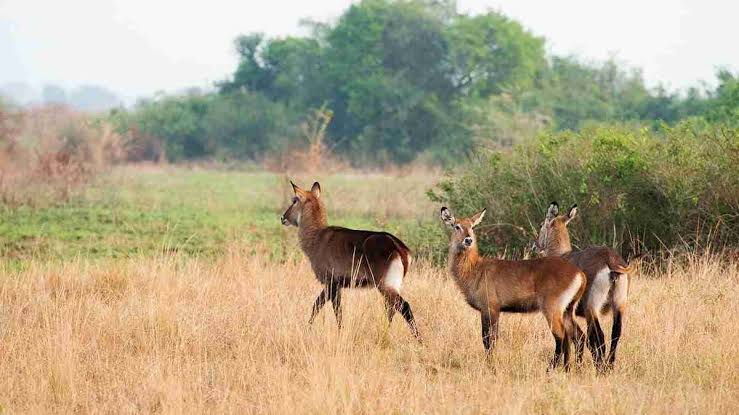
Wildlife includes Uganda kob, oribi, buffalo, hippo, leopard and lion. Most visitors encounter Bugungu indirectly — through Bugungu Gate on the Masindi–Buliisa route, landing at Bugungu Airstrip, or staying at south-bank lodges. Our Bugungu Wildlife Reserve guide covers what a dedicated visit can offer.
Karuma Wildlife Reserve
On the park’s north-eastern flank, Karuma Wildlife Reserve covers roughly 675 km² in Kiryandongo District. Established in 1964 as a buffer zone, it functions as a corridor where elephant, buffalo, giraffe and antelope move between Murchison and surrounding landscapes.
The reserve shares its name with Karuma Falls, beside the Kampala–Gulu highway about 260 km from Kampala. Uganda’s 600-megawatt Karuma Hydroelectric Power Station, commissioned in 2023, sits within the reserve under NEMA guidelines — a reminder of the tension between energy needs and corridor protection.
Budongo Forest Reserve
South of Bugungu, Budongo Central Forest Reserve is the forest anchor — 825 km² of moist semi-deciduous forest on the escarpment above Lake Albert, managed by the NFA. Six blocks hold an estimated 600 eastern chimpanzees, nine primate species, more than 360 bird species and giant mahogany trees reaching 60 metres. Kaniyo Pabidi, near Kichumbanyobo Gate, is the standard chimp-trekking sector; the Royal Mile at Busingiro is a world-class birding track.
Conservation runs through the Budongo Conservation Field Station (BCFS), established in 1990, whose snare-removal patrols and long-term chimp research have made Budongo one of Africa’s most intensively studied working forests. Wire snares and illegal logging remain serious threats. See our Budongo Forest guide and chimpanzee trekking guide for permit details.
Conservation Status and Current Challenges
The Greater Murchison landscape has recovered substantially since the poaching collapse of the 1970s and 1980s — elephant numbers rebuilt, giraffe translocations strengthened the south bank in 2016–17, and tourism now ranks among Uganda’s highest-volume wildlife destinations. UWA manages MFCA as one operational unit with shared patrols and gate infrastructure.
Pressure remains: oil exploration in the Albertine Rift, agricultural encroachment, snaring in Budongo, human–wildlife conflict and infrastructure such as Karuma dam all test corridor integrity. The Albert Delta Ramsar site and Lion Conservation Unit status reflect international recognition of what is at stake. Our ecosystem guide explains how savannah, river, forest and wetland interact day to day.
Frequently Asked Questions
- What is the difference between MFCA and the Greater Murchison Conservation Area?
-
MFCA is the official UWA-managed unit: Murchison Falls National Park plus Bugungu and Karuma Wildlife Reserves (roughly 5,072 km²). Greater Murchison typically includes Budongo Forest Reserve and the wider ecological connections between forest, escarpment and Nile corridor.
- Is Budongo Forest part of Murchison Falls National Park?
-
Partially. Kaniyo Pabidi lies within the national park and is accessed through Kichumbanyobo Gate. Most of Budongo Forest Reserve is a separate protected area under the NFA, though chimps and birds move freely between forest and park fringe.
- Do I need separate permits for Bugungu or Karuma reserves?
-
Standard UWA park entry covers MFCA when you enter through official gates. Chimp trekking in Budongo requires separate NFA or lodge-arranged permits. Confirm current fees with UWA before travel.
- Which gate is best for exploring the full conservation area?
-
Kichumbanyobo from Masindi suits combined savannah and Kaniyo Pabidi chimp treks. The Buliisa route via Bugungu Gate crosses escarpment scenery. Karuma on the Gulu highway suits northern-bank lodges. Allow at least three nights to sample more than one zone.
Plan Your Safari
The Greater Murchison Conservation Area rewards itineraries that cross habitats — a dawn drive on the Buligi savannah, a Nile boat to the falls or delta, and a morning with chimpanzees in Budongo paint a fuller picture than any single activity alone. Browse our Murchison Falls safaris or tell us your dates and wildlife priorities; we will build a route through the gates, reserves and forest sectors that match how this landscape actually works.