


Ecosystem of Murchison Falls National Park
Most visitors come to Murchison Falls for the waterfall — and rightly so. But the cascade is only the most visible piece of a much larger ecological puzzle. Spread across roughly 3,840 square kilometres at the northern tip of the Albertine Rift, the park stitches together savannah, river corridor, woodland, forest fringe and papyrus wetland into one of East Africa’s most varied protected landscapes. Lions on open plains, shoebills in the reeds and chimpanzees in mahogany trees can all be reached within a few hours — because the habitats sit side by side, linked by the Victoria Nile.
This guide maps those ecosystems: what grows where, which animals depend on each zone, and how the river connects them. Pair it with our Murchison Falls travel guide and park overview for practical planning.
Savannah Grasslands of the Northern Bank
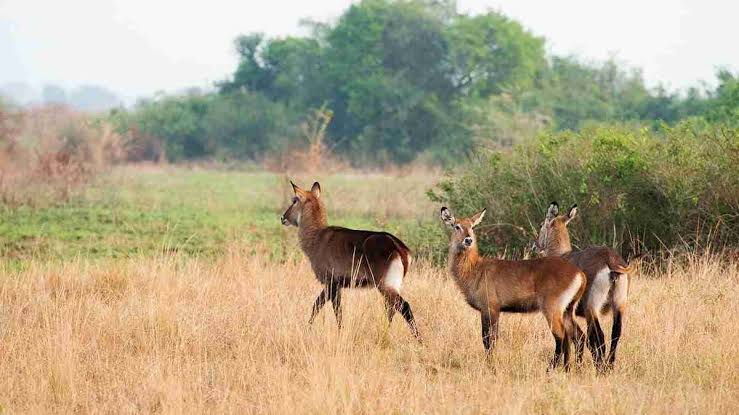
The park’s signature landscape lies north of the Nile, where the Bunyoro escarpment drops into rolling grassland dotted with borassus palms, whistling-thorn acacia and sausage trees. The Buligi Peninsula, between the Victoria and Albert Niles, is the heart of this zone — Uganda kob in herds of hundreds, Jackson’s hartebeest, oribi, buffalo and elephant moving between plains and river.
Lions patrol the tracks and leopards haunt thicker cover. The endangered Rothschild’s giraffe — now classified as Nubian giraffe — is at home here; recent surveys put the park population at well over 2,000 animals, the largest single population anywhere. Most northern game drives, including the Buligi routes, unfold across this savannah. In the dry seasons (December–February and June–September), wildlife concentrates near permanent water and viewing is at its best.
Riverine Forest Along the Victoria Nile
The Victoria Nile cuts the park east to west for about 115 kilometres. Its banks carry a strip of riverine forest — mahogany, figs and wild date palms — quite unlike the open savannah above. Below Murchison Falls the river slows to a channel roughly 200 metres wide, one of Uganda’s finest wildlife corridors. Hippos, Nile crocodiles, elephant, giraffe and bushbuck use the banks daily.
The Paraa boat cruise upstream passes this living gallery; downstream, the delta cruise explores reed-fringed channels. Riverine woodland around the ferry crossing supports hornbills and red-throated bee-eater colonies in sandy banks. See our boat cruise vs game drive comparison if you are weighing land against water.
Woodlands and Forest Patches
South of the Nile, woodland and bush dominate, with forest thickening on higher ground. Rabongo Forest offers a compact in-park experience; the vast Budongo Forest — East Africa’s largest remaining mahogany forest — forms the southern boundary. Budongo holds more than 600 chimpanzees, colobus monkeys and forest birds from the great blue turaco to Puvel’s illadopsis.
The Kaniyo Pabidi sector, reached through Kichumbanyobo Gate, lets you combine a chimp trek with savannah game on the same trip. Our Budongo Forest guide covers trekking and the Royal Mile birding track. These forests catch rainfall on the escarpment and supply fruit and shelter for species that spill onto the wooded southern bank.
Wetlands and the Albert Delta
Where the Victoria Nile meets Lake Albert, the river splits into channels through an extensive papyrus swamp — the Nile Delta, core of the 17,293-hectare Murchison Falls–Albert Delta Wetland System, a Ramsar site since 2006. Channels average around 130 metres wide; the water is shallow and nutrient-rich.
This is among Africa’s most reliable habitats for the shoebill, alongside Goliath herons, pelicans, darters, African skimmers and grey crowned cranes. The delta is a critical spawning ground for Lake Albert’s indigenous fish. In dry months it becomes a lifeline for savannah wildlife and a stopover for migratory birds. A downstream delta cruise from Paraa is the standard way in — see our guide to the best places to see shoebills.
76 Mammals and 450 Birds
UWA records 76 mammal species in the park and adjoining Budongo Forest Reserve, and more than 450 bird species. Four of the Big Five — lion, leopard, elephant and buffalo — roam the northern savannah and river corridors; rhino is absent, though you can track white rhino at Ziwa Rhino Sanctuary en route from Kampala. The park has been a Lion Conservation Unit since 2005.
Plains herbivores — kob, waterbuck, hartebeest, oribi and warthog — are daily sightings; hippos number in the thousands along the Nile. Bird diversity mirrors the habitats: ground hornbills and secretary birds on savannah, bee-eaters along the Nile, swamp specialists in papyrus, and hornbills and kingfishers in the forest. See our complete birding guide for route ideas.
How the Habitats Connect
What makes Murchison unusual is how the ecosystems overlap. The Nile is the spine: it waters the savannah, nourishes the delta, defines the riverine edge and separates the open north from the wooded south. Dry-season stress pulls wildlife back to the river — the pattern that makes game viewing predictable when water is scarce.
That connectivity creates vulnerability too. Oil development in the northern sector and expanding settlement on park boundaries press on the same corridors elephants and lions use. Thoughtful tourism — staying on designated tracks, choosing licensed operators, and allowing enough days to see more than one habitat — helps fund the protection that keeps all 76 mammals and 450 birds on the landscape.
Frequently Asked Questions
- What are the main ecosystems in Murchison Falls National Park?
-
Northern savannah grassland, Victoria Nile riverine forest, southern woodland and forest (Rabongo and Budongo), and the papyrus wetlands of the Albert Delta — a Ramsar site since 2006.
- How many animal species live in Murchison Falls?
-
Official records list 76 mammal species and more than 450 bird species, including lion, elephant, buffalo, leopard, Rothschild’s giraffe, hippo, Nile crocodile, chimpanzee and shoebill.
- Where is the best place to see shoebills in the park?
-
The Nile Delta where the Victoria Nile enters Lake Albert, explored on a downstream boat cruise from Paraa. Early morning trips through the papyrus channels offer the best chance.
- Why is the northern bank different from the southern bank?
-
The Victoria Nile divides them. The north is open savannah with most big game; the south is greener and wooded, closer to Budongo Forest and its chimpanzees and forest birds.
Plan Your Safari
Murchison rewards travellers who sample more than one ecosystem — a dawn drive on the Buligi savannah, a boat on the Nile and time in the delta or Budongo forest paints a fuller picture than any single activity. Browse our Murchison Falls safaris or speak to our team about a tailor-made itinerary matched to your wildlife priorities and travel dates.