


History of Conservation in Murchison Falls National Park
When elephants cross the Buligi Peninsula or a Rothschild’s giraffe browses beside the Victoria Nile, you are seeing the outcome of a century of protection — and a landscape that came within a generation of losing most of its large mammals. Murchison Falls National Park is Uganda’s oldest and largest conservation area, and its story runs from colonial game reserves through Idi Amin’s dictatorship to the rebuilding work of the Uganda Wildlife Authority today.
This guide traces that history from the 1926 gazetting of the Bunyoro and Gulu Wildlife Reserve through the park’s golden age, the poaching crisis of the 1970s and 1980s, and the recovery that has restored elephants, giraffe and buffalo across the Murchison Falls Conservation Area. For geography, species and practical visiting information, see our overview of Murchison Falls National Park.
From Sleeping Sickness to Game Reserve
Formal protection did not begin with tourism. Between 1907 and 1912, colonial authorities evacuated roughly 13,000 square kilometres of northwest Uganda as sleeping sickness spread through tsetse belts. In 1910 the Bunyoro Game Reserve was created south of the River Nile; boundaries expanded north into Gulu District in 1928, and the combined area was formally gazetted in 1926 as the Bunyoro and Gulu Wildlife Reserve.
Four decades of reduced hunting allowed wildlife to rebuild. When Uganda passed its National Parks Act in 1952, the reserve became Murchison Falls National Park, alongside Queen Elizabeth as one of the country’s first two national parks. Today the 3,840-square-kilometre park is managed with Bugungu and Karuma Wildlife Reserves as the 5,072-square-kilometre Murchison Falls Conservation Area.
The Golden Age and Its Collapse
By the mid-1960s, Murchison was East Africa’s premier safari destination, drawing more than 60,000 visitors a year. Churchill, Roosevelt and Hemingway all passed through; the 1951 film The African Queen was shot on Lake Albert and the Nile below the falls. Elephants numbered in the thousands on both banks; buffalo herds ran to tens of thousands; black and northern white rhino still ranged the plains.
Everything changed with the military coup of 1971. Under Idi Amin, tourism collapsed and law enforcement broke down. In 1972 the park was unofficially renamed Kabalega National Park after Omukama Chwa II Kabalega of Bunyoro — the falls became Kabalega Falls. The renaming was never formally promulgated, but the name persists locally. After Amin’s fall in 1979, the Murchison name returned.
High-ranking officials sponsored commercial poaching for ivory and bushmeat. Soldiers flew over the park in helicopters, shooting elephants for food and target practice. WWF aerial surveys in 1980 and 1981 found catastrophic declines: only about 1,200 elephants remained north of the Nile from a 1973 population of roughly 5,000, while south of the river just 160 survived from an estimated 9,000. The Nile crossing at Paraa became a flashpoint as armed groups used the park as cover. Rangers went unpaid, infrastructure was looted, and wildlife populations fell by an estimated 90%. Rhinos were poached to local extinction by around 1983. Visitor numbers collapsed from 60,000 in the 1960s to roughly 2,000 by 1999.
Wildlife Loss and Ecological Aftershocks
UWA management records illustrate the scale of collapse. Pre-1973 elephant numbers of about 12,000 fell to 1,420 by 1980 and just 300 by 1991. Buffalo dropped from 30,000 to 1,600; hippo from 12,000 to around 1,200; giraffe from 150–200 to roughly 80. Research by Iain Douglas-Hamilton documented an even sharper fall south of the Nile, where elephants declined from 9,364 in 1971 to fewer than 200 by 1976.
The ecological consequences outlasted the poaching. Woodland cover that had shrunk to 18% of the park later expanded to as much as 75% as elephant numbers fell — a shift park managers still weigh when setting population targets.
Recovery Under the Uganda Wildlife Authority
Stabilisation began in the late 1980s as Uganda restored order and reactivated anti-poaching patrols. International support from WWF, the Frankfurt Zoological Society and National Geographic filled a critical gap. The Uganda Wildlife Authority (UWA) was established in 1996 as a semi-autonomous agency managing national parks nationwide, with Murchison as a flagship site.
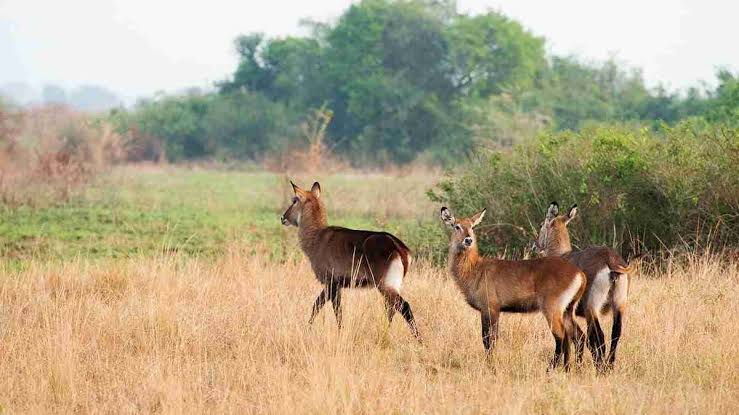
Aerial surveys in March 2010 confirmed steady recovery: elephant, buffalo, giraffe, hartebeest and waterbuck were all trending upward. The park was recognised as a Lion Conservation Unit in 2005. Rothschild’s giraffe recovered from a low of around 250 in 2010 to roughly 1,500, with 37 individuals translocated from the north bank to the south in 2016 and 2017.
Modern threats differ from the 1970s but remain serious — wire snaring for bushmeat, human-wildlife conflict and illegal fishing on the Nile delta. The Uganda Conservation Foundation, partnering with UWA since 2011, has built marine patrol stations, removed tens of thousands of snares and trained community ecoguards.
Conservation Today and What Visitors Support
Today’s park is a working recovery story. Tourism revenue feeds UWA budgets and local employment, while the Ziwa Rhino Sanctuary breeding programme — a UWA partnership from 2005 — has rebuilt a herd from six animals to more than 30 southern white rhino, with reintroduction planned as numbers allow. For how habitats function today, see our guide to the ecosystem of Murchison Falls.
Frequently Asked Questions
- When was Murchison Falls first protected?
-
The Bunyoro Game Reserve was created south of the Nile in 1910. The area was gazetted as the Bunyoro and Gulu Wildlife Reserve in 1926 and became a national park in 1952 under Uganda’s National Parks Act.
- Why was the park renamed Kabalega National Park?
-
During Idi Amin’s rule in the 1970s, the park and falls were unofficially renamed after Omukama Kabalega of Bunyoro. The change was never legally formalised, and the Murchison name was restored after Amin’s fall, though Kabalega is still used locally.
- What happened to rhinos in Murchison Falls?
-
Both black and northern white rhino were poached to local extinction by the early 1980s. A captive breeding programme at Ziwa Rhino Sanctuary is preparing for future reintroduction.
- Who manages Murchison Falls National Park today?
-
The Uganda Wildlife Authority (UWA), established in 1996, manages the park with Bugungu and Karuma Wildlife Reserves as the Murchison Falls Conservation Area. Partners including the Uganda Conservation Foundation support anti-poaching and community programmes.
- Has wildlife really recovered since the 1980s?
-
Yes. UWA aerial surveys show elephant, buffalo and giraffe populations rebuilding and tourism rising from around 2,000 visitors per year in 1999. Snaring and human-wildlife conflict remain ongoing threats.
Plan Your Safari
A safari here supports the conservation work that rebuilt this park from one of Africa’s darkest chapters. Browse our Murchison Falls safaris, read the full travel guide for gates, lodges and activities, or speak to our team about an itinerary that includes game drives, the Nile boat cruise and time on the falls trail.