



Murchison Falls vs Queen Elizabeth National Park
Ask two safari travellers whether Murchison Falls or Queen Elizabeth National Park is the better park and you will hear two confident answers — often from people who have only visited one. Both are flagship Ugandan savannah reserves, both hold four of the Big Five, and both end with a boat cruise that ranks among East Africa’s finest. Neither is objectively superior; they excel at different things.
We run trips through Murchison Falls and send plenty of guests on to Queen Elizabeth, so this is an honest head-to-head rather than a pitch for one park. Below we compare the waterfall versus the Kazinga Channel, the species you can see nowhere else, access from Entebbe, UWA fees and how the two parks fit into a combined Uganda itinerary.
Scale and Scenery: Nile Drama vs Rift Valley Variety
Murchison Falls National Park is Uganda’s largest protected area at roughly 3,840 square kilometres — gazetted as a game reserve in 1926 and upgraded to a national park in 1952. The Victoria Nile races west through the park for about 80 kilometres before forcing through a gorge just six metres wide and plunging 45 metres into the Devil’s Cauldron. North of the river at Paraa, the Buligi Peninsula opens into wide Borassus-palm savannah where you can scan for game across open plains.
Queen Elizabeth National Park covers 1,978 square kilometres beneath the Rwenzori Mountains — nearly half Murchison’s size but far richer in habitat shifts. Within a single morning you can move from explosion crater lakes to papyrus wetlands, open Kasenyi grassland and the sunken rainforest of Kyambura Gorge. The scenery changes every thirty minutes, which photographers and birders often prefer to Murchison’s more uniform northern plains.
If your bucket list centres on a waterfall you can feel in your chest and wide savannah horizons, Murchison wins on drama. If you want a park that feels like several landscapes stitched together, Queen Elizabeth is the stronger draw.
Wildlife: Giraffes, Tree-Climbing Lions and the Deciding Exclusives
Both parks hold lion, leopard, elephant and buffalo, so the comparison usually turns on what occurs in one park and not the other.
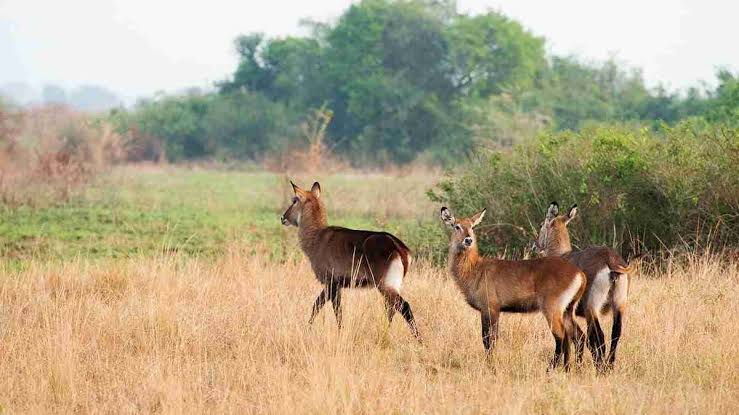
Murchison is the world’s stronghold for the Nubian giraffe — long known as Rothschild’s giraffe. Giraffe Conservation Foundation surveys put the Ugandan population at over 2,400 individuals, with roughly 2,250 on Murchison’s northern bank alone. There are no giraffes anywhere in Queen Elizabeth; geographical barriers have kept them out of the western Rift entirely. Murchison also delivers shoebill stork in the Albert Delta swamps among UWA’s recorded 76 mammal species and more than 451 bird species.
Queen Elizabeth answers with 95 mammal species and more than 600 bird species — one of Africa’s richest birding tallies in a compact area. Its headline exclusive is the tree-climbing lions of the southern Ishasha sector, draped over fig branches during warmer afternoon hours — behaviour documented in only a handful of places worldwide, alongside Tanzania’s Lake Manyara. Kasenyi Plains produce reliable lion and Uganda kob sightings, and leopard occur with reasonable frequency around the Mweya peninsula. For sheer species diversity per square kilometre, Queen Elizabeth has the edge; for giraffes and shoebill, Murchison is the only option in Uganda’s west.
The Boat Cruise: Nile Climax vs Kazinga Density
Each park’s signature activity happens on the water, and they deliver different rewards. Murchison’s UWA launch trip departs Paraa Jetty at 09:00 and 14:00, running roughly 17 kilometres upstream along the Victoria Nile to the base of the falls — a two- to three-hour round trip past hippo pods, Nile crocodiles and elephants at the bank before the gorge narrows to its climax. A separate Albert Delta cruise targets shoebill among papyrus channels. Under the UWA tariff valid July 2024–June 2026, the launch costs US$30 per person, with a Top of the Falls hike at US$15.
Queen Elizabeth’s Kazinga Channel cruise links Lakes George and Edward along a 40-kilometre waterway where hippos, crocodiles, elephants and buffalo crowd the shallows almost continuously. UWA boats depart from Mweya at 09:00, 11:00, 14:00 and 16:00, also at US$30. For guaranteed close-up density — hippos packed shoulder to shoulder, elephants drinking within metres of the hull — Kazinga is hard to beat anywhere in East Africa. Murchison’s Nile cruise is more cinematic, building to a genuine waterfall climax; Queen Elizabeth’s channel is about volume and proximity.
Chimps, Rhinos and What Each Park Adds to a Circuit
Both parks pair with chimpanzee tracking, but the settings differ. From Murchison, habituated groups in Kaniyo Pabidi within Budongo Forest sit right on the Masindi access road — a practical add-on before or after game drives. Queen Elizabeth offers chimps in the dramatic Kyambura Gorge — the Valley of Apes — and nearby Kalinzu Forest; the gorge walk is stunning, though sighting success depends more on troop movements than at Budongo.
Murchison holds one logistical advantage Queen Elizabeth cannot match: the drive north passes Ziwa Rhino Sanctuary, where guided on-foot tracking completes the Big Five over the course of a single trip. Queen Elizabeth’s trump card is geography — it sits on the doorstep of Bwindi’s mountain gorillas and slots naturally into the standard western primate circuit through Kibale and Fort Portal. If gorillas are your main goal, Queen Elizabeth is the more efficient savannah stopover; if you want a northern anchor with giraffes, the falls and rhino tracking en route, Murchison fits better.
Access, Crowds and What You Will Pay
Murchison is the quicker escape from Entebbe: roughly 305 kilometres and five to six hours via Masindi and Kichumbanyobo Gate, then the Paraa ferry between 07:00 and 19:00 for lodges on the northern bank. Aerolink Uganda flies to Pakuba and Chobe airstrips in under 90 minutes if you prefer to skip the road. Queen Elizabeth sits roughly 375 to 400 kilometres south-west of Kampala — typically six to seven hours via Mbarara, entering at Katunguru or Kasenyi, with charter flights to Mweya airstrip cutting transfer time sharply.
Queen Elizabeth generally sees more vehicles, particularly around the Mweya peninsula and Kasenyi on peak-season mornings. Murchison’s northern Buligi circuits still feel refreshingly uncrowded even in July and August. Under the current UWA tariff, foreign non-resident adults pay US$45 per 24 hours at Murchison and US$40 at Queen Elizabeth; ranger-led day game drives cost around US$25 to US$30 at both parks. The fee difference is modest — the bigger cost variable is lodge tier and whether you fly a leg or drive the full Hoima–Fort Portal corridor between the two parks, roughly 336 to 435 kilometres and six to eight hours.
So Is Murchison Falls Better Than Queen Elizabeth?
For most first-time Uganda visitors with a week or less who want a single savannah park, Murchison is the stronger choice — closer to Entebbe, the giraffe stronghold, a waterfall-and-river combination unmatched in the country, and the Big Five within reach via Ziwa. A focused three-night Murchison trip with game drives, the Nile launch and a falls hike is one of Uganda’s most complete short safaris.
Queen Elizabeth is better if tree-climbing lions in Ishasha, Kazinga Channel density, 600-plus bird species or a gorilla add-on in Bwindi top your list — and you accept slightly busier game-drive circuits. Seasoned birders and photographers who value habitat variety often rank Queen Elizabeth as Uganda’s most rewarding compact park. Neither replaces the other; the ideal answer for travellers with eight or more days is often both, linked by the Hoima–Fort Portal corridor in a single week. See our Murchison and Queen Elizabeth safari guide for day-by-day routing.
Frequently Asked Questions
- Is Murchison Falls better than Queen Elizabeth for a first safari?
-
For most first-timers, yes — Murchison offers shorter access from Entebbe, dense game on the northern plains, the unforgettable falls cruise and rhino tracking at Ziwa on the drive north. Choose Queen Elizabeth first if tree-climbing lions, exceptional birding or a gorilla extension is your priority.
- Which park has giraffes?
-
Only Murchison Falls. Queen Elizabeth has no giraffes. Murchison holds the world’s largest wild population of Nubian giraffe, numbering well over 2,000 animals on the northern bank.
- Where are the tree-climbing lions?
-
Only in the Ishasha sector of Queen Elizabeth National Park, roughly two to three hours’ drive south of Mweya. Murchison’s lions behave like typical savannah cats and stay on the ground.
- Which park has the better boat trip?
-
Different strengths. Murchison’s Nile cruise builds to the base of the falls — dramatic and scenic. Queen Elizabeth’s Kazinga Channel offers unrivalled density of hippos, crocodiles and elephants along the banks at close range.
- Can you visit both parks on one trip?
-
Yes — plan at least six to eight days with two nights at each park and a full transfer day between them. The road via Hoima and Fort Portal runs six to eight hours; an internal flight via Entebbe saves a day. Rushing both into four nights leaves too little time on the tracks.
Plan Your Safari
Still weighing the two? Tell us your dates, interests and budget and we will build the route around them — a focused Murchison Falls safari for giraffes, shoebill and the falls, a wildlife-rich Queen Elizabeth safari for tree-climbing lions and the Kazinga Channel, or a combined Murchison and Queen Elizabeth itinerary that links both without the rush. Browse our Murchison Falls safari packages and the full Murchison Falls National Park overview to start planning.