



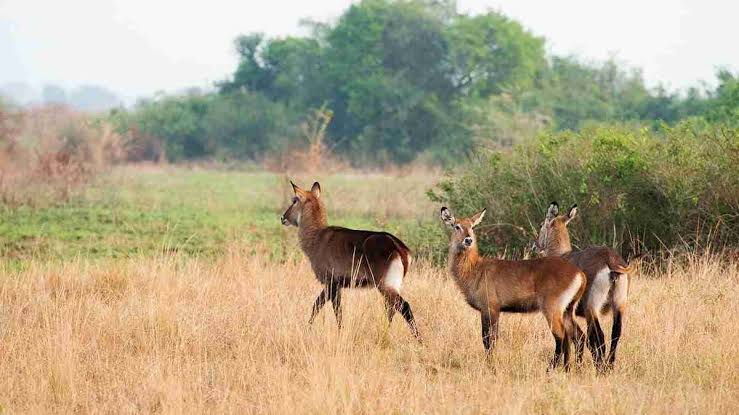
Best Camera Settings for African Safaris
The difference between a keeper and a blurry near-miss on safari almost always comes down to settings you chose seconds before the moment arrived. A lion stretching in first light, a fish eagle folding into a dive, an elephant crossing a dusty track — Uganda hands you these scenes on its own schedule, and the camera has to be ready before your brain catches up.
This guide covers the practical settings that work in Murchison Falls and across Uganda: shutter speed for moving animals, ISO in changing light, aperture, exposure compensation, and the real differences between shooting from a boat and from a vehicle. The numbers are starting points tuned for equatorial light and the way game actually behaves on the Nile.
Start in manual mode with Auto ISO
The single most useful setup for safari is manual mode with Auto ISO. You lock in the two settings that decide whether an image is sharp — shutter speed and aperture — and let the camera float ISO to handle Uganda’s fast-shifting light. It is the quickest way to keep creative control without chasing exposure every time a cloud crosses the sun or you swing from open savannah into acacia shade.
Set an Auto ISO ceiling your camera can live with: around ISO 6400 for older or crop-sensor bodies, and 12800 or higher for current full-frame mirrorless. Where the option exists, set a minimum shutter speed so the camera never drops below your motion-freezing threshold. And shoot RAW — the latitude to rescue highlights on a backlit hippo or lift shadow detail from a leopard in dappled shade is worth every extra gigabyte.
Shutter speed: the setting that matters most
Shutter speed is where safaris are won or lost. It has to beat both the animal’s movement and, on a boat or bumpy track, your own. Match it to the action rather than picking one number and hoping.
Use roughly 1/500s for resting or stationary animals — a dozing lion, a giraffe pausing to look at you. Step up to 1/1000s for walking or slow-moving mammals such as elephants ambling to the river. For running predators, fleeing antelope or any sudden action, reach for 1/1600s to 1/2000s. Birds demand more still: 1/2000s for large gliders like fish eagles and herons, and 1/2500s to 1/4000s for small, fast fliers such as bee-eaters and kingfishers snatching prey.
The honest rule: when in doubt, go faster. Once you have the safe shot, experiment — dropping to 1/30s to 1/125s for a deliberate panning shot that streaks the background while a running animal stays sharp conveys motion no frozen frame can.
Aperture and ISO: sharpness versus light
For most wildlife, f/5.6 to f/8 is the sweet spot — sharp across the subject, and the range where most telephoto zooms perform best. Open up to f/4 or wider when you want to isolate a single animal against a soft background, or when light is fading and you need every photon you can gather. Stop down toward f/8 for a herd, a group of giraffes, or when you want the environment sharp behind the subject.
Treat ISO as the price you pay for the shutter speed and aperture you need, not a number to protect. Uganda’s first hour of light often forces ISO 1600 to 3200; midday sun drops you to 200 or lower. Modern AI noise-reduction tools handle high-ISO grain remarkably well, so the best ISO is simply the one that lets you hit your target shutter speed in the light you have.
Exposure compensation for tricky light
With Auto ISO doing the exposure work, exposure compensation becomes your brightness dial. Uganda throws two classic traps at you. Bright, hazy skies and pale grass fool the meter into underexposing, so dial in +0.3 to +1 stop to keep detail in a giraffe’s coat or a light-skinned buffalo. Conversely, a dark subject against water sparkle or bright sky — a hippo, a silhouetted elephant — may need -0.3 to -1 stop to protect the highlights.
Watch the histogram rather than the rear screen, which lies in bright African sunlight. Push exposure to the right without clipping the highlights, and you will pull cleaner shadows and less noise out of every RAW file.
Boat versus land: two different approaches
The boat cruise and the game drive ask for different setups, and knowing the difference before you board saves missed shots.
On a game drive, the vehicle is your hide. A beanbag over a lowered window steadies a long lens better than any handheld grip, and asking your guide to cut the engine kills the vibration that softens frames. You can afford slightly slower shutter speeds from this stable base, and the classic Buligi tracks reward those who wait for the head to turn.
On the Nile boat cruise, everything changes. The deck pitches, the engine hums, and tripods are useless — so shoot handheld and raise your shutter speed to a minimum of 1/1600s to counter both the boat’s movement and your subject’s. Keep image stabilisation on to tame the micro-shake, brace elbows against your body, and burst in short bursts rather than single frames so at least one lands sharp between swells. When you reach the shoebills of the Nile delta, ask the guide to cut the engine and let the boat drift — a still platform transforms your hit rate.
Autofocus, timing and light
Set autofocus to continuous (AF-C / AI Servo) with animal or bird eye-detection enabled if your camera has it, and keep the drive mode on high-speed burst. Focus on the eye; a razor-sharp eye carries an image even when the rest softens.
Light dictates timing more than any setting. The first and last two hours of the day give the low, warm light that flatters wildlife and the Nile alike; midday sun is harsh but useful for shaded riverbank birds and the sparkle of the falls. For the best conditions overall, plan around the drier months — see our best time to visit guide for timing.
Frequently Asked Questions
- What shutter speed should I use for moving animals?
-
Use around 1/1000s for walking mammals like elephants, and 1/1600s to 1/2000s for running predators or fleeing antelope. For birds in flight, push to 1/2000s for large gliders and up to 1/4000s for small, fast fliers.
- What ISO is best on safari?
-
Use Auto ISO with a sensible ceiling — roughly 6400 on older bodies, higher on modern full-frame. The right ISO is whatever lets you keep your target shutter speed; a sharp, slightly noisy frame beats a clean, blurred one.
- Why do I need a faster shutter speed on the boat?
-
The boat’s rocking and engine vibration add movement on top of your subject’s, so a minimum of 1/1600s and image stabilisation help keep frames sharp. Ask the guide to cut the engine for still subjects like the shoebill.
- What aperture should I shoot at?
-
f/5.6 to f/8 suits most wildlife and is where telephoto zooms are sharpest. Open to f/4 or wider to isolate a single animal or gather light at dawn and dusk.
- Do I need a tripod?
-
No. Use a beanbag over the vehicle window on game drives and shoot handheld with stabilisation on the boat, where tripods are impractical. See our safari packing list for what to bring.
Plan Your Safari
The right settings only matter when you are in the right place at the right hour — a misty delta dawn drifting toward a shoebill, a Buligi track alive with raptors, or the launch cruise past bee-eater colonies to the foot of the falls. Talk to us about a photography-focused Murchison trip built around early boat and game-drive outings, and we will time every excursion to put you in the best light with your camera ready.