
Timing shapes a Uganda safari more than almost any other decision you will make. The country straddles the equator, so it never has a true summer or winter, but it does swing between drier and wetter spells that change how easily you find lions on the Buligi tracks, how muddy the gorilla trails in Bwindi become, and how much you pay for a lodge bed.
This guide breaks down the year region by region — from the savannah of Murchison Falls to the montane forests of the south-west — so you can match the months to what you most want to see, whether that is a Rothschild’s giraffe silhouetted against the Nile or a shoebill standing motionless in the Nile Delta reeds.
Uganda’s Two Dry and Two Wet Seasons
Uganda runs on two dry seasons and two wet seasons rather than a single long summer. The long dry season falls from June to September, and the short dry season from December to February. Between them sit the long rains of March to May and the short rains of October to November.
These are patterns, not guarantees. Rain can arrive early or linger late, and climate shifts have made the calendar less predictable than it was a decade ago. As a rule, though, the dry months bring firmer roads, thinner vegetation and animals drawn to shrinking water sources — the classic conditions for game viewing.
The Best Months for a Murchison Falls Safari
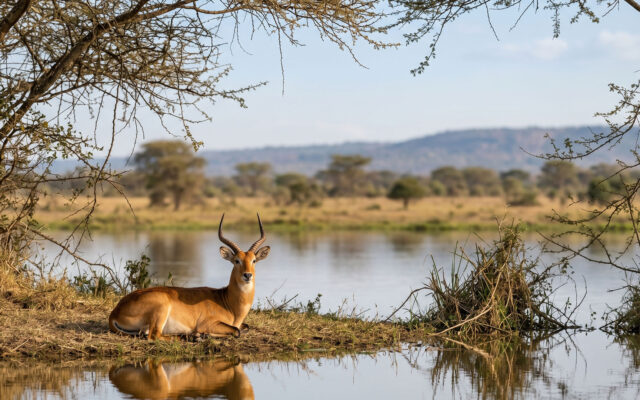
Murchison Falls sits in a relatively dry corner of northern Uganda, so rain rarely wrecks a trip here even in the wet months. That said, wildlife viewing peaks in the dry seasons — December to February and June to September — when the grass is short and elephants, buffalo, lions, hartebeest and giraffe gather along the Victoria Nile.
January and February deliver excellent sightings but can turn fiercely hot and dusty on the northern-bank plains. June and July offer the most comfortable balance of sunshine, cooler air and easy roads, which is why they are our favourite months to send first-time visitors. The boat cruise to the base of the falls also runs at its calmest in these drier spells, when hippos and Nile crocodiles crowd the banks.
If your dates fall in the rains, don’t lose heart. Murchison’s minor tracks can get sticky after a downpour, but the park stays productive, the scenery turns emerald, and the falls themselves roar with far more force as the swollen Nile funnels through the six-metre gorge.
Gorilla Trekking Conditions Through the Year
Mountain gorillas live year-round in Bwindi Impenetrable and Mgahinga Gorilla national parks, so trekking never closes. Roughly half the world’s remaining mountain gorillas are found in Uganda, and around 160 trekking permits are released each day across the two parks.
The dry seasons — June to September and December to February — bring firmer, less slippery forest trails and are the most comfortable time to hike the steep, tangled terrain. These are also the busiest months, and permits sell out well ahead, so book six to twelve months in advance for peak dates.
The wet months tell a different story. Trails turn muddy and rain is unpredictable, but the gorillas often stay lower and closer to the trailheads thanks to abundant food, and the forest is at its most dramatic. There is a financial incentive too: the Uganda Wildlife Authority now discounts the foreign non-resident gorilla permit to US$600 during April, May and November, down from the standard US$800. Note that full payment is required at booking — the old seven-day permit hold has been scrapped.
When the Birding Peaks
Uganda is one of Africa’s finest birding destinations, and Murchison Falls alone hosts more than 450 recorded species. The wet season — roughly March to May, plus November — is prime time. Rain triggers breeding displays and brings a flush of insects, while migratory birds from Europe and North Africa swell the numbers from around November through April.
The resident stars perform whatever the season: the outsized shoebill haunts the Nile Delta reeds, the Abyssinian ground hornbill stalks the savannah, and Goliath herons and African fish eagles line the river. For the best odds on the shoebill, a slow boat through the delta at dawn during the drier months, when water levels drop and the birds are easier to pin down, is hard to beat.
Chimpanzees, Crowds and Costs
Chimpanzee trekking in Budongo Forest, on the southern edge of the Murchison conservation area, is best from around October to January, when fruit ripens and the shorter grass makes the forest floor easier to walk. Rain leaves the trails slippery, so sturdy boots matter in the wetter months.
Crowds and prices track the weather closely. June to September and the December holidays are the high season, with the busiest parks and firmest lodge rates. The green seasons of March to May and October to November are quieter, and many lodges cut their rates by up to 40 per cent — a real saving for travellers who don’t mind the odd shower. Murchison’s daily park entry sits at US$45 for foreign non-residents, a touch above Uganda’s other savannah parks.
Frequently Asked Questions
What is the overall best month to visit Uganda?
June and July are the safest all-round bet: dry trails for gorilla trekking, strong game viewing, comfortable temperatures and low rain risk. February is the other standout, ideal for southern gorilla treks and savannah drives, though the north can grow very hot.
Can I still see wildlife and gorillas in the wet season?
Yes. Murchison sits in a dry belt where rain rarely interrupts a safari, gorilla sightings stay excellent year-round, and the low-season permit discount plus reduced lodge rates make the wetter months excellent value.
When should birdwatchers visit?
Time a birding trip for March to May or November, when breeding activity peaks and migratory species arrive. The delta shoebill and other residents, however, can be found throughout the year.
Plan Your Safari
The right month depends on what sits at the top of your list — big game on the Nile plains, gorillas in the mist, or a river alive with birds. Explore our step-by-step Uganda safari planner and our gorilla trekking guide, or see how easily you can combine Murchison Falls with gorilla trekking in one unforgettable itinerary. Get in touch and we’ll help you pin down the perfect dates.