



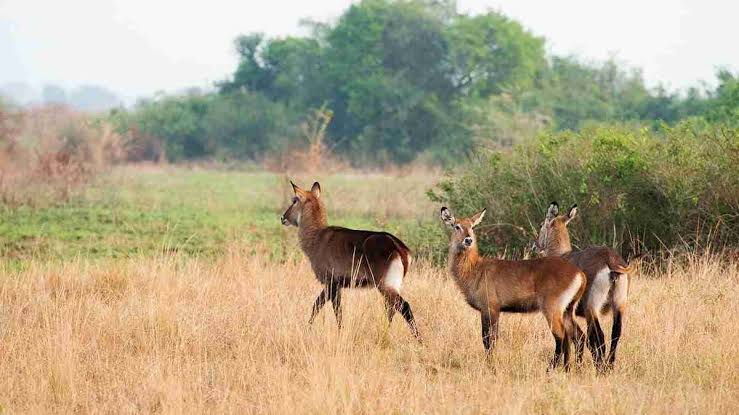
Complete Uganda Safari Circuit
Uganda is small enough to cross in a fortnight yet packed with so many landscapes that no single park comes close to telling the whole story. String them together, though, and you get one of Africa’s most complete safaris: rhinos on foot, a thundering Nile, chimpanzees, savannah lions, a channel jammed with hippos, and — the finale most people build the trip around — an hour with a wild mountain gorilla. The trick is the routing, because the parks sit far apart and the roads are slower than the map suggests.
This guide lays out the classic western and southern loop — Entebbe to Ziwa, Murchison Falls, Kibale, Queen Elizabeth, Bwindi and Lake Mburo, then home — as a realistic day-by-day flow, with honest driving times, what each leg delivers, where to fly instead of drive, how to bolt on Kidepo, and when to come.
Leg 1: Entebbe to Ziwa and on to Murchison Falls
Almost every grand circuit begins at Entebbe International Airport and runs anticlockwise, driving north first so you finish on the gorillas in the south-west. The opening day is a gentle one — roughly 176 km and three hours up the Kampala–Gulu highway to Ziwa Rhino Sanctuary, the only place in Uganda to track southern white rhino on foot. It is a short, level walk and the ideal way to shake off the flight before the longer drives ahead.
From Ziwa it is another 2–3 hours to Murchison Falls National Park, Uganda’s largest at some 3,840 square kilometres. Here the Nile is squeezed through a seven-metre gorge before crashing 43 metres into the “Devil’s Cauldron”. Give the park two nights: a Buligi game drive north of the river for lions, elephants and Rothschild’s giraffe, and the afternoon launch cruise to the base of the falls. Our Murchison Falls versus Queen Elizabeth comparison helps you weigh how long to linger.
Leg 2: Murchison Falls to Kibale for the chimpanzees
This is the circuit’s longest single transfer — around 370–410 km and seven to eight hours south-west via Hoima to Kibale Forest National Park. It is a full travel day, so leave early, break for lunch, and aim to arrive before dusk; night driving in Uganda is genuinely risky and best avoided throughout the trip.
Kibale is East Africa’s premier chimpanzee destination, home to 13 primate species and a habituated chimp population tracked most mornings. The standard permit runs US$250, while the all-day habituation experience costs more and gives you up to four hours with the group. Base yourself near Fort Portal among the crater lakes, and see our complete guide to chimpanzee trekking in Uganda for what to expect on the forest floor.
Leg 3: Kibale to Queen Elizabeth and the Kazinga Channel
A mercifully short hop follows — 110–160 km, two to four hours south to Queen Elizabeth National Park, so you can trek chimps in the morning and reach the savannah by afternoon. Queen Elizabeth is Uganda’s most biodiverse park, with over 600 recorded bird species and a landscape of crater lakes, open grassland and the wildlife-thronged Kazinga Channel.
The channel boat cruise is the headline act, linking Lakes Edward and George and delivering some of the densest concentrations of hippo and buffalo in Africa, with elephants coming down to drink. Push south to the remote Ishasha sector for its famous tree-climbing lions, draped along fig branches in the heat of the day — and a natural stepping stone towards Bwindi.
Leg 4: Queen Elizabeth to Bwindi for the gorillas
From Ishasha it is 160–200 km and four to six hours into the Kigezi highlands to Bwindi Impenetrable National Park, the emotional peak of the whole circuit and home to roughly half the world’s mountain gorillas. The final approaches are steep and often murram, so a high-clearance 4×4 is essential rather than optional.
The gorilla trek can take anywhere from one to six hours through dense forest, ending in a strictly limited hour with a habituated family. Permits cost US$800 in high season, are tied to a specific date and sector — Buhoma, Ruhija, Rushaga or Nkuringo — and sell out months ahead, so book these first and build the rest of the route around them. Our gorilla tracking in Uganda guide covers the trek in full.
Leg 5: Bwindi to Lake Mburo and back to Entebbe
The loop closes gently. Many travellers overnight at nearby Lake Bunyonyi before continuing to Lake Mburo National Park — roughly 230–290 km and five to six hours east — Uganda’s smallest savannah park and the only one with zebra, impala and eland, plus excellent walking safaris and boat trips among the Ankole cattle country.
A final 230–260 km, four to six hours returns you to Entebbe, usually pausing at the Equator crossing near Masaka for the obligatory photograph. Slotting Lake Mburo in at the end breaks what would otherwise be a punishing drive from the south-west and sends you home on a relaxed note rather than a marathon transfer.
Adding Kidepo, and when to fly instead of drive
For the adventurous with time to spare, Kidepo Valley National Park in the remote far north-east is Uganda’s most spectacular wilderness — huge herds, ostrich, and a genuine sense of being off the map. It sits some 700 km, ten to twelve hours from Kampala, so overland it demands three to five extra days; most visitors instead take a scheduled light aircraft from Entebbe and fold it in as a self-contained bookend.
Flying transforms the circuit’s longest legs. Light aircraft link Entebbe with airstrips at Pakuba and Bugungu for Murchison, and Kihihi or Kisoro for Bwindi, collapsing two-day drives into an hour or two in the air. Fly-ins cost more and carry strict soft-luggage limits of around 15 kg, but for honeymooners and time-pressed families they buy back precious game-viewing days. See how the numbers stack up in our guide to how much a Uganda safari costs.
Best season to drive the circuit
Uganda has no true off-season, but the drier windows of December to February and June to September give firmer roads, easier gorilla and chimp trekking, and better game concentrations around water. The wetter months — March to May and September to November — bring lush scenery, superb birding and lower rates, at the price of slippery murram and occasional slow going in the forests. Whenever you travel, keep daily driving to sensible five- or six-hour stretches and always reach your lodge before dark.
Frequently Asked Questions
- How many days do you need for the full Uganda circuit?
-
Ten days is the practical minimum to link Murchison, Kibale, Queen Elizabeth and Bwindi without rushing the transfers, and twelve to fourteen days lets you add Lake Mburo and slow the pace. Squeezing in Kidepo overland needs three to five days more, or you can fly it.
- Should I drive the whole loop or fly some legs?
-
Drive if you want to see the country between the parks and have the days for it — the crater lakes, tea country and Ishasha are highlights in themselves. Fly the Murchison and Bwindi legs if time is short; scheduled aircraft from Entebbe cut the two longest drives to a fraction.
- Which direction should I travel the circuit?
-
Anticlockwise — north to Murchison first, finishing on the gorillas in the south-west — is the classic flow. You always drive towards a new landscape rather than doubling back, and you save the single most memorable hour for last.
- Do I need a 4×4 for the whole trip?
-
Yes. Much of the main route is now tarmac, but the park approaches, game tracks and Bwindi’s mountain roads are murram and can be slippery in the wet, so a high-clearance 4×4 with a pop-up roof is standard on every reputable circuit.
Plan Your Safari
The complete Uganda circuit is the grandest way to see the country — rhinos, falls, chimps, lions, hippos and gorillas threaded into one unforgettable loop. We tailor the pace, mix drives with fly-in legs and secure your gorilla and chimp permits early so the whole route falls into place. Browse our best Uganda safari itineraries, compare the ready-made 7-day Uganda safari packages, then tell us your dates and we will build the circuit around them.