



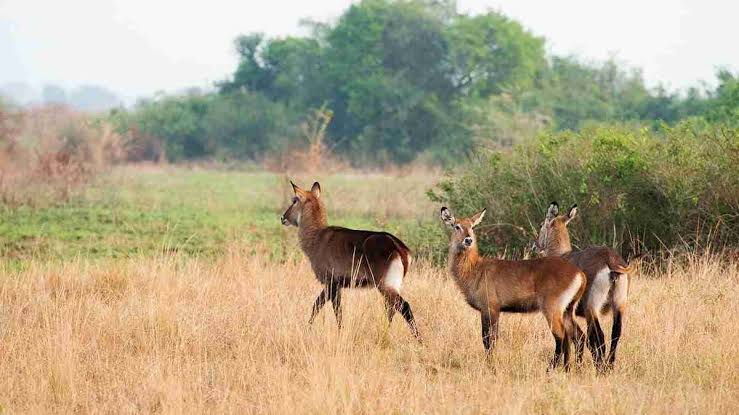
Murchison Falls National Park in June
June is when Murchison Falls National Park turns from the long rains to the long dry season — grass still green from May, but the Victoria Nile already drawing elephants, buffalo and Rothschild’s giraffe to its banks in numbers that make game drives feel effortless. For travellers tied to European summer holidays, it opens Uganda’s prime safari window.
This guide covers what June actually feels like on the ground at Uganda’s largest national park — roughly 3,840 square kilometres along the Nile — from weather and wildlife to boat cruises, road conditions and why operators recommend booking three to six months ahead. For species detail, see our monthly birding guide; here the focus is the full safari experience.
June weather: dry season begins, green still holds
June marks the start of the long dry season through September. Long-term averages show daytime highs around 30°C, nights near 19–21°C, and roughly 80–100 mm of rain across about 11 days — a sharp drop from April and May, though not yet the bone-dry conditions of July. Showers tend to be brief; mornings are often clear, with cloud building in the afternoon.
Wildlife is already concentrating at water, yet the landscape photographs greener than in late August. Pack lightweight neutral clothing — khaki and olive rather than black or navy, which can attract tsetse flies — plus sunscreen, repellent and a light waterproof layer.
Wildlife in June: gathering at the Nile
As temporary pools shrink across the northern plains, elephants, buffalo, Uganda kob, hartebeest and more than 1,700 Nubian (Rothschild’s) giraffe — recorded in recent Giraffe Conservation Foundation surveys — move towards the Victoria and Albert Nile. Guides on Buligi, Pakuba and the Queen’s Track regularly produce lion on open ridges, leopard in riverine thickets and spotted hyena at first light.
Hippos and Nile crocodiles line the banks in dense numbers. June’s firm tracks make dawn and dusk drives easier — see our morning versus afternoon game drives comparison.
The falls and the Nile boat cruise
June discharge at the gorge sits between the long-rain flood and deep dry-season flow — around 300 cubic metres per second on average, enough to shake the Top of the Falls platform without wet-season peaks that can exceed 1,000 cubic metres per second. Trails to the viewpoint are dry and firm.
The standard launch from Paraa covers about 17 kilometres each way to the Fajao Gorge — roughly three hours round-trip, with hippos, crocodiles, elephants and red-throated bee-eaters at Nyamusika. UWA boats commonly depart at 09:00 and 14:00; the tariff is US$30 per foreign non-resident under the July 2024–June 2026 schedule, separate from park entry. Read our bottom-of-the-falls boat cruise guide for operator options.
Planning activities in June
Park gates open at 07:00 and close at 19:00. Operators schedule northern-bank drives to leave as early as the Paraa ferry or bridge crossing allows — sailings commonly at 07:00, 09:00, 11:00, 12:00, 14:00, 16:00, 18:00 and 19:00 for guests south of the Nile — so you reach the Buligi circuit before heat haze builds. The 09:00 launch combines shade with strong wildlife viewing; afternoon drives from 16:00 still deliver.
Kaniyo Pabidi in Budongo Forest, via Kichumbanyobo Gate, offers chimp tracking. The sealed Masindi–Paraa road from Kampala — roughly 305 kilometres and four to five hours — stays reliable in June. Fly-in guests use Pakuba Airstrip, with Entebbe flights in roughly 60 to 90 minutes.
Birding and peak-season logistics
Palearctic migrants mostly depart by April, but with more than 451 recorded species in the conservation area, June resident birding remains exceptional — Abyssinian ground hornbills on the savannah, Goliath herons on the Nile and grey crowned cranes in wetter grassland. Delta routes still offer shoebill stork when water levels suit.
June opens Uganda’s European summer peak. Lodges near Paraa, Pakuba and the south bank fill from mid-month; confirm accommodation and launch cruises three to six months ahead. Foreign non-residents pay UWA Category A+ entry of US$45 per adult per 24 hours, plus activity fees — ranger US$25, falls hike US$15, launch US$30. See our fees guide. Gorilla permits elsewhere stay at US$800; discounted US$600 rates apply only in April, May and November.
Honest trade-offs
June is not the quietest month — lodge rates sit at dry-season levels, not April’s discounts. The Paraa ferry queue at 07:00 can add 20–30 minutes; the Paraa Bridge removes that wait when open. Midday heat reaches 30–32°C, and taller grass than in August can hide predators briefly. Allow two full northern-bank days. Compare our best time to visit Murchison Falls guide.
Frequently Asked Questions
- Is June a good time to visit Murchison Falls National Park?
-
Yes — for most visitors it is one of the best months. Wildlife concentrates at the Nile, tracks are largely dry and boat cruises run reliably. Trade-offs are peak-season occupancy and occasional afternoon showers, not mud or impassable roads.
- How hot is Murchison Falls in June?
-
Daytime highs around 30°C, nights near 19–21°C. Schedule game drives for early morning and late afternoon; midday suits boat cruises or rest at camp.
- Does it rain in June at Murchison Falls?
-
Some — roughly 80–100 mm across about 11 days, usually brief. Murram tracks on Buligi and Pakuba stay firm for standard 4×4 access.
- Are lodges busy in June?
-
Yes, especially from mid-month. Book three to six months ahead for fixed dates. June is busier than January but generally less crowded than August or September.
- Is June good for birding?
-
Very good for residents — hornbills, bee-eaters, raptors and Nile specials — though migrants have mostly departed. Delta shoebill cruises and Budongo walks reward dedicated birders.
- How do I get to Murchison Falls in June?
-
From Kampala or Entebbe via Masindi and Kichumbanyobo Gate — about 305 kilometres and four to five hours on the sealed road. Pakuba Airstrip serves fly-in guests. See our Kampala to Murchison Falls routing guide.
Plan Your Safari
June at Murchison Falls trades peak-season demand for dependable game viewing, firm tracks and a Nile that draws every major species within range — against a savannah that still remembers the rains. We build long dry-season itineraries around early crossings, dawn Buligi drives, launch cruises and lodge choices close to the action. Tell us your dates and nights available, and we will sequence tracks, boats and forest walks so you are on the plains when wildlife gathers at the water. Browse our Murchison Falls safari packages or read the fees guide to budget your June trip.