



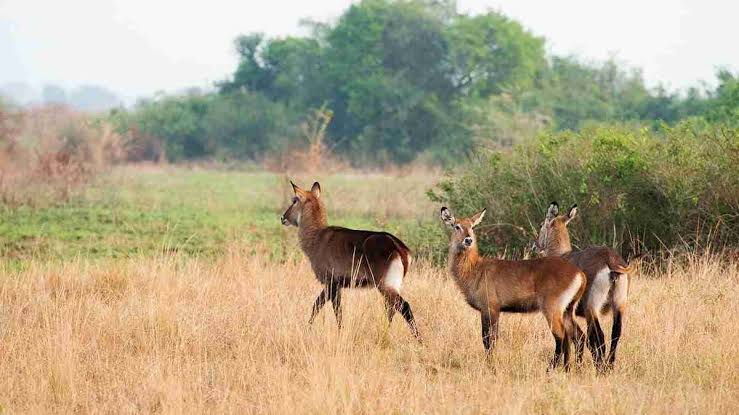
Murchison Falls National Park in September
September closes Uganda’s long dry season at Murchison Falls National Park — the month when the northern savannah is still golden and readable, wildlife remains packed along the Victoria Nile, and the first afternoon showers hint at the short rains to come. It is peak safari country by any measure, yet the European summer holiday rush has often eased, leaving Buligi tracks and launch cruises slightly less congested than in July or August.
This guide covers what September actually feels like on the ground at Uganda’s largest national park — roughly 3,840 square kilometres along the Nile — from weather and wildlife to boat cruises, game drives and bird migration. For species-by-species birding detail, see our monthly birding guide; here the focus is the full safari experience.
September weather: dry-season logic, first showers
September sits at the tail of the long dry season — the window from June through September that most operators treat as Murchison’s strongest game-viewing period. Long-term averages show daytime highs around 30°C, nights near 19°C, and roughly 120 mm of rain across about 13 days. The pattern is clear mornings, building heat through midday and brief afternoon showers rather than the sustained storms of April or October.
Humidity runs high and the UV index is extreme — plan hats, sunscreen and water for open-roof game drives. Tracks on Buligi, Pakuba and the Queen’s Track generally stay firm enough for standard 4×4 access. Pack lightweight breathable clothing, a light waterproof layer and closed shoes with grip.
Wildlife in September: still concentrated at the Nile
Game viewing in September follows dry-season rules. Temporary pools are scarce, so elephants, buffalo, Uganda kob, hartebeest and the park’s strong population of Nubian (Rothschild’s) giraffe — more than 1,700 individuals in recent Giraffe Conservation Foundation surveys — gather along the Victoria and Albert Nile. Guides who know the northern savannah still produce lion on Buligi’s open ridges, leopard in riverine thickets and spotted hyena at first light.
Buffalo herds and warthogs are particularly visible, often mingling with waterbuck at the water’s edge. Hippos and Nile crocodiles line the banks in dense numbers. For how to use the cool hours, see our comparison of morning versus afternoon game drives.
The falls and the Nile boat cruise
September water volume at the gorge sits between the low flow of January and the full spate of the long rains — average discharge is around 300 cubic metres per second, enough to shake the viewing platform where the Victoria Nile is forced through a cleft roughly six metres wide.
The standard launch cruise from Paraa covers about 17 kilometres each way to the base of the Fajao Gorge. Hippos, crocodiles, elephants and red-throated bee-eaters at the Nyamusika cliffs line the route. UWA boats depart the north-bank jetty at 09:00 and 14:00; the tariff is US$30 per foreign non-resident under the July 2024–June 2026 schedule, separate from park entry. Read our bottom-of-the-falls boat cruise guide for details.
Planning activities in September
Park gates open at 07:00 and close at 19:00. Operators schedule northern-bank game drives to leave as early as the Paraa ferry allows — sailings at 07:00, 09:00, 11:00, 12:00, 14:00, 16:00, 18:00 and 19:00 for guests south of the Nile — so you are on the Buligi circuit before heat haze builds. If an afternoon shower arrives, shift to the launch cruise or Top of the Falls hike rather than forcing a muddy loop.
Kaniyo Pabidi in Budongo Forest offers chimpanzee tracking under mahogany canopy. The sealed Masindi–Paraa road makes the drive from Kampala — roughly 305 kilometres and four to five hours — straightforward. Fly-in guests use Pakuba Airstrip, with flights from Entebbe in roughly 60 to 90 minutes.
Birding: the migration season opens
September marks the opening of the Palearctic migrant window — birds from Europe and western Asia begin arriving to escape northern winter, a season that runs through March. Early lists may show ospreys over the Nile, barn swallows and the first waders on delta sandbars alongside residents such as the Abyssinian ground hornbill and Goliath heron. With more than 450 recorded species, Murchison is one of East Africa’s richest lowland birding destinations.
Peak migrant diversity still lies ahead, but September birders who know the Nile Delta can pick up species that pure mammal safaris miss. See our birding calendar for the month-by-month picture.
Why travellers choose September — and honest trade-offs
September delivers reliable sightings, firm tracks and activities that run on schedule. Foreign non-residents pay UWA’s Category A+ park entry of US$45 per adult per 24 hours plus separate activity fees. Full breakdowns sit in our guide fees guide. Lodge rates remain at high-season levels, but vehicle traffic on Buligi often thins once August school holidays end in Europe.
September is not a secret low season — major lodges stay busy and midday heat regularly touches 30°C. October and November bring heavier rain at the cost of dispersed wildlife. Build at least two full days on the northern bank. Compare our best time to visit Murchison Falls guide for the wider seasonal picture.
Frequently Asked Questions
- Is September a good time to visit Murchison Falls National Park?
-
Yes — for most visitors it is one of the best months. Wildlife concentrates at the Nile, vegetation is still relatively low, tracks are firm and boat cruises run reliably. The main trade-offs are midday heat and occasional afternoon showers.
- Does it rain in September at Murchison Falls?
-
Some rain is normal — roughly 120 mm across about 13 days, usually as brief afternoon showers with clear mornings. September is drier than October or November but wetter than June and July.
- How hot is Murchison Falls in September?
-
Expect daytime highs around 30°C and nights near 19°C. Schedule game drives for early morning and late afternoon; the middle of the day suits boat cruises or rest at camp.
- Is September good for birding at Murchison Falls?
-
It is the start of the migrant season rather than the peak. Palearctic arrivals begin in September and diversity builds through November. See our monthly birding guide for route detail.
- Are lodges busy in September?
-
Yes — September remains high season. Book ahead if your dates are fixed, though crowds are often slightly lighter than in July and August.
- How do I get to Murchison Falls in September?
-
The standard road route from Kampala or Entebbe runs via Masindi and Kichumbanyobo Gate — about 305 kilometres and four to five hours. Pakuba Airstrip serves fly-in guests. See our Kampala to Murchison Falls routing guide.
Plan Your Safari
September at Murchison Falls offers dry-season wildlife at the Nile, thundering water at the gorge and slightly quieter tracks than midsummer — with the first migrants overhead. We build September itineraries around early ferry crossings, firm-morning game drives on the Buligi circuit and launch cruises when hippo pods line every bend. Browse our Murchison Falls safari packages or read the full fees guide to budget your September trip.