


Savannah Ecosystem of Murchison Falls
Stand on the Buligi peninsula at first light and the horizon reads like a textbook savannah: gold grass, scattered acacia crowns and the upright silhouettes of borassus palms against a pink sky. That open country north of the Victoria Nile is not a backdrop to Murchison Falls National Park — it is the engine room. Most of Uganda’s largest protected area is grassland and woodland savannah, and it supports the herds, predators and birds that most visitors come to see.
This guide explains how the Murchison savannah works: where it sits in the Albertine Rift, the mosaic of palms and acacia that shapes it, the grazing animals and carnivores that depend on it, and how wet and dry seasons redraw the map. Pair it with our Buligi area guide and wildlife checklist for route and species detail.
Where the Savannah Sits
Murchison Falls National Park covers about 3,893 square kilometres at the northern end of the Albertine Rift, where the Bunyoro escarpment drops onto palm-dotted plains. The Victoria Nile cuts the park almost in half for roughly 115 kilometres, and almost all classic savannah game viewing happens on the northern bank.
Three sectors matter for safari planning. The Buligi peninsula — roughly 170 square kilometres wedged between the Victoria and Albert Niles — holds the densest mix of open grassland and riverine edge. West of Buligi, the Pakuba sector runs borassus savannah along the Albert Nile toward Tangi Gate. East of Paraa, the Heart of Murchison opens into wider plains where kob leks and lion territories stretch toward Chobe and Wankwar gates. Southern-bank lodges reach these tracks via the Paraa ferry (07:00–19:00 daily); northern lodges and fly-in guests using Pakuba Airstrip skip the crossing.
Vegetation Mosaic: Grass, Palms and Acacia
Murchison’s savannah is not uniform short grass. UWA describes the northern sector as a patchwork of open grassland, borassus palm stands, whistling-thorn acacia bushland and riverine woodland along the Nile. Common grasses include thatching grass (Hyparrhenia hirta) and cat’s-tail dropseed (Sporobolus pyramidalis); woody cover is dominated by acacias such as Vachellia constricta and the African fan palm, Borassus aethiopum.
That mosaic matters ecologically. Giraffe browse acacia crowns; kob graze the open flats; elephants push through palm groves. Termite mounds across Buligi and Pakuba become lookout points for lions and perches for martial eagles. Where savannah meets papyrus at the Albert Delta, shoebill stork and skimmers add wetland species without breaking the plains character of the north. UWA has also fought invasive borassus spread that closed grazing ground; controlled restoration has reopened up to 15,000 hectares north of the Nile.
Keystone Grazers of the Northern Plains
The signature animal is the Uganda kob (Kobus kob thomasi) — Uganda’s national emblem and the figure on UWA’s logo. Males defend leks on open ground, and herds number in the thousands across Buligi and the Heart of Murchison. After poaching collapsed numbers to roughly 5,300 in the mid-1990s, improved law enforcement triggered a remarkable recovery; camera-based aerial surveys in 2015–2016 estimated more than 118,000 kob across the wider conservation area.
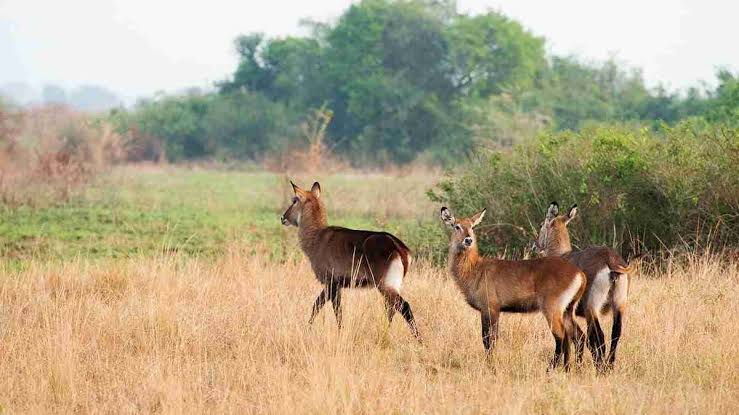
Jackson’s hartebeest, oribi, Defassa waterbuck and warthog share the same grass layer. Cape buffalo exceed 10,000 on recent counts. African elephants cross the plains toward river crossings near Paraa and the delta, especially in dry months.
Above the grazers, Nubian giraffe — formerly called Rothschild’s giraffe — define the skyline. Murchison holds the world’s largest wild population, estimated at roughly 2,250 individuals, representing well over half of all Nubian giraffe on Earth. Research shows partial seasonal migration between acacia savannas in wet months and broad-leaf woodland in the dry season. See our giraffe guide for survey detail.
Predators and Savannah Specialists
Open ground makes Murchison one of Uganda’s best lion parks. The protected area has been a Lion Conservation Unit since 2005, and ranger-led surveys in the Nile Delta tourism zone recorded a density of 13.91 lions per 100 km². Prides concentrate where kob leks and buffalo herds overlap, particularly along Buligi’s central tracks and the delta margins.
Leopard favour riverine drainage lines; spotted hyena scavenge kills after dark. The savannah also supports patas monkey on dawn Buligi drives, and ground birds such as Abyssinian ground hornbill and secretary bird walking the same flats as the antelope.
Seasonal Rhythms and the River Edge
Elevation runs from about 619 metres at the Lake Albert delta to roughly 1,292 metres at Rabongo Hill, with mean annual rainfall around 1,085–1,500 millimetres in bimodal peaks from April to May and August to October. For game viewing, drier windows from December to February and June to September shorten grass and pull animals toward the Nile.
Savannah does not stop at the waterline. Riverine woodland follows the Victoria and Albert Niles, supplying shade and browse for waterbuck, baboon and leopard. Elephants and buffalo drink at Paraa sandbanks; hippos and Nile crocodiles occupy the channels below — which is why a Buligi morning pairs naturally with an afternoon launch cruise on the same river corridor.
Frequently Asked Questions
- Which part of Murchison Falls is savannah?
-
The northern bank north of the Victoria Nile — especially Buligi, Pakuba and the Heart of Murchison — is open savannah grassland with borassus palms and acacia. The southern bank is mainly woodland and forest, including Budongo.
- Why is Uganda kob so abundant here?
-
Open grassland with reliable water, decades of anti-poaching work and lek-breeding behaviour that concentrates herds make Murchison ideal kob habitat. Populations recovered from a few thousand in the 1990s to well over 100,000 on recent survey methods.
- When is the best season for savannah game drives?
-
June to September and December to February offer shorter grass and animals clustered near the Nile. Early-morning drives on Buligi or Pakuba tracks, with a UWA ranger guide (around US$25 per day), deliver the most consistent sightings.
- How does the savannah differ from Queen Elizabeth National Park?
-
Both hold kob and lions, but Murchison’s northern plains are more open, larger in scale and centred on the Nile. Murchison also holds the global stronghold of Nubian giraffe — a savannah signature Queen Elizabeth lacks.
Plan Your Safari
The Murchison savannah rewards travellers who give the northern bank a full morning — and ideally two. Cross the Paraa ferry at dawn or stay north of the Nile, drive Buligi or Pakuba with a ranger, and add a Nile cruise to see how plains and river fit together. Browse our Murchison Falls safari packages and the Buligi game drive guide to build an itinerary around the grasslands, palms and predators that make this Uganda’s defining savannah experience.