



Murchison Falls Expert Guide
Murchison Falls is not a park you understand from a brochure alone. It is a Nile landscape split in two — savannah north, forest south — with a ferry schedule that can make or break your dawn drive, a giraffe population that carries global conservation weight, and a waterfall that compresses Africa’s longest river through a gap barely seven metres wide. This guide is what we tell travellers who already know they want to come and now need the detail that turns a good trip into a sharp one.
We cover the conservation area as a whole, how the river shapes wildlife and logistics, where experienced operators spend their time on the ground, and the choices — gates, lodges, seasons, permits — that separate a rushed checklist from a well-run safari. Pair it with our Murchison Falls travel guide for the overview, or our planning guide when you are ready to fix dates.
The Conservation Area, Not Just the Park
Most visitors say “Murchison Falls National Park” and mean the full experience — but the map is larger than the park boundary. UWA manages roughly 3,840 square kilometres of national park together with the adjoining Karuma and Bugungu Wildlife Reserves as the Murchison Falls Conservation Area, totalling about 5,072 square kilometres. The core was gazetted as the Bunyoro and Gulu Game Reserve in 1926 and upgraded to one of Uganda’s first national parks in 1952 — still the country’s largest protected area.
Animals move freely between Buligi, the Nile corridor, Budongo and the Albert Delta — three ecosystems in one itinerary, which is why two nights at Paraa often feels tight and three feels right.
How the Nile Defines Everything
The Victoria Nile enters from the east, runs through rapids and pools, then forces through a gorge about six to seven metres wide and drops roughly 43 to 45 metres into the Devil’s Cauldron before spreading toward Lake Albert. Samuel and Florence Baker mapped this stretch in the 1860s and named the falls after Roderick Murchison, then president of the Royal Geographical Society.
At Paraa — Luo for “home of the hippo” — the Nile bisects the park. The northern bank holds open savannah and the Buligi track network; the southern bank is woodier, with Rabongo Forest and access to Budongo. Unless you enter via northern gates at Tangi, Wankwar or Chobe, or fly to Pakuba airstrip about 19 kilometres from Paraa, you cross by ferry. Scheduled sailings run at 07:00, 09:00, 11:00, 12:00, 14:00, 16:00, 18:00 and 19:00 — treat the 07:00 crossing as fixed if your game drives are on Buligi and your lodge is south of the Nile.
Wildlife: What Experts Look For
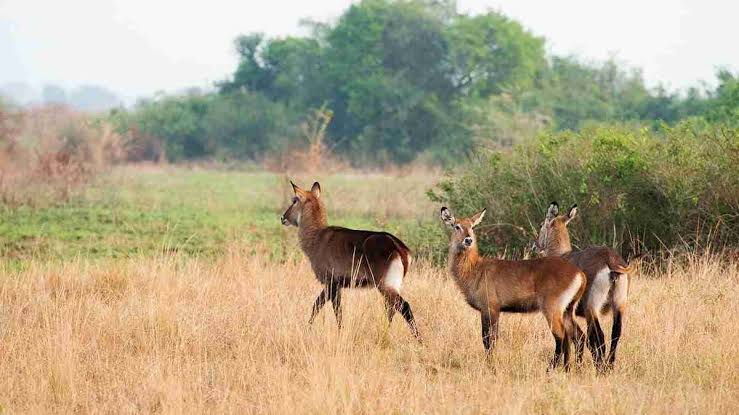
UWA records 76 mammal species and more than 450 bird species. Four of the Big Five — lion, leopard, elephant and buffalo — are present on the northern plains, with lion sightings improving steadily on Buligi. There are no wild rhino inside the park; add them with a guided walk at Ziwa Rhino Sanctuary, roughly halfway between Kampala and the southern gates.
The headline story is the critically endangered Nubian giraffe — formerly Rothschild’s giraffe. GCF surveys recorded roughly 1,770 unique individuals across three rounds in 2024–2025; Uganda holds about half of all wild Nubian giraffe globally. The Nile adds hippo pods, large crocodiles and riverine elephants; birders target shoebill in the Albert Delta from roughly January to March on a dedicated downstream cruise. Chimps are tracked at Kaniyo Pabidi in Budongo — not mountain gorillas, which live in Bwindi and Mgahinga.
Getting In: Gates, Lodges and Timing
From Kampala or Entebbe, Paraa is about 305 kilometres — typically four to five hours from Kampala, six to seven from the airport. The direct southern route enters at Kichumbanyobo Gate, roughly 16 kilometres north of Masindi, then runs about 85 kilometres through Budongo to the Nile. Northern gates suit routes from Gulu or Pakwach and drop you into the game zone without a ferry if your lodge sits on the north bank.
Southern-bank lodges suit afternoon cruises and Budongo chimps but require the morning ferry for Buligi; northern-bank lodges at Pakuba or Chobe put you on the tracks at first light. Fly-in guests reach Pakuba, Bugungu or Chobe in about an hour from Entebbe. See our Kichumbanyobo Gate guide for route detail.
Activities Done the Right Way
Game drives on Buligi — roughly 170 kilometres of tracks between the Victoria and Albert Niles — reward a clockwise dawn loop with a UWA ranger guide (around US$25). The launch cruise runs two to three hours upstream from Paraa, typically at 09:00 and 14:00, with an optional hike to the clifftop (around US$15). Book the Albert Delta cruise and Kaniyo Pabidi chimps (around US$130) as separate mornings. Details in our Buligi game drive guide.
Seasons, Fees and Conservation Reality
Dry windows of December to February and June to September concentrate game at remaining water and firm up murram tracks — book lodges three to six months ahead for peak dates. Wet seasons from March to May and October to November bring lush scenery and breeding birds, though western Buligi tracks can turn slick.
Under the UWA tariff valid through June 2026, entry is US$45 per foreign non-resident adult per 24 hours (Category A+), plus separate activity fees — see our cost guide. GCF monitoring tracks wire snares in the western delta and giraffe skin disease; tourism revenue funds the patrols and translocations that rebuilt populations across Uganda.
Frequently Asked Questions
- What makes Murchison Falls different from other Uganda parks?
-
Scale and the Nile. At 3,840 square kilometres it is Uganda’s largest park, combining savannah big-game viewing, a waterfall boat cruise, delta birding and Budongo chimp trekking in one conservation area — something no other Ugandan park replicates at this size.
- How many Nubian giraffe are in Murchison Falls?
-
Recent Giraffe Conservation Foundation surveys recorded roughly 1,770 unique individuals across 2024–2025 monitoring rounds, with the northern sector holding the majority — a major share of the global wild Nubian giraffe population.
- Which gate should experts use?
-
Kichumbanyobo from Masindi is the standard southern approach — 16 kilometres north of town, then 85 kilometres to Paraa. Choose Tangi, Wankwar or Chobe if your lodge is on the northern bank. Bugungu suits scenic arrivals from the rift escarpment.
- Is the Paraa ferry really that important?
-
Yes, if your game drives are on Buligi and your lodge is south of the Nile. Missing the 07:00 crossing typically costs the best two hours of predator and giraffe activity. Northern-bank lodges and fly-in guests to Pakuba avoid this entirely.
- How many days does an expert-level visit require?
-
Two full days inside the park covers a game drive, launch cruise and falls hike — assuming you arrive the afternoon before. Three days with two nights at Paraa suits most first-timers; four opens the delta shoebill cruise or Budongo chimps. See our how many days guide.
Plan Your Safari
Murchison rewards travellers who understand the river, the ferry and the seasons before they arrive — not those who treat it as a single-day add-on from Kampala. Browse our Murchison Falls safaris, read the first-time visitors guide, or tell us your dates and we will map gates, lodge side, ranger bookings and daily timings so your days follow the wildlife rather than fight the schedule.