



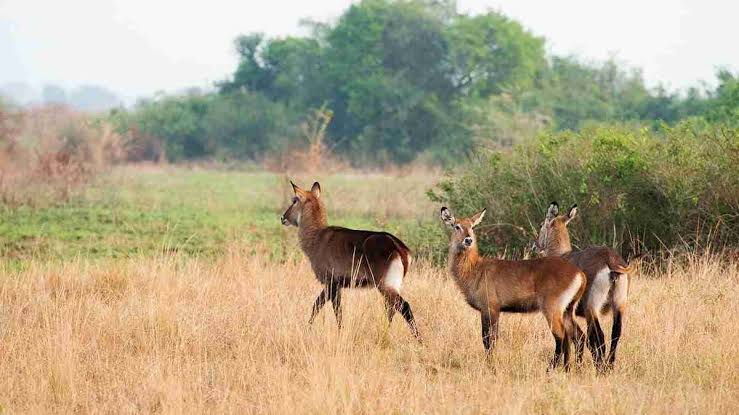
Murchison Falls National Park in July
July sits at the heart of Uganda’s long dry season, and Murchison Falls National Park reads like an open book — cropped grass, a predictable Victoria Nile and wildlife gathered at every bend of the Albert Nile. Firm tracks on Buligi, elephants shoulder-deep at the riverbank and the falls thundering through a gorge barely seven metres wide make this the month most operators recommend without hesitation.
This guide covers what July actually feels like on the ground at Uganda’s largest national park — roughly 3,840 square kilometres straddling the Nile — from weather and wildlife to boat cruises, game drives and peak-season logistics. For birding detail, see our July birding guide; here the focus is the full safari experience.
July weather: dry, warm and clear
July is firmly inside the long dry season that runs from June through September. Long-term averages show daytime highs around 29–30°C, nights near 19°C, and roughly 90–110 mm of rain across about 10–11 days — brief showers, not April’s sustained storms. Skies stay largely clear, and murram tracks on Buligi, Pakuba and the Queen’s Track remain firm for standard 4×4 access.
July tends to feel a degree cooler at midday than December or January — useful on open Borassus grassland. Park gates open at 07:00 and close at 19:00; plan drives for those hours and pack lightweight clothing, a hat, sunscreen and water. Evenings are mild; a light layer helps on early ferry or bridge crossings at Paraa.
Wildlife in July: peak visibility
When temporary pools shrink, elephants, buffalo, Uganda kob, hartebeest and more than 1,700 Nubian (Rothschild’s) giraffe — per recent Giraffe Conservation Foundation surveys — gather along the Victoria and Albert Nile. Guides who know the northern circuit produce lion on Buligi’s ridges, leopard in riverine thickets and spotted hyena at dawn. Hippos and Nile crocodiles line the banks in dense numbers; crocodiles bask on sandbars in July in concentrations that make the upstream cruise from Paraa as much a reptile census as a scenic run.
Predators stay most active in the crepuscular window — the same rhythm that makes July productive year-round. For how to use those hours, see our morning versus afternoon game drives comparison.
The falls and the Nile boat cruise
July discharge at the gorge averages around 300 cubic metres per second — well below wet-season peaks above 1,000 cubic metres per second — yet the spectacle remains formidable. The Nile is forced through a cleft six to seven metres wide and drops about 43 metres; dry-season skies often deliver a rainbow in the spray at the Top of the Falls trail.
The launch cruise from Paraa covers about 17 kilometres each way to the Fajao Gorge — roughly three hours round-trip — with hippos, crocodiles, elephants and red-throated bee-eaters at Nyamusika. UWA boats depart the north-bank jetty at 09:00 and 14:00; the tariff is US$30 per foreign non-resident under the July 2024–June 2026 schedule, separate from park entry. See our bottom-of-the-falls boat cruise guide for route detail.
Planning activities in July
Book early and lead with mornings. Operators schedule northern-bank drives to leave as soon as the Paraa ferry or bridge allows — sailings commonly at 07:00, 09:00, 11:00, 12:00, 14:00, 16:00, 18:00 and 19:00 south of the Nile — so you reach the Buligi circuit before heat haze builds. The 09:00 launch cruise doubles as shaded wildlife viewing.
Kaniyo Pabidi in Budongo Forest, via the Masindi approach to Kichumbanyobo Gate, offers firm-trail chimp tracking in July. The sealed Masindi–Paraa road makes the drive from Kampala — roughly 305 kilometres and four to five hours — straightforward. Fly-in guests use Pakuba Airstrip, about 60 to 90 minutes from Entebbe. A morning Nile delta cruise for shoebill is a strong July add-on when water is lower.
Birding in July
Palearctic migrants have departed, but residents and delta specials compensate — African skimmers on sandbars, Abyssinian ground hornbills on the savannah, Goliath herons along the Nile and Denham’s bustards on open plains. With more than 450 recorded species, Murchison is one of East Africa’s richest lowland birding destinations, and July’s dry tracks make early starts easy. Our July birding guide covers delta routes and a three-day target list.
Why travellers choose July — and the trade-offs
July delivers reliable sightings, dry roads and clear photography light. Foreign non-residents pay UWA Category A+ entry of US$45 per adult per 24 hours, plus activity fees — game drive ranger US$25, Top of the Falls hike US$15, chimp tracking separate. See our fees guide. The month aligns with northern summer holidays, so lodges near Paraa and Pakuba fill at peak rates. Gorilla permits elsewhere stay at US$800; the US$600 discount applies only in April, May and November.
The cost of peak season is crowds and dust. Midday on Buligi can hit 30°C, the Paraa ferry queue at 07:00 may add 20–30 minutes, and shared launches book out. Build two full northern-bank days — Buligi predators one morning, delta birding or a second launch cruise the next. For the wider picture, see our best time to visit Murchison Falls guide and Nile ferry crossing notes.
Frequently Asked Questions
- Is July a good time to visit Murchison Falls National Park?
-
Yes — for most visitors it is one of the best months. Wildlife concentrates at the Nile, vegetation is low and tracks are dry. Trade-offs are peak-season crowds and higher lodge rates, not rain or mud.
- How hot is Murchison Falls in July?
-
Daytime highs around 29–30°C, nights near 19°C. Schedule game drives for early morning and late afternoon; midday suits boat cruises or camp rest.
- Does it rain in July at Murchison Falls?
-
Very little — roughly 90–110 mm across about 10–11 days, usually brief showers. January is typically drier still.
- Are lodges busy in July?
-
Yes. July is peak season. Book accommodation and launch cruises well ahead.
- How do I get to Murchison Falls in July?
-
From Kampala or Entebbe via Masindi and Kichumbanyobo Gate — about 305 kilometres and four to five hours on the sealed Masindi–Paraa road. Pakuba Airstrip serves fly-in guests. See our Kampala to Murchison Falls routing guide.
Plan Your Safari
July at Murchison Falls trades solitude for dependable game viewing and a Nile that draws every major species within range. We build peak-season itineraries around early ferry crossings, dawn Buligi drives and launch cruises in calm light. Browse our Murchison Falls safari packages or the fees guide to budget your July trip.