



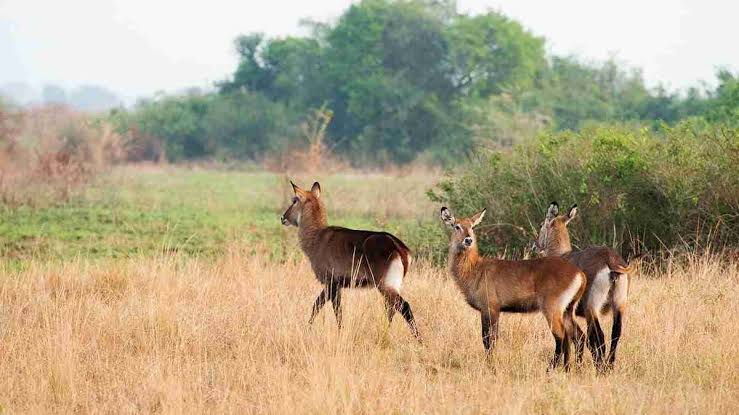
Murchison Falls National Park in October
October opens Uganda’s short rains at Murchison Falls National Park — the savannah greens, afternoon storms build over the Albert Nile and the Victoria Nile carries more volume through the gorge than in August. It is not the month for the easiest lion sighting on a dusty track, yet it delivers fresh landscapes, rising bird diversity and a park quieter than the European summer rush.
This guide covers what October feels like on the ground at Uganda’s largest national park — roughly 3,840 square kilometres along the Nile — from weather and wildlife to boat cruises, game drives and road conditions. For birding detail, see our October birding guide; here the focus is the full safari experience.
October weather: short rains, clear mornings
October opens the short rainy season that runs through November. Long-term averages for the Murchison area show daytime highs around 30–31°C, nights near 19–21°C, and roughly 125–200 mm of rain across about 16 days — often the wettest month of the year in northern Uganda, though still far from the sustained downpours of April. The pattern most guides recognise is clear mornings, building cloud from mid-morning and afternoon storms that break to sunshine. Expect around seven hours of sunshine on average even on days when rain falls.
Pack lightweight breathable clothing, a waterproof jacket, closed shoes with grip for muddy tracks and a dry bag for cameras. Rain rarely shuts the park entirely — but it does change how you schedule each day.
Wildlife in October: dispersed but active
Game viewing in October follows wet-season logic. When water lies in every depression and fresh grass covers the plains, elephants, buffalo, Uganda kob, hartebeest and the park’s strong population of Nubian (Rothschild’s) giraffe — more than 1,700 individuals in recent Giraffe Conservation Foundation surveys — spread across the northern savannah rather than clustering along the Nile. Sightings take more patience, but guides who know Buligi, Pakuba and the Queen’s Track still produce lion, leopard and hyena on morning drives.
Forest primates — black-and-white colobus, red-tailed monkeys and blue monkeys — become more visible along the Budongo corridor. Predators remain active in the cool hours; see our comparison of morning versus afternoon game drives for how to use that rhythm.
The falls and the Nile boat cruise
October discharge at the gorge averages around 300 cubic metres per second, with short-rain pulses pushing toward 800–1,000 cubic metres per second after sustained upstream rainfall. The launch cruise from Paraa covers about 17 kilometres each way to the Fajao Gorge — hippos, crocodiles, elephants and red-throated bee-eaters at Nyamusika line the route. UWA boats depart at 09:00 and 14:00; the tariff is US$30 per foreign non-resident under the July 2024–June 2026 schedule. See our bottom-of-the-falls boat cruise guide.
Planning activities around the rain
October rewards a morning-first itinerary. Park gates open at 07:00 and close at 19:00; schedule northern-bank game drives to leave as early as the Paraa ferry allows — sailings at 07:00, 09:00, 11:00, 12:00, 14:00, 16:00, 18:00 and 19:00 for guests south of the Nile — so you are on the Buligi circuit before clouds build. Afternoon rain then becomes a reason to rest, take the launch cruise or walk the Top of the Falls.
Kaniyo Pabidi in Budongo Forest offers chimpanzee tracking under mahogany canopy — success rates drop in the short rains compared with May through August. The sealed Masindi–Paraa corridor makes the drive from Kampala — roughly 305 kilometres and four to five hours — reliable; murram tracks beyond Paraa favour a high-clearance 4×4. Fly-in guests use Pakuba Airstrip; Aerolink operates in October outside its pause in March, April, May and November.
Birding: migrants arrive, residents breed
October is when the short rains and the Palearctic migration overlap. Birds from Europe and western Asia begin filtering in — European bee-eaters, barn swallows, steppe eagles and waders on delta sandbars — while residents such as the Abyssinian ground hornbill and Goliath heron enter breeding dress. With more than 450 recorded species, Murchison is one of East Africa’s richest lowland birding destinations. Delta shoebill cruises remain productive, though higher water can push some waders further out than in January. Our October birding guide covers routes and track conditions.
Why travellers choose October — and honest trade-offs
October sits in the shoulder season. Lodge rates often sit 15–30 per cent below peak dry-season levels, shared launches are less crowded and the northern tracks see fewer vehicles than July or January. Foreign non-residents still pay UWA’s Category A+ park entry of US$45 per adult per 24 hours — the same tariff year-round — but accommodation savings can fund an extra night or a delta cruise. Gorilla permits elsewhere in Uganda remain at US$800 in October; the discounted US$600 rate applies only in April, May and November.
Long grass hides animals further from the track, black-cotton soils turn greasy after overnight rain and remote Buligi loops can become impassable until they dry. Build buffer time: two full days on the northern bank and a weather contingency for the delta cruise. Compare our best time to visit Murchison Falls guide and the Uganda best time to visit overview.
Frequently Asked Questions
- Is October a good time to visit Murchison Falls National Park?
-
Yes, if you accept short-rain logistics. Wildlife is present but more dispersed, the falls carry stronger volume than in the long dry season, birding is strong and shoulder-season rates make longer stays affordable. First-time visitors who want the easiest game viewing should prefer June–September or December–February.
- How much does it rain in October?
-
Expect roughly 125–200 mm across about 16 days, usually as heavy afternoon showers with clear mornings. Daytime temperatures stay around 30–31°C with around seven hours of sunshine on average.
- Do boat cruises and game drives still run in October?
-
Both operate year-round. Morning game drives and the 09:00 launch cruise are the most reliable slots before afternoon rain. Tracks can be muddy — a 4×4 and experienced guide are standard.
- Is October cheaper than the dry season?
-
Generally yes for accommodation — commonly discounted 15–30 per cent. Park entry fees at Murchison stay US$45 per foreign non-resident adult per 24 hours regardless of season.
- How do I get to Murchison Falls in October?
-
The standard road route from Kampala or Entebbe runs via Masindi and Kichumbanyobo Gate — about 305 kilometres and four to five hours on the sealed Masindi–Paraa road. Pakuba Airstrip serves fly-in guests. See our Kampala to Murchison Falls routing guide.
Plan Your Safari
October at Murchison Falls trades easy sightings for fresh scenery, rising water and a park that feels almost yours. We build short-rain itineraries around early ferry crossings, firm-morning game drives on Buligi, launch cruises when the Nile is in fuller flow and lodge choices that reward shoulder-season value. Browse our Murchison Falls safari packages or read the full fees guide to budget your October trip.