



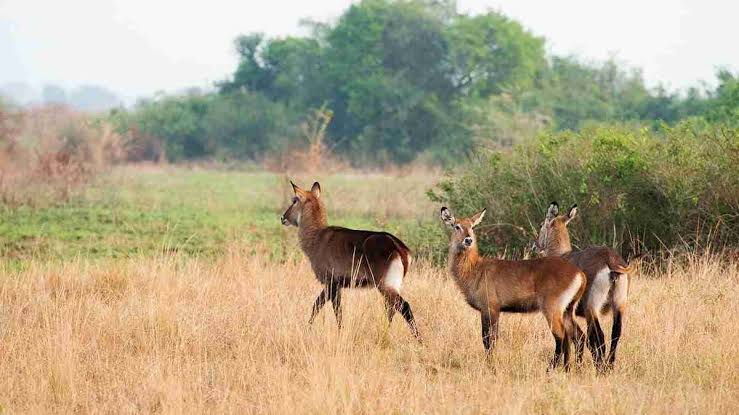
How Close Can You Get to the Animals in Murchison Falls?
Close wildlife encounters are what draw most travellers to Murchison Falls — a lion on the Buligi track, an elephant herd blocking the road, hippos snorting beside your Nile launch. The honest answer to how close you can get is not a single number. It depends on the activity, the species, and the judgement of your UWA ranger or guide, whose instructions override any photo opportunity.
This guide sets out the official Uganda Wildlife Authority rules, the practical distances on game drives, boat cruises and forest treks, and what to expect when elephants, predators, primates and river wildlife behave unpredictably. It covers Murchison Falls National Park and the adjoining Budongo Forest sector where most visitors combine savannah and chimp trekking on one itinerary.
The UWA Baseline: Rules That Apply Everywhere
Every protected area in Uganda shares a core code in the UWA Conservation Tariff: stay on marked tracks, keep below 40 km/h, avoid horns, retain fee receipts, and respect gate hours of 07:00–19:00. Off-track driving costs US$150 per person in the vehicle; overspeeding and hooting each incur UGX 100,000. UWA does not publish a metre chart for every savannah species, but the principle holds — observe from a respectful distance, stay inside your vehicle on game drives unless a ranger directs otherwise, and never argue with guide instructions.
Game Drives: Your Vehicle Is the Viewing Platform
On the northern Buligi Peninsula and linked Albert, Queen’s and Pakuba tracks — where most lion, elephant, buffalo and Nubian giraffe sightings happen — viewing takes place from inside a safari vehicle. Rangers treat roughly 25 metres as a sensible minimum from elephants, buffalo and other large herbivores, and more distance from predators. Habituated animals often approach on their own terms; a good driver stops, kills the engine if appropriate, and waits rather than edging closer for a photo.
Self-drivers pay a US$10 self game drive fee per vehicle per day, but a UWA ranger guide at US$25 on the northern bank remains strongly advisable. Night drives require a mandatory UWA guide and a lodge stay inside the park. Read our Buligi game drive guide and game drive overview for route detail.
What “Close” Actually Feels Like on the Plains
On a dawn run starting around 06:30, expect kob and hartebeest at medium range, giraffe within a few metres of the track, and elephant herds close enough to hear tearing vegetation. Lions on the Nyamsika Flats may allow a slow vehicle approach; leopards often stay 30 metres or more. Olive baboons along the tracks are bold — keep windows partly closed and never feed them. Flash photography is discouraged, and if an elephant spreads its ears or a lion’s tail flicks, your guide will back away.
Nile Boat Cruise: Close From the Water
The launch from Paraa Jetty toward the base of Murchison Falls is often the closest large-mammal viewing in the park. UWA estimates more than 5,000 hippos in the Murchison river section. From a slow-moving boat, hippos and crocs are frequently within 20–30 metres, with elephants and buffalo drinking at the bank. Shared cruises cost US$30 per foreign non-resident; the run covers roughly 17 kilometres each way over two to three hours. Stay seated while moving, wear a life jacket, do not lean over rails, and never touch the water. See our boat cruise vs game drive guide.
Chimpanzee Trekking in Budongo: Measured in Metres
Chimp tracking at Kaniyo Pabidi in Budongo Forest is the closest on-foot primate encounter most Murchison visitors experience. UWA requires a minimum of 10 metres (32.8 feet), a maximum visit of one hour, no flash photography, and no trekking if you are ill. Minimum age is 12 years. Chimps move; your ranger repositions the group, never the reverse. Our Budongo chimp trekking guide covers sessions and permits.
Guided Walks and Species-Specific Safety
Outside chimp trekking, walking near wildlife happens only on designated routes with an armed UWA ranger — the Top of the Falls hike, delta walks for shoebill, and short forest trails at Rabongo. You do not approach elephants or buffalo on foot in open savannah. Never drive between a cow and calf; remain seated with arms inside near predators. Baboons at gates are habituated but not tame — secure bags and food. Self-drivers often hire a UWA guide for northern game days — see our guided vs self-drive safari and guided nature walks pages.
Frequently Asked Questions
- How close can you get to elephants on a Murchison game drive?
-
Stay inside your vehicle and let elephants choose the distance. Rangers advise roughly 25 metres as a minimum when approaching; habituated herds often come closer when crossing tracks. Never drive between herd members or block their path to water.
- Can you get out of the car to take photos?
-
Not during standard game drives. You may only leave at designated safe points or when a UWA ranger explicitly permits it. Off-track stops for photography incur fines and create genuine danger.
- Is the Nile boat cruise closer than a game drive?
-
Often yes for hippos, crocodiles and river-edge elephants, because the boat glides parallel to the bank at slow speed. You remain seated behind rails with a guide controlling spacing.
- How close do you get to chimpanzees in Budongo?
-
UWA requires at least 10 metres at all times, with one hour maximum observation. Rangers adjust positioning as chimps move through the canopy or on the forest floor.
- Are Murchison Falls safaris safe for wildlife viewing?
-
Yes, when UWA rules are followed. The park has a strong ranger presence and decades of habituated tourism. Most incidents involve guests ignoring distance or vehicle rules, not random animal aggression.
Plan Your Safari
Close encounters at Murchison come from patience, correct timing and professional guidance — not from pushing boundaries. Start northern game drives at dawn, add a Nile launch for river-level viewing, and slot Budongo chimp trekking where UWA’s metre rules apply on foot. Browse our Murchison Falls safari packages, read the first-time visitors guide, and use the full Murchison Falls travel guide to match activities to your wildlife priorities.