


Lake Albert Ecosystem
Lake Albert is the quiet giant at the western edge of Murchison Falls country — a 5,300-square-kilometre rift lake shared between Uganda and the Democratic Republic of Congo, fed by the Victoria Nile and Semliki River and drained northward as the Albert Nile. Most safari itineraries focus on the falls and the Buligi savannah, yet the lake shapes everything downstream: papyrus deltas where shoebills hunt, spawning grounds for a fishery supplying roughly 30 per cent of Uganda’s catch, and escarpment woodland where elephants move between shore and park.
This guide explains how the Lake Albert ecosystem works — its hydrology, habitats, fish and wildlife, human pressures and what travellers can see from Murchison Falls National Park. Pair it with our ecosystem of Murchison Falls guide and the Murchison Falls travel guide for practical logistics.
Where Lake Albert Sits in the Rift
Lake Albert occupies the northern end of the Albertine Rift, the western branch of the East African Rift Valley. It lies at roughly 615–619 metres above sea level — about 160 kilometres long and 30 kilometres across at its widest, with an average depth of 25 metres and a maximum of about 51–58 metres. Uganda holds roughly 46 per cent of the surface; the remainder is Congolese territory.
Two major rivers define the system. The Victoria Nile enters from the east after plunging through Murchison Falls and spreading into a papyrus delta. The Semliki River arrives from the south, draining Lake Edward through rapids that act as a partial faunal barrier. At the northern tip, the Albert Nile flows out toward South Sudan. Because Lake Albert connects to the wider Nile basin, most fish are riverine species shared with the lower Nile — not the hyper-diverse cichlid radiations found farther south.
Wetlands, Deltas and Shoreline Habitats
Most of Lake Albert’s shoreline is too steep for extensive swamp growth. Where the Victoria Nile and Semliki River meet the lake, papyrus (Cyperus papyrus) swamps and fringes of Vossia grass create shallow nurseries for fish and wading birds.
The Murchison Falls–Albert Delta Wetland System — a Ramsar site since September 2006 covering 17,293 hectares — stretches from the top of the falls through the Victoria Nile’s final ten kilometres, where the river splits into three main channels before reaching open water. The designation extends up to four kilometres into Lake Albert. That shallow convergence zone is one of Uganda’s most reliable shoebill habitats, alongside pelicans, darters, goliath herons and African fish eagles.
Research on the Ugandan shoreline identifies six main fish habitat types: shallow river-associated waters, open sandy shores, lagoons, large bays, rocky escarpments and open lake. Lagoons, bays and rocky shores hold the highest species counts; shoreline shallows function as natural refugia for juvenile fish. South of the delta, roughly 18 kilometres of community land runs to the lake port of Wanseko — a gateway for local ferries and boat access to bird-rich shallows outside the standard Paraa circuit.
The Fish Community and Fisheries
Lake Albert holds between 40 and 55 fish species — modest compared with Lake Malawi or Victoria, but supporting Uganda’s most diverse commercial inland fishery by species mix. The lake contributes an estimated 30 per cent of national fish production, second only to Lake Victoria in total yield.
Nile perch (Lates niloticus) is native here — unlike in Lake Victoria, where it was introduced — and ranks among the largest predators alongside elongate tigerfish, marbled lungfish and semutundu (Bagrus docmak). Commercial landings lean heavily on small pelagic species, especially Engraulicypris bredoi (mukene), caught with light fishing at night. Tilapia, Niger barb and giraffe catfish support artisanal nets in lagoons and bays.
Cichlid diversity is limited: six haplochromines and three tilapia species, mostly in sheltered inshore waters, with four haplochromines endemic to Lake Albert. The key conservation concern is Albert lates (Lates macrophthalmus), listed as Vulnerable on the IUCN Red List. The Victoria Nile delta within Murchison Falls National Park serves as a critical spawning ground for indigenous fish that later sustain livelihoods from Butiaba to Pakwach.
Wildlife Beyond the Waterline
Open lake and delta support dense populations of hippopotamus and Nile crocodile. Semi-aquatic reptiles include Nile monitor and Central African mud turtle. More than 75 water-associated bird species are recorded; the shoebill (Balaeniceps rex) is the headline target for delta cruises from Paraa, especially in dry months when falling water concentrates fish in narrow channels. Goliath heron, saddle-billed stork and grey-crowned crane appear regularly.
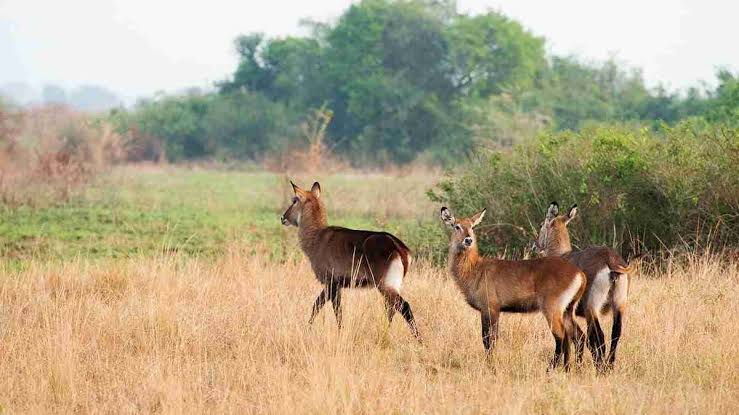
Elephants, buffalo and antelope use the shore as a dry-season refuge. The lake anchors the western edge of the Greater Murchison Conservation Area, linking river, savannah and Budongo escarpment forest into one seasonal movement system.
Communities and Conservation Pressures
Population density in parts of the Albert basin exceeds 149 people per square kilometre. Fishing villages — Butiaba, Wanseko and Panyimur — land mukene, tilapia and Nile perch for domestic markets and export into eastern Congo. Tourism reaches the lake through delta boat cruises, sport fishing on the Victoria Nile and occasional community boats from Wanseko. Pakwach, at the Albert Nile outflow, connects to northern park gates at Tangi and Wankwar.
Pressures include overfishing, illegal gear, invasive weeds and oil and gas exploration in the Albertine Graben. Ramsar and national park status offer partial safeguards; UNESCO World Heritage proposals acknowledge the falls-to-lake continuum as a landscape of global value.
Experiencing Lake Albert on a Murchison Safari
Most visitors encounter the lake through the standard delta boat cruise from Paraa, following papyrus channels where the Victoria Nile meets Lake Albert. Dry seasons from December to March and June to October typically offer lower water and better shoebill sighting odds. Sport anglers experience the lake’s influence upstream, where Nile perch and tigerfish hunt the Zipper below the falls before juveniles drift toward delta nurseries — see our fish of the River Nile guide.
Birders should allow a dedicated delta morning; it pairs well with an afternoon game drive on the Buligi Peninsula. See our birding in the delta area guide for species targets and timing. Few lodges sit directly on Lake Albert; most reach the delta by road and launch from Paraa within 90 minutes.
Frequently Asked Questions
- How is Lake Albert connected to Murchison Falls National Park?
-
The Victoria Nile flows from Lake Victoria through the park, drops 43 metres at Murchison Falls, then runs west through papyrus channels into Lake Albert. The Albert Delta and adjacent open lake form the western edge of the park and part of the 17,293-hectare Ramsar wetland system.
- Can I see shoebill on Lake Albert?
-
Yes. The papyrus delta where the Victoria Nile enters the lake is one of Uganda’s most reliable shoebill sites. Organised delta boat cruises depart from Paraa; dry-season months generally offer the best conditions, though sightings are never guaranteed.
- How many fish species live in Lake Albert?
-
Surveys record between 40 and 55 species, depending on methods and season. Albert lates is the key endemic species of conservation concern.
- Is Nile perch native to Lake Albert?
-
Yes. Nile perch occurs naturally in Lake Albert and the lower Nile. It was introduced to Lake Victoria in the 1950s, but the Albert population is part of the native riverine fish community linked to Murchison Falls and the Victoria Nile delta.
- Which towns give access to Lake Albert near Murchison Falls?
-
Wanseko is the main lakeshore port south of the delta. Butiaba lies further south on the escarpment road from Masindi. Pakwach sits at the Albert Nile outflow and connects to northern park gates. Most park-based visitors reach the lake via Paraa delta cruises.
Plan Your Safari
Lake Albert rewards travellers who treat it as more than a backdrop to the falls — a living fishery, Ramsar wetland and rift-lake system that feeds the Nile northward. We can pair a delta cruise for shoebill with savannah game drives, an upstream boat to the falls and time in Budongo Forest. Browse our Murchison Falls safaris or share your dates and priorities; we will build an itinerary that includes the lake experiences worth the early start.