



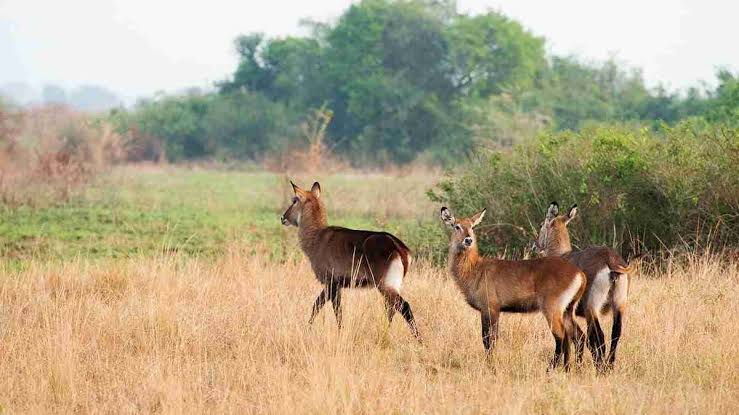
Murchison Falls National Park in February
February closes Uganda’s short dry season at Murchison Falls National Park — pale savannah, a low Victoria Nile and thinning grass make wildlife easy to read from the track. Heat builds through the afternoons, but mornings on the northern bank still deliver the classic dry-season picture: elephant herds at the waterline, Rothschild’s giraffe on open Borassus plains and hippos stacked along the Albert Nile in numbers that surprise first-time visitors.
This guide covers what February actually feels like on the ground at Uganda’s largest national park — roughly 3,840 square kilometres straddling the Nile — from temperatures and late-month rain hints to game drives, boat safaris, delta birding and the practical reasons travellers book safaris before the long rains begin in March. For species-by-species birding detail, see our birding calendar; here the focus is the full safari experience.
February weather: hot, dry and bright
February is typically the hottest month in the Murchison area. Long-term averages show daytime highs around 33–36°C, nights near 19–22°C, and roughly 26–40 mm of rain across about eight days — still very dry, though occasional showers can appear toward the month’s end before March’s long rains. Murram tracks on Buligi, Pakuba and the Queen’s Track stay firm.
Plan game drives for the cool hours — park gates open at 07:00 and close at 19:00 — and treat midday as rest or a shaded boat cruise. Pack lightweight clothing, a wide-brimmed hat, high-SPF sunscreen and plenty of water.
Wildlife in February: concentrated at the Nile
When temporary pools shrink, elephants, buffalo, Uganda kob, Jackson’s hartebeest and more than 1,700 Nubian (Rothschild’s) giraffe — per recent Giraffe Conservation Foundation surveys — gather along the Victoria and Albert Nile. Lion patrol Buligi’s open ridges; leopard and hyena appear at dawn when foliage is sparse.
Hippos and Nile crocodiles line the banks in dense numbers. For how to use the cool hours, see our comparison of morning versus afternoon game drives.
The falls, the Nile cruise and delta birding
February water volume at the gorge is at its annual low — around 300 cubic metres per second against wet-season peaks exceeding 1,000 — but lower flow concentrates the force through a cleft roughly six metres wide where the Nile drops 43 metres. The launch cruise from Paraa covers about 17 kilometres each way; UWA boats depart at 09:00 and 14:00 at US$30 per foreign non-resident under the July 2024–June 2026 schedule.
Downstream, the Victoria Nile Delta is at its most navigable. Lower water exposes mud margins where shoebill, Goliath heron and African skimmer feed; dawn cruises from Paraa around 07:00 offer calm water and Palearctic migrants still present through February. Read our bottom-of-the-falls boat cruise guide and delta birding guide.
Planning activities in February
Schedule northern-bank game drives as early as the Paraa ferry allows — sailings at 07:00, 09:00, 11:00, 12:00, 14:00, 16:00, 18:00 and 19:00 — so you are on the Buligi circuit before heat haze builds.
Kaniyo Pabidi in Budongo Forest offers chimpanzee tracking on firm dry-season trails via Masindi and Kichumbanyobo Gate. The sealed Masindi–Paraa road makes the drive from Kampala — roughly 305 kilometres and four to five hours — straightforward; fly-in guests use Pakuba Airstrip, about 19 kilometres from Paraa. See our Budongo chimpanzee trekking guide.
Why travellers choose February — and honest trade-offs
February delivers dependable game viewing without January’s post-holiday squeeze. Park entry is US$45 per adult per 24 hours for foreign non-residents, plus separate activity fees — see our guide fees guide. Gorilla permits elsewhere remain at US$800; the US$600 discount applies only in April, May and November.
Trade-offs include midday heat exceeding 36°C, dust on dry tracks and dry-season lodge rates. Late February may bring brief showers — allow two full northern-bank days rather than one rushed loop. Compare our best time to visit Murchison Falls guide and Uganda best time to visit overview.
Frequently Asked Questions
- Is February a good time to visit Murchison Falls National Park?
-
Yes — for most visitors it is one of the best months. Wildlife concentrates at the Nile, vegetation is low, tracks are dry and boat cruises run reliably. The main trade-offs are midday heat and the possibility of light showers toward the month’s end.
- How hot is Murchison Falls in February?
-
Expect daytime highs around 33–36°C and nights near 19–22°C. Schedule game drives for early morning and late afternoon; the middle of the day suits boat cruises or rest at camp.
- Is February good for shoebill and chimpanzee tracking?
-
Yes on both counts. February sits within the prime delta window when lower Nile levels concentrate shoebill in papyrus channels — book a dawn cruise. Kaniyo Pabidi trails are dry and undergrowth is thin, making chimp tracking straightforward on a three- or four-night itinerary.
- Is February less busy than January?
-
Generally yes — similar wildlife conditions with slightly fewer travellers and easier lodge availability at Paraa and Pakuba.
- How do I get to Murchison Falls in February?
-
The standard road route from Kampala or Entebbe runs via Masindi and Kichumbanyobo Gate — about 305 kilometres and four to five hours on the sealed Masindi–Paraa road. Pakuba Airstrip serves fly-in guests. See our Kampala to Murchison Falls routing guide.
Plan Your Safari
February at Murchison Falls trades afternoon heat for dependable game viewing, firm tracks and a Nile that draws every major species within camera range. We build short-dry-season itineraries around early ferry crossings, dawn game drives on Buligi, launch cruises when the river is calm and delta outings timed for shoebill activity. Tell us your dates and how many nights you have, and we will sequence the tracks, boats and forest walks so you are on the savannah when the light is gold — not when the thermometer hits its peak. Browse our Murchison Falls safari packages or read the full fees guide to budget your February trip.